




Design the perfect vending solution for your location and customers.

Join the VMFS newsletter and step into a thriving network dedicated to collective success.
One signup. Endless possibilities.
Economics & Hardware | Smart Fridge Vending | By the VMFS USA Team | August 2026
The short version
Think about the last time you bought something from a vending machine. You paid, one item dropped, and the transaction ended. If you wanted a second thing, you had to start over. Pay again, select again, wait again. Most people do not bother, and that small fact has been quietly capping vending revenue for about sixty years.
We saw a machine at Venditalia that simply does not work that way, and the more we looked at it the more we thought the interesting story is not the technology. It is the arithmetic.
Where this comes from: we build and supply vending systems, so we spend a lot of time on the numbers behind them. We examined this format up close on the show floor, and the photographs here are our own.

Every retailer on earth obsesses over basket size. How many items in the average transaction. Supermarkets redesign entire aisles over it, coffee shops train staff to ask about a pastry, and every checkout in the world is lined with things you did not come in for.
Vending has never had that conversation, because vending cannot have it. A coil machine sells one item per transaction. Not usually one, not on average one. Exactly one, every single time, because the machine physically ends the interaction the moment the product drops.
Traditional vending is the only retail format in existence with a structurally fixed basket size of 1.0. Not because customers only want one thing. Because the machine will not let them have two without starting again.
Open the door instead and that constraint evaporates. Somebody reaching into a fridge for a water sees the iced tea next to it. They take both. It costs them no extra time and no second transaction, and it happens in the two seconds their hand is already inside the cabinet.
You do not need a dramatic uplift for that to matter. Moving an average transaction from one item to one and a half is a fifty percent revenue increase from the same foot traffic, the same location and the same rent. No extra customers required.
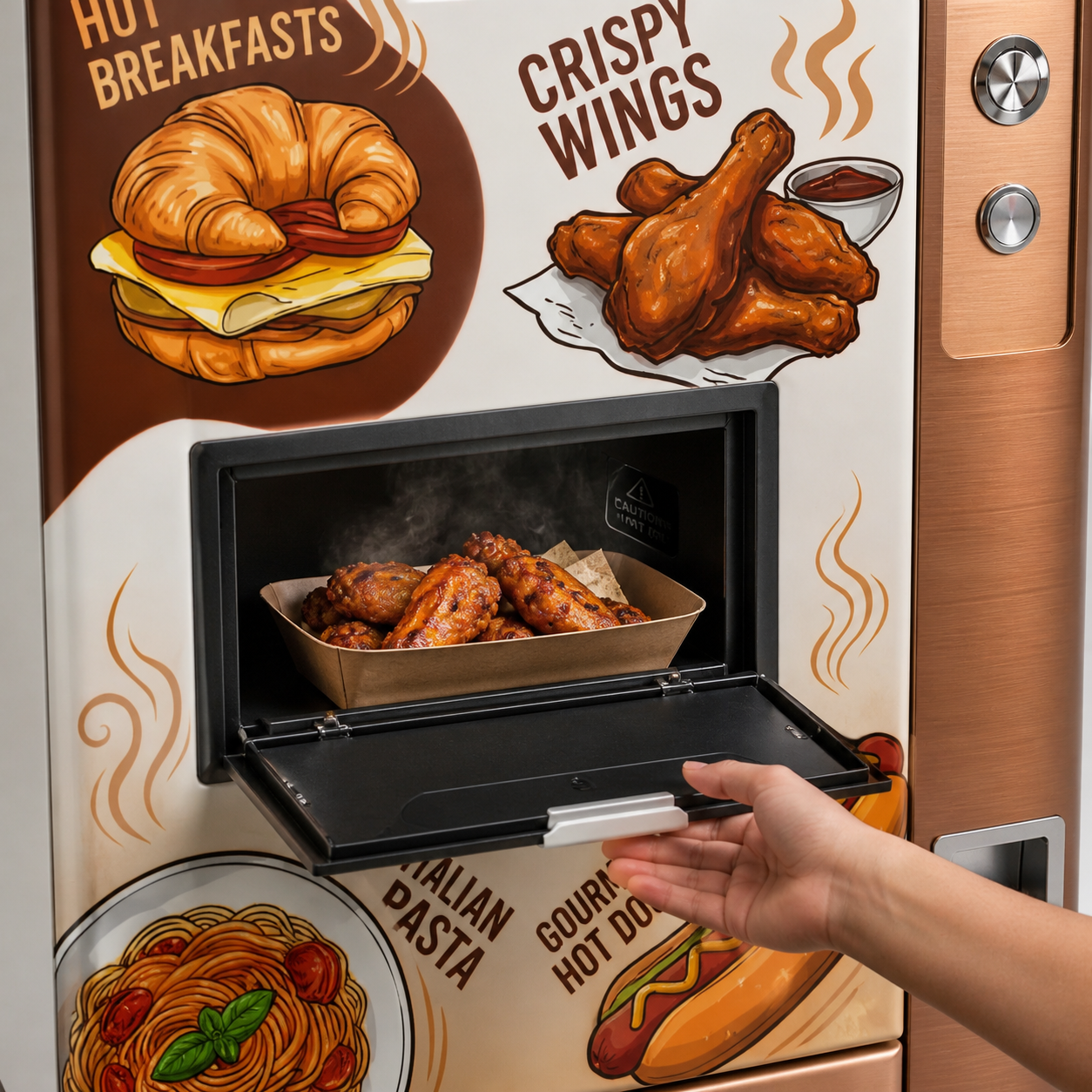
Here is the other ceiling, and it is easy to miss because it hides inside the hardware. A coil machine can only sell what a coil can hold and survive dropping. That is a narrow list: bagged snacks, cans, plastic bottles, small boxed items. Uniform, cheap, robust.
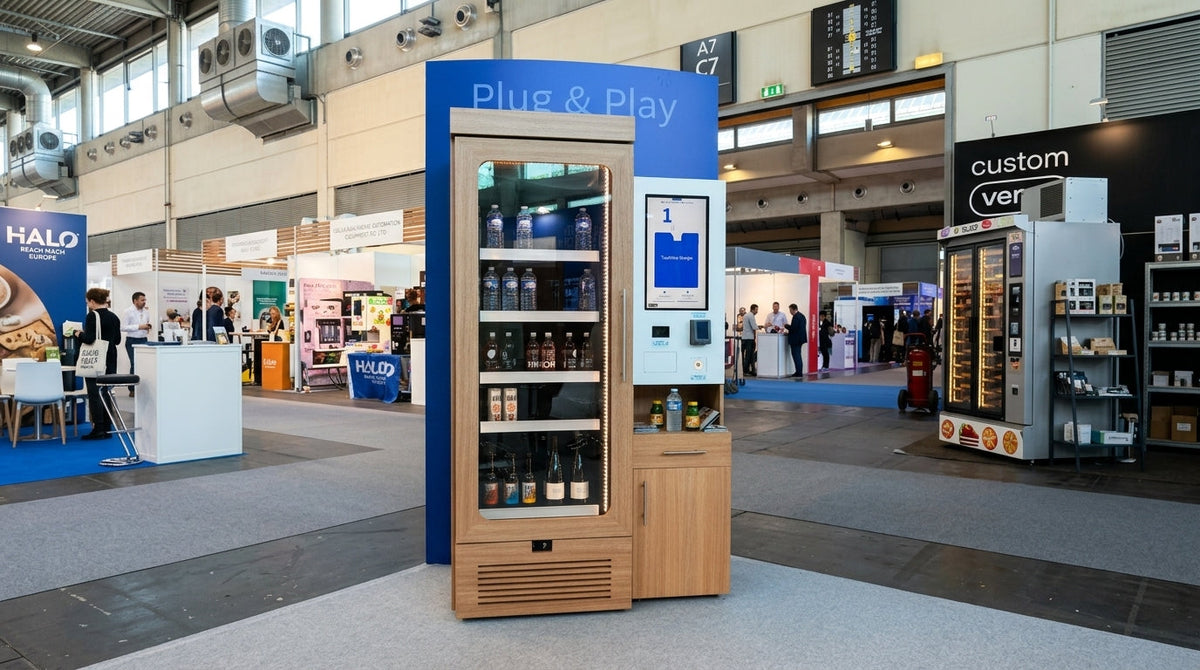
Look at what was in the cabinet we photographed, though:
That is the point. Roughly eighty percent of what was in that cabinet is unvendable by traditional means, and it is also the higher priced eighty percent. A machine that can only hold two dollar plastic bottles has a hard revenue ceiling per slot. A cabinet that can hold a twenty dollar bottle of wine on the same shelf as a one dollar water does not.
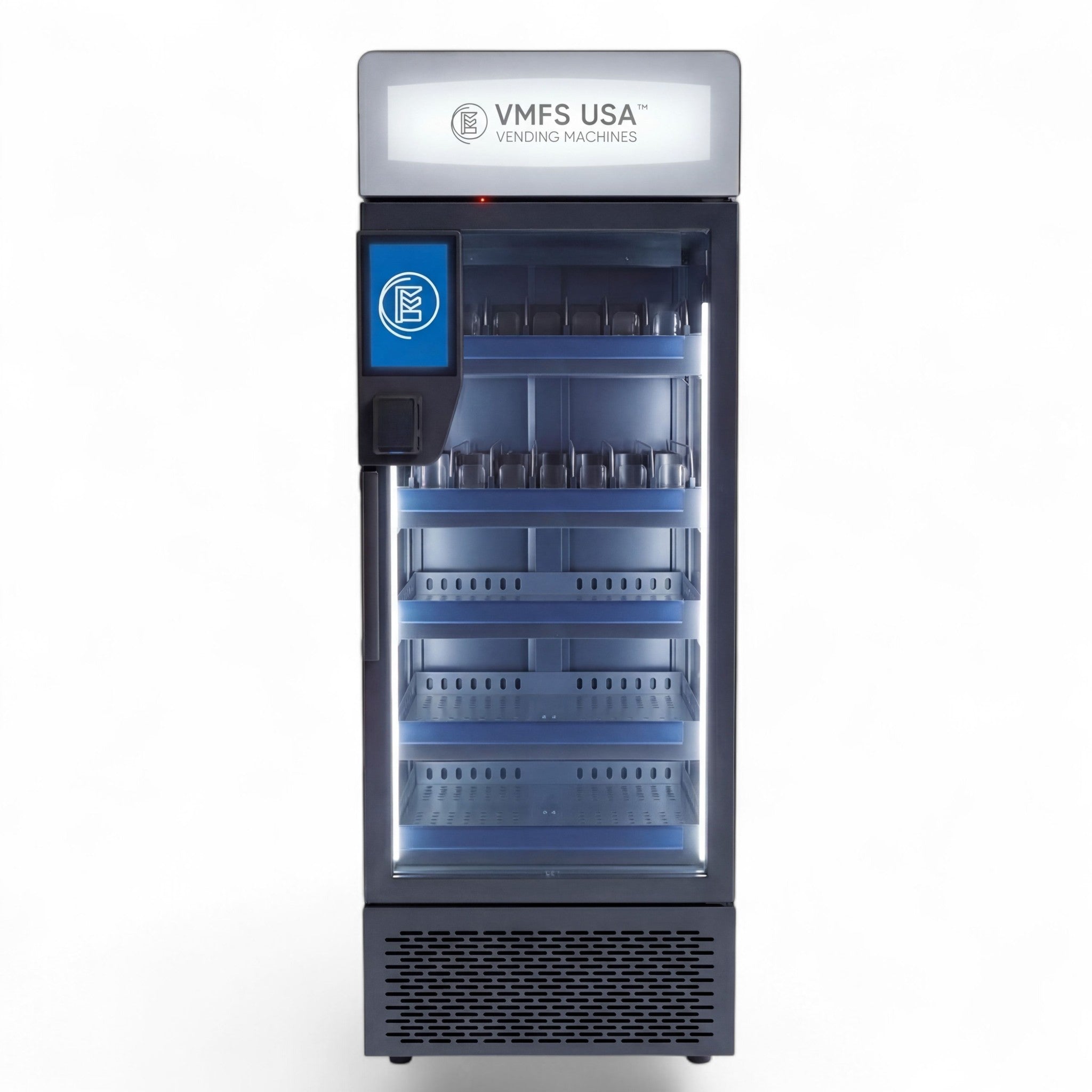
If you want to see the format itself, our smart fridge vending machine works on this principle, and it sits alongside the wider refrigerated vending and beverage vending machine ranges.
The sequence is the opposite of what you are used to, and that inversion is the whole design.
| Traditional machine | Grab and go cabinet |
|---|---|
| Choose the item first | Identify yourself first |
| Pay a fixed amount | Door unlocks |
| Machine dispenses one thing | You take what you want, by hand |
| Transaction ends | Close the door, then you are charged |
| Machine never knows who you are | Machine knew before it opened |
On the unit we saw, the kiosk column next to the cabinet handled that first step. Touch the screen, then either tap a card or scan a badge. There was a contactless option for people without an account, and a catalogue view for browsing before committing. Similar interfaces run across our touch screen vending machines.
Once the door closes, the machine works out what left. Three approaches are common, sometimes combined:
Each has a trade. Weight struggles with two products of near identical mass. Vision needs decent lighting and clear packaging. RFID adds labour and tag cost to every restock. Worth understanding which one a machine uses before you buy, because it directly affects your day to day. If you are specifying a build around a particular product mix, a food vending machine system is the place to start that conversation.

Every operator knows the cost of a jam, and most underestimate it. It is not one lost sale. It is the refund, the service call, and a customer who now assumes your machines eat money and will walk past the next one.
Remove the coil and that entire failure mode goes with it. There is no mechanism to jam, nothing to hang on the edge of a shelf, and no product wedged against glass. The customer takes the item with their own hand, which is a delivery method with a very long track record.
Fewer moving parts changes your maintenance profile too. What you are maintaining instead is refrigeration, the payment terminal and the sensing system, which is a different kind of work rather than less of it.
We are not going to pretend this away. In a coil machine, theft means physically breaking in. Here, the door opens. That is the trade you accept for everything above.
What genuinely limits it:
Budget for some shrink, choose the location accordingly, and the maths still works comfortably in the right setting. Choose the wrong location and it will not, which is why placement matters more with this format than almost any other. Our partners at VPlaced vet sites for exactly this, and property owners can list space through their location owners page.
Worth noticing in the photographs: the cabinet is finished in wood veneer with a warm LED strip round the door and a matching cupboard beneath. It looks like a wine cabinet or a piece of hotel furniture, not equipment.
That is a commercial decision, not a styling one. A great many premium venues have a standing rule against vending machines, and the objection is almost never the concept. It is that a big backlit box with a plastic fascia wrecks the look of a lobby they spent money on. Put the same function inside something that reads as furniture and the objection often just disappears. You are selling a service, not equipment. Custom and non standard cabinets like this sit in our specialty vending machines range.
| Factor | Coil machine | Grab and go |
|---|---|---|
| Items per transaction | Fixed at one | Unlimited per door open |
| Stockable products | Coil safe only | Anything that sits on a shelf |
| Price ceiling | Low, cheap uniform goods | High, premium and glass |
| Jams and refunds | Ongoing cost | None |
| Shrink risk | Very low | Real, must be managed |
| Venue acceptance | Refused by premium sites | Accepted as furniture |
It is a poor fit for high volume low value snacking in an unsupervised public space. That is still coil territory, and there is no shame in it, which is why we keep both formats across our range of vending machines.
Two things matter and both are counterintuitive. First, do not sell it as vending. The venues you want have already decided how they feel about that word. Sell it as an amenity, a self service bar, an unattended shop.
Second, merchandise it like a shop rather than a machine. The glass is the whole storefront, so what the shelves look like is your marketing. Face the labels forward, group products sensibly, leave the lighting doing its job. Presentation and the local visibility side are what VMarketed handles, including the cabinet wraps and marketing material that make a machine read as an amenity.
And if beer or wine is going into that cabinet, sort the licensing before it is switched on rather than after. Selling age restricted product from an unattended cabinet is entirely doable and it is not something to improvise, which is why VAdviced exists.
Usually weight sensing shelves, camera based vision recognition, RFID tags, or a combination. You authenticate first so the machine has your payment details, the door unlocks, and when you close it the system compares before and after and charges you for the difference.
Yes, and this is the main economic advantage. Take three items in one door open and you are charged for three in a single transaction. Traditional vending physically cannot do this, which is why its average basket has always been stuck at one item.
It is a genuine consideration and worth budgeting for. It is limited by the fact that payment details are captured before the door opens, by sensing that counts what actually left, and above all by placement. These machines belong in offices, hotels and access controlled buildings rather than unsupervised public spaces.
That is one of the strongest reasons to choose the format. Nothing drops, so glass bottled beer, wine and premium soft drinks sit on shelves exactly as they would in a shop. Age restricted product brings licensing and verification requirements, so get that in place first.
Want the Bigger Basket?
We supply smart fridge, refrigerated and beverage vending systems built for premium product. Tell us what you want to sell and where, and we will help you spec it. In stock units typically ship within 7 to 21 days, with a one year parts warranty.
Browse the Machines
Share:
What Is a Vending Machine Operator? Duties, Pay and Daily Work
What Does a Vending Machine Operator Do? Operational & Financial Guide