



Design the perfect vending solution for your location and customers.

Join the VMFS newsletter and step into a thriving network dedicated to collective success.
One signup. Endless possibilities.
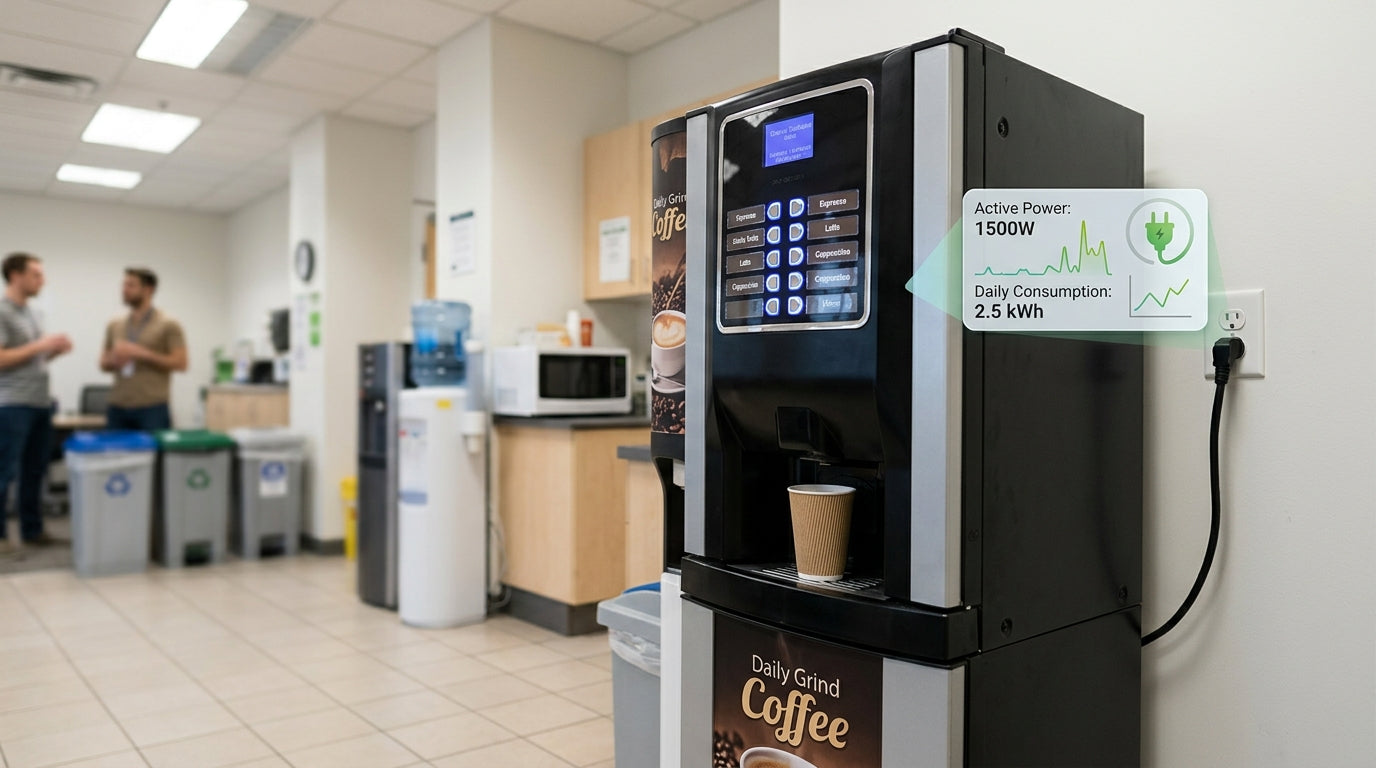
Coffee vending machine electricity consumption typically ranges from 1,200 to 2,500 watts during active heating, with average daily usage between 3 and 8 kWh depending on machine size, cup volume, and how often the boiler cycles to maintain temperature. This guide breaks down wattage by machine type, calculates realistic monthly running costs, and covers the specific factors — boiler design, standby mode, refrigeration — that drive consumption up or down.
A commercial coffee vending machine uses between 1,200 and 2,500 watts while actively heating water, and this power draw drops significantly once the boiler reaches and holds its target temperature. Daily electricity consumption typically falls between 3 and 8 kWh, driven primarily by how often the heating element cycles on to maintain brew-ready temperature throughout operating hours.
This range varies by machine category and directly connects to the broader mechanical picture covered in how coffee vending machines work, since the boiler — the single largest power draw in any machine — cycles on and off continuously to offset heat loss and satisfy each brew cycle's demand.
The single largest power draw, typically 1,000–2,000 watts during active heating.
Iced or cold-brew machines add compressor load running continuously in the background.
Machines idle between transactions but keep the boiler warm, consuming reduced but nonzero power.
Higher daily transaction counts mean more brew cycles and proportionally higher total consumption.
Electricity consumption in a coffee vending machine is driven primarily by boiler cycling, since the heating element must repeatedly reactivate to compensate for heat loss and to reheat water drawn down during each brew cycle. A machine processing more daily transactions cycles its boiler more frequently, directly raising total kWh usage over a billing period.
Every brew cycle draws hot water from the boiler, which then must reheat to maintain the machine's set temperature — this reheating draw is the primary reason high-volume machines consume more electricity than their rated wattage alone would suggest.
Machines placed in colder environments, or those with less effective internal insulation, lose heat faster and cycle the boiler more often to compensate, which is why the environmental factors discussed in the installation guide indirectly affect long-term energy cost as well as mechanical performance.
Wattage varies meaningfully across coffee vending machine categories because brewing method, refrigeration, and drink complexity all add to the base electrical load. Instant-powder machines draw less than bean-to-cup units, and iced coffee machines add compressor draw on top of standard boiler wattage.
Technical note: Rated wattage on a machine's nameplate reflects peak draw during active heating, not average continuous consumption — actual kWh usage over a day is meaningfully lower than peak wattage multiplied by total operating hours.
Calculating monthly running cost requires multiplying average daily kWh usage by the local electricity rate, then by the number of operating days in the billing period. A machine averaging 5 kWh per day at a typical commercial rate of $0.13 per kWh costs roughly $19.50 per month to operate, though rates and usage patterns vary by region and machine type.
This operating cost is a small but real factor in the total cost of ownership discussed in the price guide, and should be factored into budgeting alongside supplies and maintenance rather than treated as negligible.
This table summarizes typical wattage, daily kWh, and estimated monthly cost across common commercial machine categories at a standard $0.13/kWh rate.
| Machine Type | Peak Wattage | Avg. Daily kWh | Est. Monthly Cost |
|---|---|---|---|
| Compact countertop unit | 1,000–1,400W | 2.5–4 kWh | $10–$16 |
| CorePro bean-to-cup machine | 1,400–2,000W | 4–6 kWh | $16–$23 |
| Coffee and hot beverage machine | 1,800–2,200W | 6–8 kWh | $23–$31 |
| Iced coffee vending machine | 2,100–2,800W (with compressor) | 7–10 kWh | $27–$39 |
| Pro coffee vending machine | 2,000–2,500W | 7–9 kWh | $27–$35 |
Standby mode consumes noticeably less power than active heating because the boiler maintains rather than raises water temperature during idle periods, drawing intermittent bursts rather than sustained high wattage. A machine sitting idle overnight still consumes power to keep the boiler warm, unless equipped with a scheduled sleep or standby-reduction feature.
Machines with programmable standby scheduling — reducing or pausing heating during predictable low-traffic hours like overnight for office placements — can meaningfully cut total daily consumption without affecting service quality during active hours.
Reducing energy use starts with matching machine capacity to actual demand, since an oversized machine with a larger boiler running well below its designed capacity wastes energy maintaining heat for capacity that goes unused. Right-sizing equipment, covered in the commercial coffee vending machines guide, indirectly reduces energy waste alongside its primary cost and mechanical benefits.
Choosing between an energy-efficient and a standard-efficiency coffee vending machine affects both upfront cost and long-term operating expense. Energy-efficient models use improved insulation and smarter standby management to reduce consumption, typically at a modest price premium over standard equipment.
| Factor | Standard Machine | Energy-Efficient Machine |
|---|---|---|
| Boiler insulation | Standard | Enhanced, reduces heat loss |
| Standby management | Basic or none | Programmable scheduling available |
| Upfront cost | Lower | Modest premium |
| Long-term energy cost | Higher | Lower, compounds over machine lifespan |
Operators running multiple machines across a coffee vending route see the energy-efficiency premium compound into meaningful savings at scale, making it a worthwhile factor in fleet-wide equipment decisions.
Electricity requirements for installation depend on the machine's peak wattage rather than its average consumption, since the circuit must handle startup and active-heating draw without tripping. Most commercial machines require a dedicated 120V or 208–240V circuit rated for the equipment's peak amperage, detailed further in the installation guide.
Confirming this specification before installation prevents the voltage-drop related faults covered in the troubleshooting guide, since an undersized circuit causes both reliability issues and inefficient energy use as the boiler struggles to reach set temperature.
Browse VMFS USA's commercial coffee vending machine lineup and compare models built for efficient, reliable operation.
Shop Coffee Vending Machines


Share:
Coffee Vending Machine Lease: How Leasing Works and What It Costs
How Many AI Vending Machines Do You Need to Run a Full-Time Business