


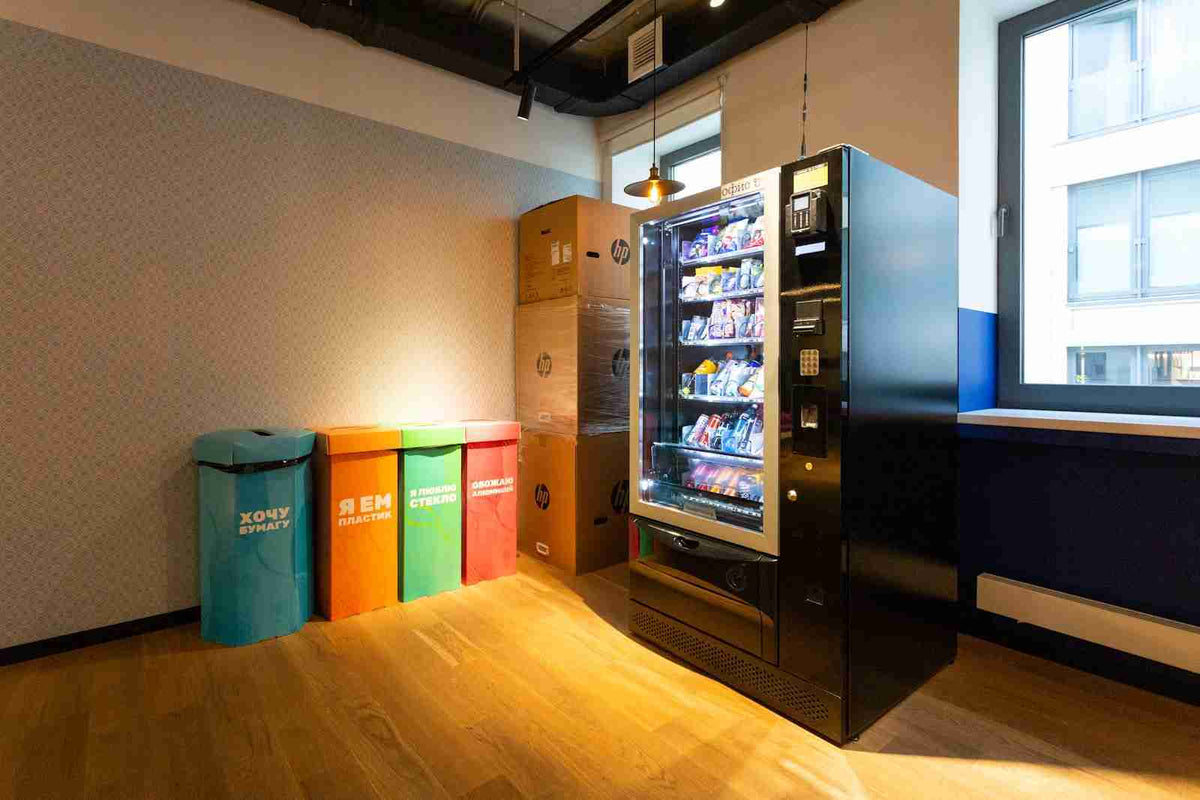


Design the perfect vending solution for your location and customers.

Join the VMFS newsletter and step into a thriving network dedicated to collective success.
One signup. Endless possibilities.
Yes, vending machines are profitable when they sit in a busy, well-matched location. A well-placed machine typically grosses $300 to $1,500 a month and keeps roughly 20% to 35% as net profit, about $60 to $500 a month, and a vending business grows its income by adding machines to a dense route.
This guide shows how much a vending machine makes a month, where every sales dollar goes, margins by product, realistic income from 1 to 50 machines, payback periods and what a route is worth, using 2026 industry data and live VMFS USA hardware prices.
Yes, vending machines are profitable when the location has steady, captive traffic and the machine sells what those people want. A typical placement grosses roughly $150 to $700 a month, a strong one $700 to $1,500, and a top tier site such as a hospital or a 24-hour plant can pass $2,000. After product, commission, card fees, mileage and upkeep, well-run machines keep roughly 20% to 35% of sales as net profit.
Those ranges line up with what independent operator guides report. Nav's 2026 vending business guide puts a decent machine at $100 to $300 a week and an exceptional one above $500, while Gumball's profitability guide places medium-traffic machines at $100 to $500 a month and high-traffic sites at $500 to $1,000 or more. The spread is wide because profit is decided by the placement, not by the cabinet. The same machine can lose money in a quiet lobby and pay for itself in a year in a busy breakroom.
Here is how outcomes usually spread across placement quality. The net figures assume the machine is part of a small route, so mileage and insurance are shared rather than carried by one machine alone.
| Placement quality | Monthly gross sales | Net margin | Monthly net profit | Verdict |
|---|---|---|---|---|
| Weak site (under 50 people a day) | Under $150 | 0% to 15% | $0 to $20 | Relocate or replace |
| Typical site (small office, shop, gym) | $150 to $700 | 15% to 25% | $20 to $175 | Solid building block |
| Strong site (100+ daily users) | $700 to $1,500 | 22% to 30% | $155 to $450 | Core of a profitable route |
| Top tier site (hospital, plant, transit hub) | $2,000 to $3,000+ | 25% to 35% | $500 to $1,050+ | Anchor location |
So, are vending machines profitable for you specifically? The honest answer depends on whether you can find sites in the top three rows and keep adding them. Vending rewards operators who treat their vending machines like a portfolio: measure every placement, move the weak ones, and cluster new machines near the winners.
Vending pays off when you
Vending disappoints when you
A vending machine makes roughly $150 to $700 a month in gross sales at a typical location, $700 to $1,500 at a strong one, and $2,000 or more at a top tier site. Monthly revenue is simply the number of vends multiplied by the average ticket, so traffic and price point explain almost every difference between two machines.
The ticket side is well documented. Cantaloupe's 2026 Micropayment Trends Report, built on 2025 transactions from hundreds of thousands of card readers and kiosks, puts the average vending transaction at $2.01, the average cashless ticket at $2.45 and the average cash ticket at $1.57. A machine selling 15 items a day at about $2.10 therefore brings in close to $950 a month. A machine selling five items a day brings in closer to $300. That is why an average vending machine revenue figure only means something next to the traffic behind it.
The fastest way to project how much a vending machine can make at a specific site is to work from the people who are there every day. Multiply the daily on-site population by a purchase rate, the average ticket and the number of operating days. For a workplace, a 10% purchase rate is a conservative planning assumption rather than a promise.
Take a warehouse with 150 employees working 20 days a month. At a 10% purchase rate and a $2.50 average sale, the machine sells 15 items a day, or $37.50, which is about $750 a month. Lift the average sale to $3.00 with better drinks and the same traffic produces $900. If a better product mix also lifts the purchase rate to 15%, the month reaches $1,350. Small changes in ticket and conversion move revenue more than most new operators expect, which is exactly why product and payment decisions matter as much as the machine.
Breaking the same numbers into days, weeks and years makes them easier to plan around. The net column assumes a 25% net margin, the middle of the healthy range.
| Site type | Per day | Per week | Per month | Per year | Net profit per year |
|---|---|---|---|---|---|
| Typical site | $16 | $115 | $500 | $6,000 | $1,500 |
| Strong site | $37 | $254 | $1,100 | $13,200 | $3,300 |
| Top tier site | $75 | $519 | $2,250 | $27,000 | $6,750 |
Two identical machines a mile apart can produce completely different paychecks. Raw foot traffic is not the deciding factor; dwell time is. A hallway where people rush to a gate converts poorly, while a breakroom where employees spend a 30-minute lunch converts well. These four factors explain most of the gap:
Captive traffic
Employees, patients, students and people waiting buy far more often than people walking past on the way somewhere else.
Ticket size
Fresh meals, energy drinks and premium items earn more per vend than a coil of candy bars.
Payment options
With 78% of vending sales now cashless, a machine without a card reader turns most buyers away.
Uptime and stock
An empty best seller or a jammed bill validator quietly erases a week of profit before anyone notices.
On a machine grossing $900 a month, a realistic monthly profit is about $197, a 22% net margin, after product, a 10% location commission, card fees, software, mileage, insurance, shrink and maintenance. Remove the commission and the same machine keeps about $287, or 32%.
This is the part most profit articles skip, so here is every line item for a Slim Combo Vending Machine at a typical office. Card fees use the transaction rate shown on the VMFS cashless payment system page, and mileage uses the IRS 2026 business rate.
| Line item | Assumption | Monthly amount | Share of sales |
|---|---|---|---|
| Gross sales | About 14 vends a day at roughly $2.15 | $900.00 | 100% |
| Product cost | Blended snacks and drinks | $432.00 | 48% |
| Location commission | 10% of gross | $90.00 | 10% |
| Card processing | 78% cashless at about 5.95% | $41.77 | 4.6% |
| Card reader service | Monthly reader plan | $9.95 | 1.1% |
| VMFS Cloud Basic | Monitoring plan; works with every VMFS machine | $7.99 | 0.9% |
| Mileage | 60 miles at 72.5 cents | $43.50 | 4.8% |
| Insurance | General liability share | $40.00 | 4.4% |
| Shrink and spoilage | 2% of gross | $18.00 | 2% |
| Maintenance reserve | Parts and service set aside | $20.00 | 2.2% |
| Net profit | Before your own time | $196.79 | 21.9% |
A leaner setup changes the picture. In the waterfall below, a $500 machine with a 5% commission and no separate insurance or software line keeps $172.50, a 34.5% margin, because more of its costs are variable. Most real routes sit between these two examples: fixed costs weigh heavily on one isolated machine and get lighter with every machine you add to the same loop.

Product cost
The biggest line. Buying from wholesale distributors and pricing for convenience keeps it near 45% to 50% of sales; retail-store buying can push it toward 60%.
Location commission
Many small sites take nothing, while busy institutional sites ask for a share of gross. Every point you avoid drops straight to profit.
Card fees
Processing is a percentage, a fixed fee per sale, or both. Small tickets lose the most to fixed fees, so the plan should match your average ticket.
Four costs rarely show up in early projections. Spoilage comes first: buying large wholesale quantities for a discount backfires when cases expire before they sell, and one discarded case of pastries can wipe out a whole visit's profit. Connectivity and software fees come next, because every reader carries a monthly plan whether it processes ten sales or a thousand, so a ten-machine route pays a fixed monthly bill before the first vend.
Vehicle cost is the third. At the IRS rate of 72.5 cents a mile, a 30-mile round trip costs about $21.75, which consumes most of the profit from a machine that sold $30 since the last visit. Shrink is the last: coin jams, double vends and occasional theft quietly remove a small percentage of sales. Telemetry that compares stock used against sales recorded is the cleanest way to see all four before they become a pattern.
The average vending machine profit margin is about 50% gross, meaning sales minus product cost, and roughly 20% to 35% net after commission, card fees, mileage, insurance and maintenance. Drinks usually carry the highest product margin, candy the lowest, and fresh food the lowest percentage but the most dollars per sale.
Gross margin tells you whether your pricing works. Net margin tells you whether your business works. They move for different reasons: gross margin is controlled at the shelf through price and product choice, and net margin is controlled at the route level through commissions, density and efficiency. Nav cites a rule of thumb of product cost at about half the selling price, and VendSoft's operator data points to 25% to 35% net margins for well-run machines.
| Category | Typical markup | Approximate gross margin | Notes |
|---|---|---|---|
| Canned soda and bottled drinks | About 3x cost | 60% to 67% | A soda bought at $0.50 to $0.75 commonly vends for $1.50 to $3.00 |
| Chips and salty snacks | 2x to 2.5x cost | 50% to 60% | Steady sellers that anchor most snack spirals |
| Candy bars | About 2x cost | About 50% | Low ticket, so card fees take a bigger bite |
| Fresh food and premium items | Lower multiple | Lower percentage | Higher dollars per vend, but spoilage risk and cold-chain work |
For detailed price setting by category, use the operator pricing guide.
Card fees take a larger share of a small sale when the plan includes a fixed fee per transaction. The VMFS payment page lists two common structures: a flat rate around 5.95%, or about 2.5% plus $0.10 per sale. The flat rate costs the same share on every ticket, while the fixed-fee plan is expensive on small tickets and cheap on large ones. The two cost the same at roughly $2.90, so a route averaging close to the national $2.01 ticket is usually better on the flat plan, and a cooler selling $5 meals is better on the fixed-fee plan.
| Ticket | Flat 5.95% | 2.5% + $0.10 | Fixed-fee plan as share of sale |
|---|---|---|---|
| $1.25 candy | $0.07 | $0.13 | 10.5% |
| $2.01 average vend | $0.12 | $0.15 | 7.5% |
| $3.00 energy drink | $0.18 | $0.18 | 5.8% |
| $5.00 fresh item | $0.30 | $0.23 | 4.5% |
A $2.00 candy bar at a 50% margin earns $1.00. A $5.00 fresh item at a 45% margin earns $2.25. Percentage margin is a useful health check, but dollars per vend multiplied by vends per day pay the bills. That is why higher-ticket formats such as AI grab-and-go vending machines and coffee vending machines keep winning premium placements even with lower percentage margins.
Combo snack and drink machines are the dependable workhorse, coffee machines lead on product margin, and AI smart coolers earn the most per sale because they sell fresh food and premium drinks. The right machine is the one that matches what the people at your location actually buy, so revenue below is shown as vends per day multiplied by a realistic ticket.

| Machine type | VMFS starting price | Illustrative monthly gross at a good-fit site | Margin profile | Best locations |
|---|---|---|---|---|
| Mini and countertop machines | $1,900 | 3 to 8 vends a day at $2.00: $180 to $480 | Moderate | Small offices, salons, waiting rooms |
| Combo snack and drink machines | $3,450 | 10 to 25 vends a day at $2.10: $630 to $1,575 | Steady | Offices, gyms, warehouses, apartments |
| AI smart coolers | $2,950 | 10 to 25 vends a day at $3.00: $900 to $2,250 | Highest dollars per sale | Corporate campuses, hospitals, hotels |
| Coffee machines | $4,470 | 10 to 30 cups a day at $2.50: $750 to $2,250 | Highest product margin | Offices, dealerships, hospitals |
| Elevator machines | $8,650 | 8 to 20 vends a day at $4.00: $960 to $2,400 | Premium, fragile items | Hotels, airports, upscale lobbies |
| Trading card machine | $3,800 | 3 to 10 vends a day at $8.00: $720 to $2,400 | High-ticket collectibles | Card shops, malls, arcades |
Starting prices are for active models on vmfsusa.com in October 2026. Vends per day and ticket size are planning assumptions, not guarantees. Payment hardware is priced separately, and VMFS Cloud works with every VMFS machine; plans start at $7.99 per machine per month.
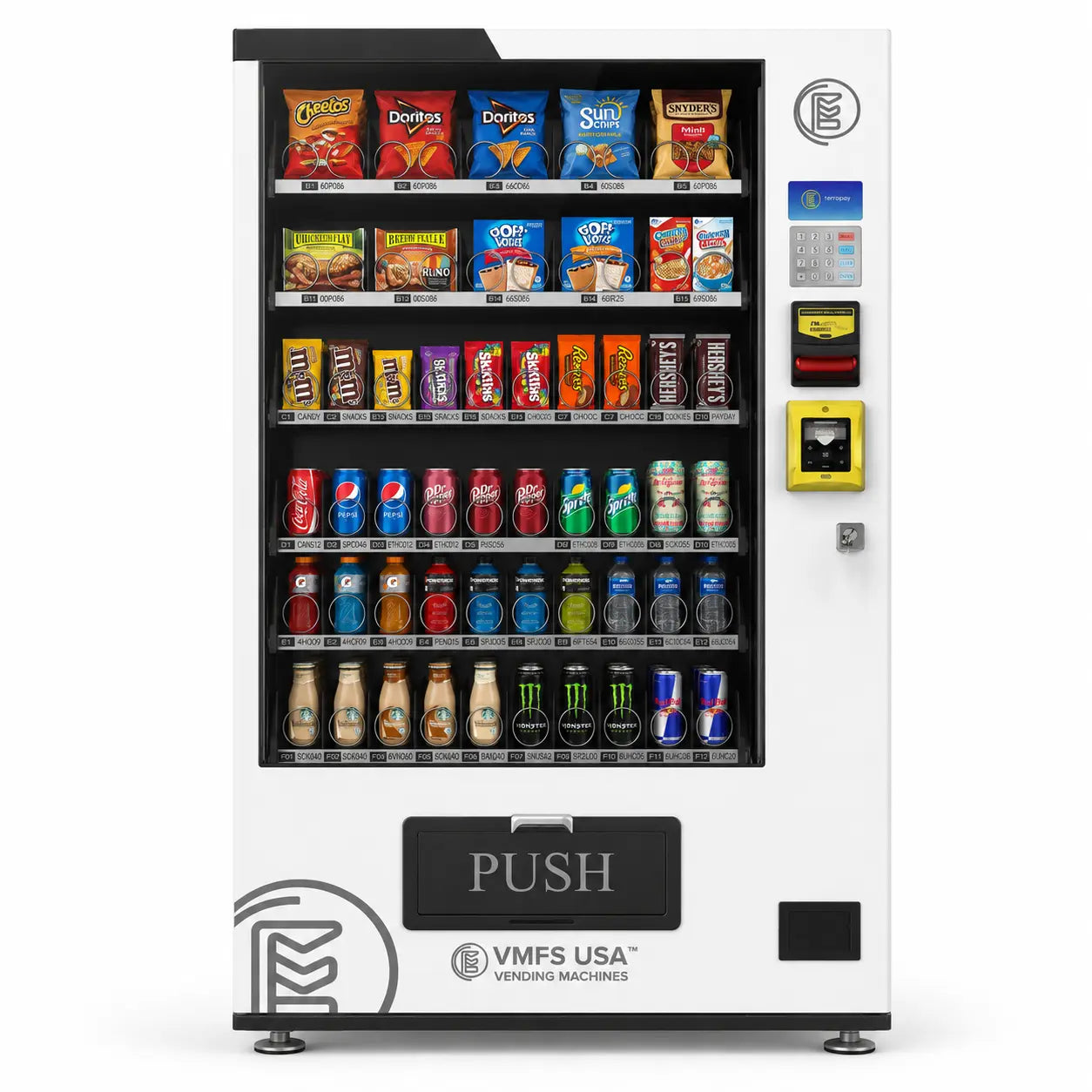
Most routes start with snack vending machines and drink vending machines because demand is universal and products are easy to source. Combo vending machines such as the Smart Combo Vending Machine put both categories in one footprint, which suits a site with room for only one machine.
Smart vending machine revenue per machine is higher mainly because the basket is bigger. Cantaloupe's 2026 data shows micro market transactions averaging $3.02 against $2.01 for traditional vending, roughly 50% more per purchase. An AI Smart Cooler Vending Machine brings that open-door, grab-and-go behavior to sites too small for a full micro market, and its net profit per machine per month depends on keeping fresh items moving before they expire. In the ROI scenarios below, an AI cooler grossing $2,500 a month at a premium site nets about $513 after a 12% commission and all fees.
Coffee, fresh food, elevator and trading card machines earn more per vend, but they need more precise placement before those earnings appear. Age-restricted categories carry strong tickets too, with extra compliance work and an optional ID verification add-on. School placements follow their own rules: products sold to students during the school day must meet the USDA Smart Snacks standards summarized in this Smart Snacks summary, and school sites drop sharply in summer. For a ranked view of which formats earn the most, see the guide to the most profitable vending machines.
A vending machine business with 10 machines typically nets about $1,100 to $2,500 a month, a 25-machine route about $2,900 to $6,400, and a 50-machine route about $3,400 to $10,500 after paying a part-time helper. Income grows faster than machine count because a dense route spreads driving time, insurance and other fixed costs across more sales.
| Route size | Monthly gross sales | Monthly net profit | Annual net profit | Hours per week | Stage |
|---|---|---|---|---|---|
| 1 machine | $500 to $900 | $55 to $195 | $660 to $2,360 | 1 to 2 | Learning |
| 5 machines | $2,500 to $4,500 | $500 to $1,200 | $6,000 to $14,500 | 3 to 5 | Side income |
| 10 machines | $5,000 to $9,000 | $1,100 to $2,500 | $12,900 to $29,900 | 6 to 10 | Serious side business |
| 25 machines | $12,500 to $22,500 | $2,900 to $6,400 | $34,500 to $76,900 | 15 to 25 | Part-time to full income |
| 50 machines | $25,000 to $45,000 | $3,400 to $10,500 | $41,000 to $125,900 | 40+ with a helper | Full-time company |
Modeled on machines averaging $500 to $900 in monthly gross sales, a 10% commission, 78% cashless sales at about 5.95%, route mileage at 72.5 cents a mile and shared insurance. The 50-machine row includes about $2,500 a month for a part-time driver.
One to three machines are an education. You learn sourcing, pricing and service rhythm while storing stock in a garage and driving your own car, and the income is closer to a few hundred dollars a month than a salary. Five to ten machines produce meaningful side income that fits around a full-time job, usually serviced one or two days a week; at this stage buying shifts from warehouse clubs to distributor accounts, and the cost to stock a vending machine becomes a working-capital line you manage every week.
Between roughly 12 and 20 machines the business stops being a hobby. Route density becomes critical, because 15 machines scattered across a 50-mile radius burn fuel and hours that a tight industrial-park cluster would not. At 25 to 50 machines you are running a small logistics company with a cargo van, storage, distributor terms and often a helper, which is where a planned, data-driven service schedule pays for itself.
To net $5,000 a month you typically need 20 to 35 machines averaging $150 to $250 of net profit each. Six figures takes more: the full math on how many vending machines it takes to make $100k a year shows why most operators who get there combine 25 to 50 machines, a tight geographic cluster and several high-ticket anchor sites.
Growth brings one federal obligation that small routes skip. Under the FDA's menu and vending machine labeling rules, operators who own or operate 20 or more vending machines must disclose calories for covered foods when the front-of-package label is not visible at the point of purchase. Budget for labels or digital calorie display before machine 20, not after.
A single-machine vending business usually needs about $4,500 to $8,000 up front, turns cash-flow positive from the first month of sales, and recovers its full investment in roughly 12 to 30 months depending on the location. Card sales settle to your bank within days, while location commissions are usually paid monthly in arrears.
| Startup item | Typical range | Notes |
|---|---|---|
| Machine | $1,900 to $19,950 | Countertop units start at $1,900 and combo machines at $3,450 on vmfsusa.com |
| Card reader | $450 to $650 | Plus about $7.95 to $18.95 a month in service, depending on provider and plan |
| Shipping | Varies by ZIP code | Curbside, liftgate or white glove on request |
| Opening inventory | $200 to $1,000 | One full fill plus a small backup stock, depending on capacity |
| Business license and permits | $50 to $500 | Local license and health permit fees vary by state and city; LLC filing fees are separate |
| Insurance | About $300 to $600 a year | Many locations ask for a certificate with $1 million per occurrence in general liability |
| VMFS Cloud | From $7.99 per machine per month | Works with every VMFS machine: remote sales, stock and fault monitoring |
For model-by-model pricing, see how much a vending machine costs, and check what your sites require in the vending machine insurance guide. Rules for permits and sales tax differ by state, and VAdviced handles vending entity setup, seller's permits and sales tax registration.
Here is the first stretch for a Smart Combo Vending Machine at a busy site. Total investment is $6,300: machine $4,650, card reader $450, shipping estimate $400, opening inventory $500 and setup $300. Sales ramp over the first quarter as people discover the machine, then settle at $1,500 a month with the same cost assumptions as the profit table above.
| Month | Gross sales | Net profit | Cumulative cash position |
|---|---|---|---|
| Start | $0 | $0 | ($6,300) |
| Month 1 | $900 | $197 | ($6,103) |
| Month 2 | $1,200 | $303 | ($5,800) |
| Month 3 | $1,400 | $374 | ($5,427) |
| Month 6 | $1,500 | $409 | ($4,200) |
| Month 12 | $1,500 | $409 | ($1,746) |
| Month 17 | $1,500 | $409 | $298 |
The machine is fully paid back in month 17, and every month after that is profit. If you finance the purchase, the payment comes out of that $409, which is why many operators use flexible financing through partners such as PayPal, Klarna and ClickLease to keep cash free for inventory and the next placement. Larger fleet purchases can also look at SBA-backed loans.
Vending machine ROI usually runs about 40% to 95% a year on the total investment, so most machines pay for themselves in roughly 12 to 30 months. Strong and premium locations pay back in about a year to a year and a half, while typical sites with a commission take two years or more.
| Scenario | Total investment | Monthly gross | Monthly net | Annual ROI | Payback |
|---|---|---|---|---|---|
| Slim Combo, typical office, 10% commission | $5,300 | $900 | $197 | 45% | 27 months |
| Slim Combo, commission-free site | $5,300 | $900 | $287 | 65% | 19 months |
| Smart Combo, strong site, 10% commission | $6,300 | $1,500 | $409 | 78% | 16 months at full sales (17 including ramp-up) |
| AI Smart Cooler, premium site, 12% commission | $6,600 | $2,500 | $513 | 93% | 13 months |
Investment includes the machine, a $450 card reader, a $400 shipping estimate, $500 of opening inventory and $300 of setup. The cooler scenario assumes all-cashless sales, a 52% product cost for fresh items, VMFS AI Cloud at $39.99 a month and the $0.07 AI recognition fee on about 500 monthly transactions.
Run the numbers for your own location
Plug in daily traffic, price points and commission to see a monthly projection and payback period before you buy.
Open the ROI CalculatorA used machine pays back faster on paper, and a new one usually pays back more predictably. In the comparison below, a $2,200 refurbished unit netting $160 a month recovers its cost in about 14 months, while a $4,600 new unit netting $190 takes about 24. The gap narrows once you price in card reader retrofits, refrigeration or motor repairs on unknown equipment, and the placements a dated cabinet can lose to a modern one.

Buying new
Buying used
Inventory float is the first trap: you buy product before it sells, so keep two to three weeks of stock money set aside per machine. Seasonality is the second, since school sites fall sharply in summer, offices dip over the holidays and outdoor sites slow in winter, so budget on your slowest month rather than your best. Repairs are the third; a bill validator or motor can fail at the worst moment, and a maintenance reserve of $20 to $30 per machine each month keeps one bad week from becoming a cash crunch. Commission timing is the last, because monthly checks are based on reported sales and clean reporting avoids disputes with the location.
Two federal rules make equipment purchases more attractive. The 2025 tax law made a permanent 100% first-year depreciation deduction for qualified property acquired after January 19, 2025, and raised the Section 179 expensing limit to $2.5 million, so a vending machine placed in service this year can often be deducted in full in year one. As an illustration, deducting a $4,650 machine at a 22% federal bracket lowers federal tax by about $1,023. The IRS 2026 business mileage rate is 72.5 cents a mile, so a 60-mile weekly route represents about $2,262 a year in deductible mileage. Ask your tax advisor how these apply to you.
The five main vending business models are a traditional route, a specialty route, a smart cooler or micro market route, an owner-hosted machine at your own business, and buying an existing route. Each trades startup capital, margin and time differently.
| Business model | Startup capital | Typical net margin | Time required | Best for |
|---|---|---|---|---|
| Traditional route (snack, drink, combo) | $4,500 to $8,000 per machine | 20% to 30% | Weekly restocks | First-time operators building steadily |
| Specialty route (coffee, elevator, trading cards) | $5,000 to $20,000 per machine | 25% to 35% | Fewer visits, more precise stocking | Operators with niche product knowledge |
| Smart cooler and micro market | $4,500 to $12,000 per site | 20% to 30% | Frequent fresh restocks | Corporate and healthcare accounts |
| Owner-hosted machine | $2,500 to $6,000 | 30% to 40% (no commission) | Minutes a week on site | Gyms, shops, hotels, offices |
| Buying an existing route | About 2.2 to 2.7 times annual SDE (median 2.15) | Depends on the route | Full workload from day one | Buyers who want income immediately |
Most placements run on a revenue share in which the location earns a percentage of sales for floor space and power, commonly somewhere between 5% and 20% of gross according to Nav and Gumball. Others take nothing because the machine is simply an amenity for staff or customers. In the profit table above, dropping a 10% commission lifts net margin from 22% to 32%, so the placement agreement matters as much as the machine. Avoid fixed monthly rent or a high gross commission before you have verified real traffic, and use vending contract support to set commission terms, contract length and exclusivity that protect your margin.
Location is the single biggest profit lever and the hardest step for most new operators. Start with the best vending locations by category, then use VPlaced, a verified placement network that matches operators with reviewed, high-traffic locations, or the VMFS location matching service, which pairs machine types with the sites where they earn best.
Vending businesses usually sell for about two times their annual seller's discretionary earnings (SDE). BizBuySell's valuation benchmarks for vending businesses sold from 2021 to 2025 show a median sale price of $83,500, median revenue of $71,000, median SDE of $39,601, a median multiple of 2.15 times cash flow (2.35 on average) and a median of 64 days on market.
The same data shows SDE at a median 55.8% of revenue, far above the 20% to 35% net margins in this guide. The difference is definitional: SDE adds back the owner's pay, vehicle costs, depreciation and interest, so it shows what the business pays one owner-operator in total. A route with $70,000 in revenue and $40,000 in SDE at the 2.15 median is worth about $86,000. Long location contracts, modern cashless machines and clean sales records justify the top of the range; month-to-month placements, cash-only machines and handwritten records belong at the bottom. Read vending machine routes for sale before you make an offer, and ask the seller for:
A vending machine business is worth it for people who want a scalable, low-staff business they can run part time and grow into a sellable asset. It is not fully passive: each machine needs restocking, reconciliation and occasional repairs, so plan on roughly 30 to 60 minutes per machine each week.
With 10 machines netting $1,100 to $2,500 a month on 6 to 10 hours a week, owners typically earn the equivalent of about $25 to $95 an hour for their time, and the route keeps building resale value. At 25 to 50 machines the business can replace a full-time income, though by then you are managing inventory, vehicles and usually a helper. If you are weighing vending against other uses of the same capital, compare it with the analysis of whether vending machines are a good investment.
Yes, vending is one of the better side hustles because the work happens on your schedule. Vending machine passive income is really semi-passive income: one to five machines fit around a full-time job, and most operators who later go full time started exactly that way, learning on a handful of machines before scaling.
There is no official national success or failure rate for vending businesses, but the reasons routes struggle are consistent. The machine rarely fails; execution does. The four mistakes that most often destroy income expectations are overpaying for complex machines in low-traffic breakrooms, buying placements spread across distant suburbs, stocking from retail stores so product cost climbs toward 60% of sales, and signing rent or high-commission contracts before verifying daily traffic. Operators who check traffic first, cluster the route and review numbers weekly avoid nearly all of them.
The quickest ways to raise vending machine profit are adding card and tap payments, moving underperforming machines, pricing for convenience and stocking by sales data. Together these often lift a machine's monthly profit noticeably without any new placements, because each one acts on revenue or cost that already exists.
Location sets the ceiling, and six other drivers decide how close you get to it.
| Profit driver | Impact | What good looks like |
|---|---|---|
| Location traffic | Very high | 100+ people on site daily with time to spend |
| Product mix | High | Best sellers in prime slots, slow movers rotated out monthly |
| Pricing | High | Convenience pricing, reviewed whenever supplier costs move |
| Payment options | High | Card, tap and mobile wallet on every machine |
| Uptime and stock | Medium to high | Faults and empty slots caught the same day |
| Route density | Medium | Machines clustered within a short drive |
| Shrink and cash control | Medium | Sales reconciled against stock every visit |
Cashless deserves special attention. Cantaloupe's 2026 report shows 78% of vending sales were cashless in 2025, up from 73%, that 85% of cashless purchases were contactless, and that cashless tickets were 59% larger than cash tickets. Adding a reader through vending machines with card readers is one of the fastest payback upgrades in vending.
Two further levers compound over time. Raising the average ticket with premium drinks, fresh food and better-for-you snacks earns more dollars per vend, and negotiating commissions with service levels instead of a higher percentage keeps every saved point as profit. When you are ready to grow, add machines based on measured results from your best sites rather than gut feel.
The fastest way to raise profit is to stop guessing. VMFS Cloud shows live sales, slot-level stock and machine faults for every machine from your phone, so you restock what is actually selling, fix problems the day they happen and move weak machines before they cost you a season. By five to ten machines, notebooks and spreadsheets break down, and that is the point where a dashboard pays for itself.

| Plan | Price per machine per month | Built for |
|---|---|---|
| VMFS Cloud Basic | $7.99 | Live inventory and slot stock, real-time sales with margin, fault and low-stock alerts |
| VMFS Advertising Cloud | $16.00 | Everything in Basic plus screen ads, video playlists and remote pricing |
| VMFS AI Cloud | $39.99 | Everything in Advertising plus computer-vision stock monitoring for AI machines |
VMFS Cloud does not promise profit, and no software can. What it gives you is a 15-minute weekly review: rank machines by the last seven days of sales, flag any machine down more than 20% from its four-week average, list the three slowest products per machine for a swap, check repeated fault alerts, compare stock used against sales to catch shrink, and reprice anything whose supplier cost moved.
Rule of thumb: review every machine weekly, fix faults the same day and relocate the bottom 20% each quarter. Small improvements across many machines are how vending profit compounds.
The key vending statistics for 2026 are a $31.1 billion US convenience services industry, 78% of vending sales paid cashless, a $2.01 average vending transaction, and vending businesses selling for a median 2.15 times cash flow.
| Statistic | Figure | Source |
|---|---|---|
| US convenience services revenue, 2025 (estimated) | $31.1 billion | NAMA Foundation census with Technomic |
| US convenience services revenue, 2023 | $26.6 billion | NAMA Foundation census |
| Projected annual growth across business lines | About 6.5% | NAMA Foundation census |
| Operators citing client requests for healthier mixes | 65% | NAMA Foundation census |
| Share of vending sales paid cashless, 2025 | 78%, up from 73% | Cantaloupe 2026 Micropayment Trends Report |
| Share of cashless vending sales made by tap | 85%, up from 78% | Cantaloupe 2026 Micropayment Trends Report |
| Average cashless vs cash ticket | $2.45 vs $1.57 | Cantaloupe 2026 Micropayment Trends Report |
| Average vending vs micro market transaction | $2.01 vs $3.02 | Cantaloupe 2026 Micropayment Trends Report |
| Median sale price of vending businesses, 2021 to 2025 | $83,500 | BizBuySell valuation benchmarks |
| Median price to cash flow multiple | 2.15x (average 2.35x) | BizBuySell valuation benchmarks |
| IRS business mileage rate, 2026 | 72.5 cents a mile | Internal Revenue Service |
| Section 179 expensing limit under the 2025 tax law | $2.5 million | Internal Revenue Service |
| Calorie disclosure threshold for vending operators | 20 or more machines | US Food and Drug Administration |
The census figures come from the NAMA Foundation's State of Convenience Services Census, conducted with Technomic and reported by Vending Times in April 2026. Machine-level revenue, cost and margin figures elsewhere in this guide are worked examples built from the assumptions shown, not guarantees; actual results depend on location, products, pricing and management. This guide is not tax or legal advice.
Ready to build a profitable vending route?
Browse new snack, drink, coffee, AI and specialty machines with card-ready payments. VMFS Cloud monitoring works with every VMFS machine; plans start at $7.99 per machine per month.
Browse Vending Machines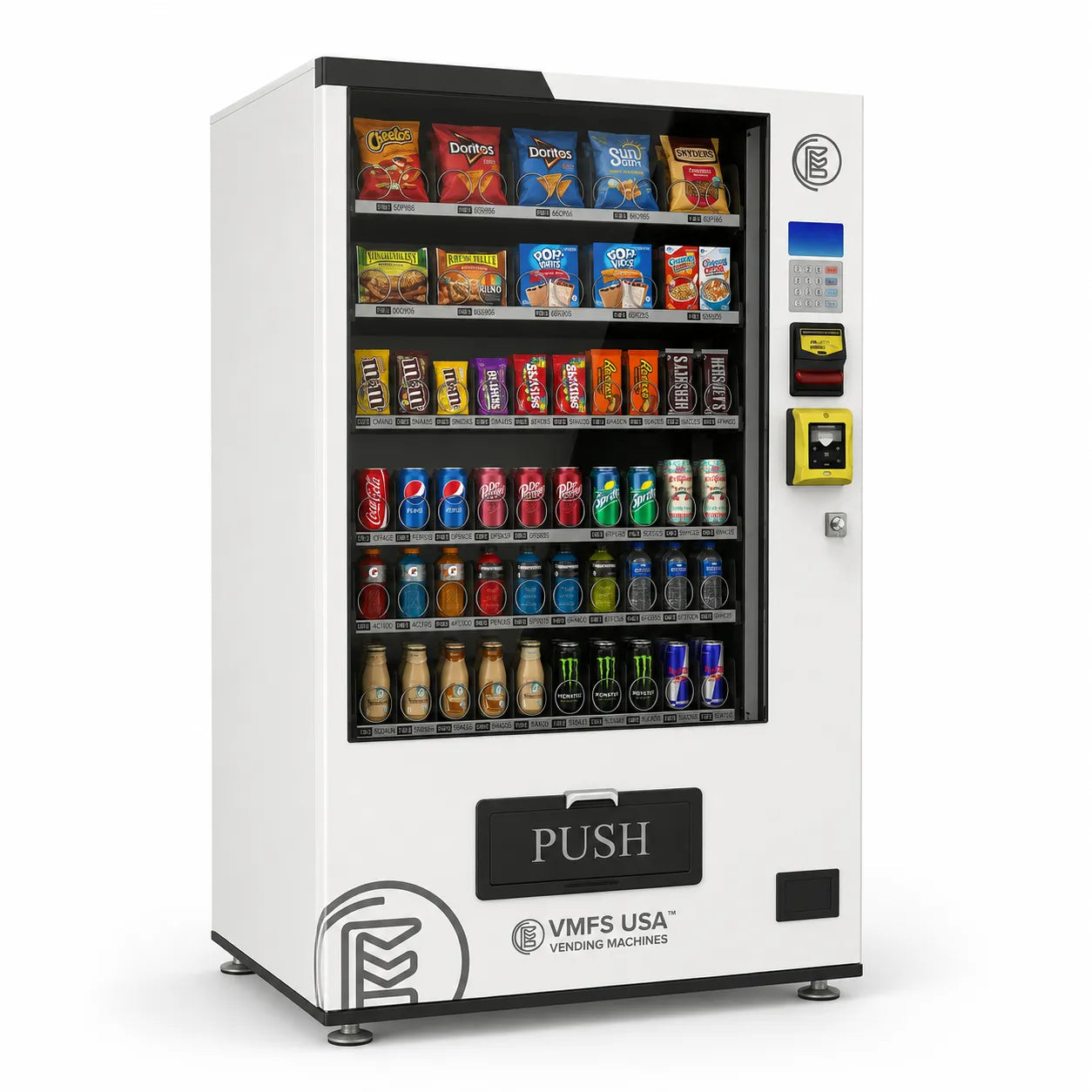
Share:
How to Start a Vape Vending Machine Business: Laws, Costs, Locations
AI Vending Machine ROI: Are AI Vending Machines Profitable?