


Design the perfect vending solution for your location and customers.

Sales, inventory and alerts for your whole route, from one machine to a fleet.
Answer a few questions about your location, products and budget and get a shortlist.
Estimate revenue, payback period and margin before you buy.
Sales, setup help, warranty and parts from the VMFS USA team.
Join the VMFS newsletter and step into a thriving network dedicated to collective success.
One signup. Endless possibilities.
If you have ever used a self checkout lane at a grocery store, you have already met a weight sensor. That familiar warning about an unexpected item in the bagging area comes from a scale checking that what you scanned matches what you bagged. Smart vending machines can do something similar, with sensors hidden under every shelf.
Some smart vending machines identify products with cameras alone. Others add weight sensors, so every sale is checked twice. VMFS USA sells both kinds, and operators ask the same question about them almost every week: is weight sensing worth paying for? The honest answer is that it depends on what you sell and where you sell it. This guide lays out how each approach works, the real pros, the real cons, and a practical way to decide.
There are two main ways to answer that question, and many machines use both at once.
Cameras watch the shelves and the doorway while the door is open. Software that has been trained on pictures of each product recognizes what leaves the cabinet, and the customer is charged when the door closes. On the VMFS AI lineup, that means dual 1080p cameras watching every opening.
Vision is flexible. It does not care which shelf a product sits on, and it can tell two items apart by their labels, colors and shapes. What it needs is a clear view. Anything that blocks the camera, or makes two products look alike, makes its job harder.
Under each shelf sit small metal parts called load cells. Each one bends a tiny amount under weight, and a strain gauge bonded to the metal turns that bend into an electrical signal. The machine reads that signal all the time, so it always knows how heavy each shelf is.
When a 12 ounce can of soda leaves a shelf, that shelf gets roughly 13 ounces lighter once you count the can itself. The machine knows which products live on which shelf and what each one weighs, so it can work out from the change what was taken, and how many.
When a machine uses both, the cameras report what they saw and the shelves report what they felt. If the two agree, the sale goes through. If they disagree, the system has a second source of evidence to settle it instead of guessing. Researchers who build these systems call this sensor fusion, and it is the same idea behind the checkout free stores that large retailers have tested in recent years.
A traditional vending machine sells one item per transaction. A grab and go machine lets a customer take a sandwich, a drink and a snack in one visit. Industry payment data shows smart store transactions averaged $4.49 in 2025, more than double the $2.01 average for regular vending. When each transaction is worth more, each mistake costs more too.
Open shelving is convenient, and it is also harder to police. In the latest State of the Vending and Micro Market Industry report from Automatic Merchandiser, operators reported average micro market shrink of 4%, against a US retail average of 1.6%. A smart cooler is far more controlled than an open micro market, because the door only unlocks for a paying customer. But the lesson carries over: the better a machine knows what left it, the less quietly walks away.
When a customer is charged for something they did not take, they may simply call their bank. Mastercard research puts the average all in cost of a chargeback to a merchant at about $128, counting outside fees and staff time, on top of refunding the sale itself. One disputed $6 sandwich can end up costing an operator far more than the sandwich.
Cameras can only bill what they can see. Research on camera only checkout points to the same weak spots again and again: a hand or arm blocking the view, products that look alike, and the large amount of computing power and training data needed to cover every angle. A shelf that gets lighter does not care whether the camera had a clear view.
A study published in the journal Frontiers in Built Environment tested this on a replica convenience store shelf with 85 items from 33 different products. Combining shelf weight with cameras reached up to 92.6% item identification accuracy, roughly half the error rate reported for self checkout stations. Just as telling, adding cameras on top of weight alone improved accuracy by up to 3.4 points. Neither sensor was as good on its own as the two together.
People pick things up, read the label and change their mind. A 2026 study of camera only smart vending cabinets, published in the journal Sensors, listed shelf movement after a pickup as one of the causes of false charges. With weight sensing, a product that goes back on the shelf puts its weight back too, which gives the system a clear sign that nothing was bought.
When a customer grabs three of the same drink in one reach, a camera has to see three separate cans. A shelf simply gets three cans lighter. For machines that sell multiples of the same product, weight is a straightforward way to confirm the count.
Because every shelf is always being weighed, the machine keeps a running count of what is left. That makes remote stock reports more trustworthy and helps operators load the van with the right products before a trip, instead of discovering empty shelves on arrival and a surplus of something nobody is buying.
Every wrong charge costs twice: the refund, and the customer who stops trusting the machine. With chargebacks averaging about $128 in all in costs, preventing even one a month is meaningful. When a charge is backed by both what the cameras saw and what the shelf lost, there is less to argue about, and it is easier to review when a customer does get in touch.
A weight sensor records ounces, not faces. That matters because several states regulate biometric data, and Illinois is the strictest. Its Biometric Information Privacy Act lets individuals sue directly, with damages of $1,000 per negligent violation and $5,000 per intentional or reckless one. A 2024 amendment limited recovery to once per person rather than once per scan, and in April 2026 a federal appeals court ruled that limit applies to pending cases too. Even so, the exposure across a large group of customers is serious. Weight sensing does not remove the need for cameras on these machines, but it is one part of the system that collects nothing about the customer at all.
On the VMFS AI Smart Fridge, weight sensing is an optional add on at 3 cents per transaction, on top of the 7 cent AI recognition fee. At 1,500 sales a month, that is $45 a month, or $540 a year. Small, but real, and worth running against your own sales numbers before you choose it.
Weight sensing works best when products on the same shelf weigh clearly different amounts. Two flavors of the same brand of chips can carry exactly the same label weight. And no two packages weigh exactly the same, even legally. Under NIST Handbook 133, the federal guide that inspectors use to check packaged goods, a package labeled under about 1.3 ounces can individually come in up to 10% light. That natural wobble can be as large as the difference between two products. This is why weight sensing is paired with cameras rather than used alone.
The system has to know which products belong on which shelf. If a customer puts a sandwich back on the drinks shelf, or a restock goes on the wrong shelf, the numbers stop matching what the system expects. Camera only machines are more forgiving about where things sit.
Load cells are metal, and metal changes slightly with temperature. Cold makes readings drift from their true zero, which is why manufacturers build in temperature compensation, typically for a range of about 14°F to 104°F. Frozen food machines run colder than that, so the sensors in them need to be rated for the job. Patent filings for smart shelves also describe how opening a refrigerated door pushes cold air across the shelves and can briefly nudge the readings. Good systems filter these effects out, but shelves still benefit from checks and occasional calibration.
A shelf cannot tell a sandwich from a phone. A customer who rests their keys, phone or coffee cup on a shelf while deciding adds weight that has nothing to do with a sale. Well built systems use the cameras and the timing of events to sort this out, but it is one more situation the software has to handle correctly.
Moving products between shelves or adding a new item means updating the shelf setup, not just loading the product. For operators who test new products often or change the mix with the seasons, that is a little extra work on every visit.
| Situation | Camera only | Camera plus weight |
|---|---|---|
| Hand blocks the camera | Can miss or misread the item | Shelf still records the change |
| Products look alike | Can confuse them | Weight helps tell them apart |
| Products weigh the same | Tells them apart by look | Relies on the cameras |
| Several of the same item taken | Must see each one | Shelf confirms the count |
| Item picked up and put back | Harder to confirm | Weight returns, no charge |
| Phone or keys rested on a shelf | Not an issue | Software must filter it out |
| Stock counts | Based on what cameras see | Backed by shelf weight |
| Cost per sale | Lower | Small extra fee |
| Upkeep | Keep cameras clean | Cameras plus shelf checks |
| Rearranging products | Easy | Update the shelf setup |
Eight kinds of canned and bottled drinks, clearly different labels, a steady trickle of customers through the day, and most people taking one drink at a time. Cameras handle this well on their own, and the product mix rarely changes. Camera only is usually the sensible, lower cost choice.
Salads, wraps, sandwiches and yogurts, many in similar clear packaging, bought in bigger baskets by staff in a hurry between shifts. Items get picked up and put back as people compare options. This is where weight sensing earns its fee, backing up the cameras on exactly the moments they find hardest.
A dozen flavors of the same protein bar, all the same label weight, sitting beside shakes and waters. Weight alone cannot tell the bars apart, so the cameras do the identifying. Weight still helps confirm counts when someone grabs three bars at once. Here the decision comes down to volume: a busy gym may justify the add on, and a quiet one may not.
Weight sensing changes the restocking routine a little. A typical visit looks like this.
VMFS USA sells vending machines with both approaches, so the choice can follow the location rather than the other way around.
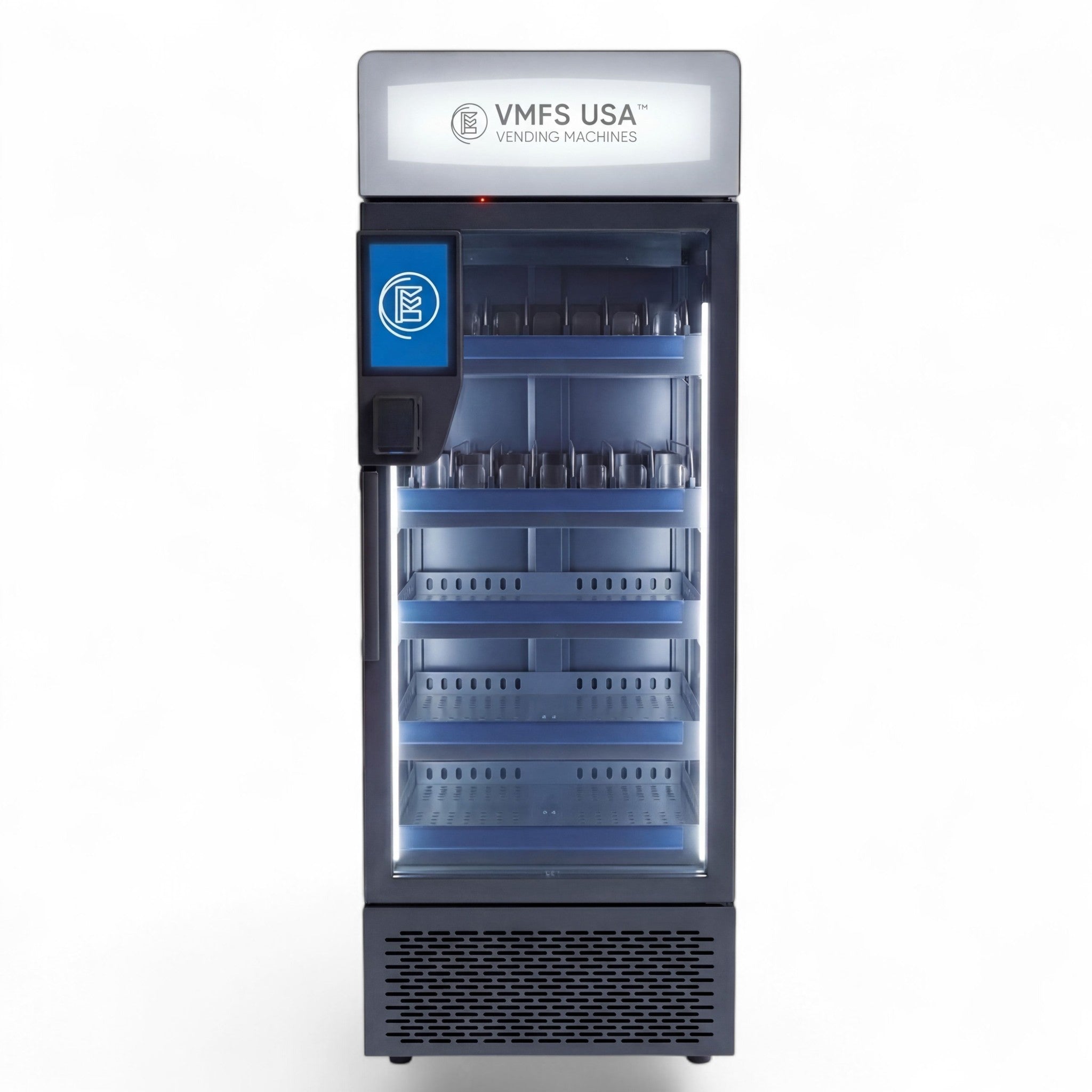
The AI smart fridge vending machine combines dual 1080p camera vision with weight sensing and is rated at 99% recognition accuracy, with weight sensing offered as an optional add on. It comes in refrigerated and frozen versions for drinks, fresh meals, frozen entrees and ice cream. For simpler product mixes, the AI smart combo vending machine uses camera based recognition, and the new AI Grab and Go Cooler runs on camera vision only.
The full range of smart vending machines is available to compare side by side, and operators who want to shape a setup around one specific location can start with a custom AI vending machine.
Operating costs are published up front. On the AI lineup, VMFS AI Cloud is $39.99 per month, AI recognition is 7 cents per transaction, and the weight sensing add on is 3 cents per transaction where it is offered.
It can on shelves where every product weighs clearly differently, but mixed shelves need cameras to tell same weight products apart. That is why modern machines combine the two rather than rely on weight alone.
No. The shelves are weighed continuously in the background, and the customer is still charged when the door closes.
They make it much harder for items to leave unnoticed, because every removal changes a shelf's weight. The bigger protection is that the door only unlocks for a customer with a valid payment method.
Often not. A short list of clearly different products and low traffic is where camera only machines are at their best and cheapest.
Yes, when they are rated for the temperature. Ask the supplier directly, because cold is the biggest environmental factor in load cell accuracy.
It depends on the model. Where it is offered as an add on, the VMFS team will confirm what can be enabled on the specific machine before you order.
The right sensing setup depends on the right location. Operators looking for trusted, steady sites for grab and go machines work with VPlaced, and customers can find machines near them on VendingFinder. Questions about cameras, face payment and state privacy rules run through VAdviced, and VMarketed helps operators explain grab and go shopping to a new location's customers.
VMFS USA continues to run private pilot programs across the United States in different climates and types of locations, and every pilot sharpens its advice on which setup fits where. Operators can compare the full range of vending machines for sale online, or book a visit to the Miami showroom to see both approaches working side by side before they choose.

Compartir:
Tea Vending Machines: Why the Tea Button Has Always Disappointed You