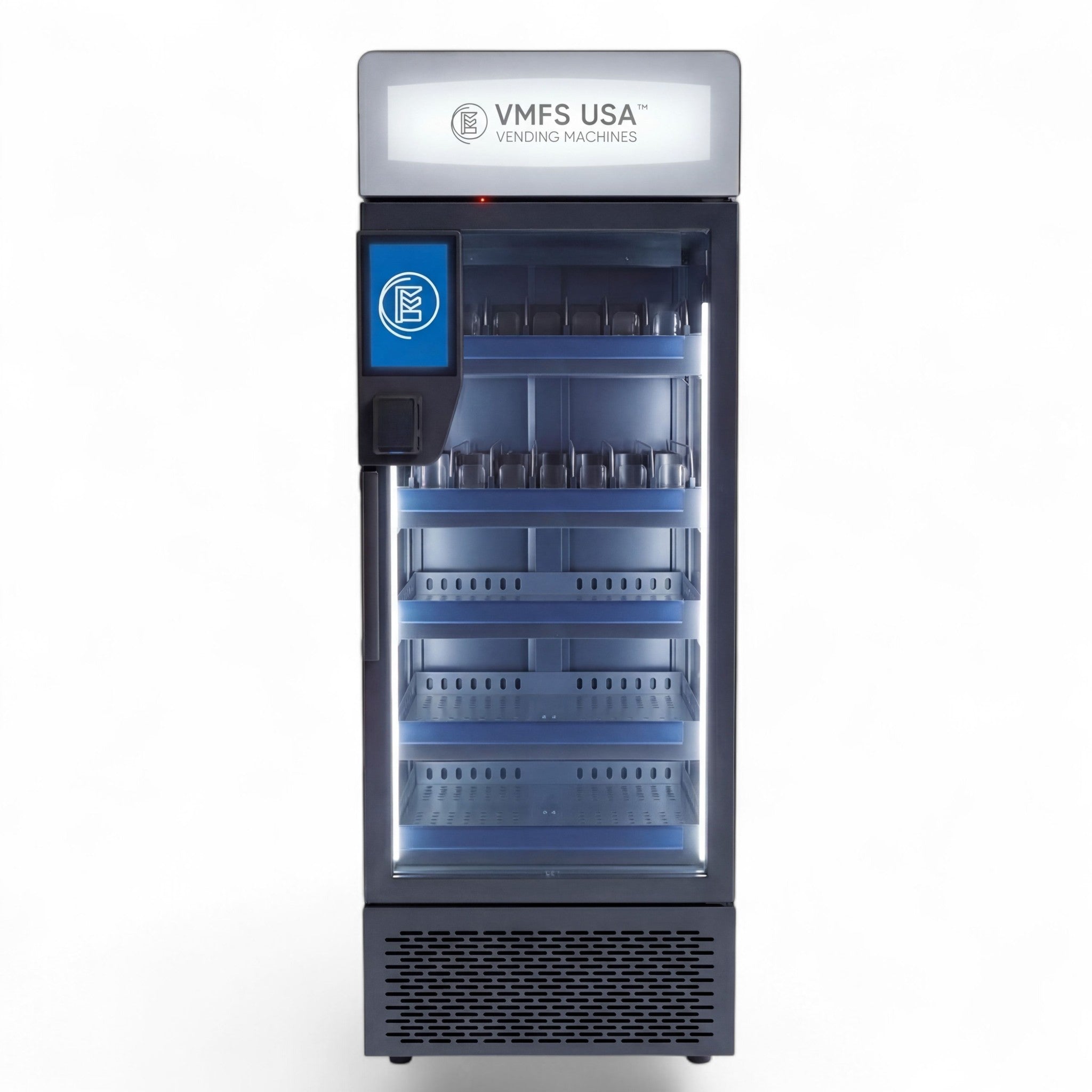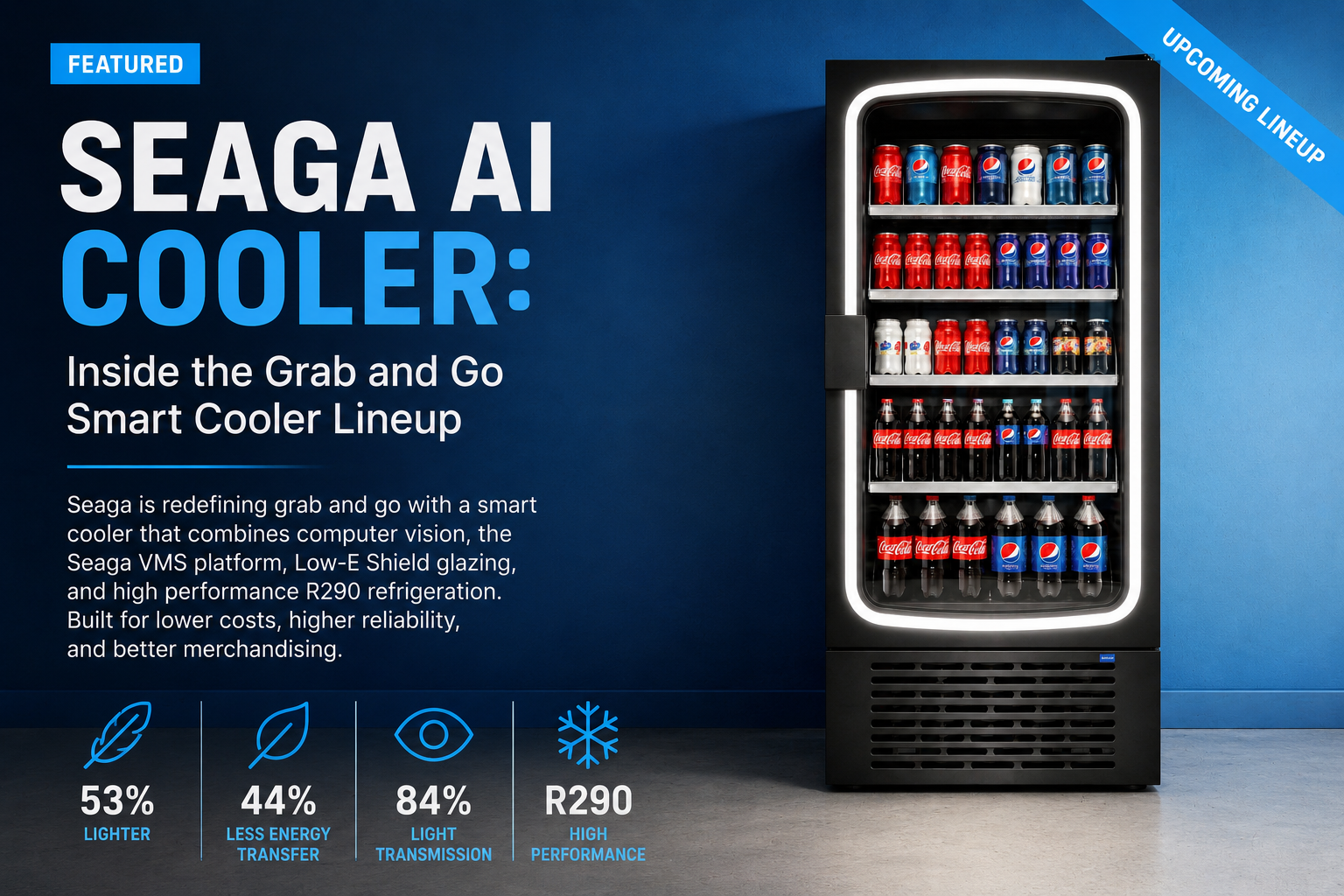
Seaga AI Cooler: Inside the Grab and Go Smart Cooler Lineup

VMFS USA | Machines, technology and operator strategy

For almost four decades Seaga built machines that hand you a product. Now they are building one that lets you take it yourself. The upcoming Seaga AI cooler lineup is a grab and go smart cooler running computer vision on top of Seaga's own VMS, and the most interesting engineering decision on the whole machine is one most buyers will walk straight past.

Grab and go has been the loudest category in unattended retail for three years, and until now it has belonged almost entirely to software companies and importers. Vision algorithms wrapped around a cabinet somebody else made. That model works, plenty of those machines are earning money right now, but it leaves operators holding a support question with two possible answers and no clear owner.

A manufacturer entering the category changes the shape of that question. Seaga has been engineering refrigeration, cabinets, controllers and service networks since 1987 out of Freeport, Illinois, with additional operations in New Delhi, Kearneysville in West Virginia, and Guadalajara. When a company with that manufacturing base builds a grab and go cooler, the decisions it makes about the parts nobody photographs tell you a great deal about how the machine will behave in year three.

This post covers what has been confirmed about the lineup, why the glazing is the genuine headline, what R290 refrigeration means for your power bill and your service plan, and how to prepare a location for one now rather than scrambling when the units land. If you want to compare formats in the meantime, our current range of AI vending machines covers the same category.

What the Seaga AI cooler is

The machine is a grab and go smart cooler. The customer authorizes payment, the door releases, they take what they want from open shelving, and the system charges them when the door closes. No keypad, no selection code, no drop bin, no scanning. Computer vision identifies what left the shelf, and Seaga's VMS handles the transaction, the inventory and the reporting behind it.

Here is what has been confirmed about the platform so far.

FormatGrab and go smart cooler
RecognitionAdvanced computer vision
Software platformSeaga VMS
GlazingLow-E Shield
Weight reduction vs glass53% lighter
Energy transfer reduction44% less
Light transmission84%
RefrigerationHigh performance R290
ManagementRemote management built in
StatusUpcoming lineup

Read that list twice and notice what is missing from the marketing emphasis. There is no boast about camera count, no accuracy percentage in the headline, no talk of proprietary neural networks. The specifications that got named first are about the door and the compressor. That is a manufacturer talking, not a software company, and it is the most revealing thing about the whole announcement.

Why the glazing is the real story

Every grab and go cooler on the market has a glass front, and every one of them fights the same physical problem. Glass is heavy, glass conducts heat, and the more you insulate glass the less you can see through it. Those three constraints have shaped refrigerated merchandising for decades and nobody has beaten them, they have only traded between them.

Low-E Shield glazing, developed with DALB, is a departure from that trade. The numbers are worth taking apart individually because each one solves a different operator problem.

53%Lighter than the glass it replaces
44%Less energy transfer through the door
84%Light transmission, so the product still sells itself

53% lighter, and why weight is an operating cost

Weight sounds like a delivery detail. It is actually a lifetime cost line, and it shows up in more places than most operators expect.

A refrigerated cooler door is a heavy panel hanging off two hinges that get swung open and slammed shut dozens of times a day, every day, for years. Halve the mass of that panel and you halve the load on the hinge, the gasket compression cycle and the door frame. Doors sag because heavy doors sag. Gaskets fail early because a heavy door lands hard. Cutting the weight of the glazing attacks the single most common failure point on any glass front refrigerated machine, and it does it without adding a part that can break.

Then there is everything before the machine is even plugged in. Freight is priced on weight. Two people can place a lighter cabinet where three were needed before. Doorways, elevators and floor loading limits stop being obstacles at a whole class of location. Upper floors of older office buildings, mezzanines, converted spaces and anywhere with a weight restricted lift all become viable sites rather than sites you have to decline. If you have ever lost a good location to a building manager worried about floor loading, you know exactly what this is worth.

44% less energy transfer, and what that does to the compressor

This is the number that shows up on the power bill, but the more important effect is on the machine's health.

Energy transfer through the door is the main way heat gets into a refrigerated cabinet when it is closed. Reduce it by close to half and the compressor runs less often to hold the same internal temperature. Fewer compressor starts means less wear on the single most expensive component in the machine, and a compressor that spends more time resting is a compressor that lasts.

It matters more in a grab and go cooler than in a conventional vendor, and the reason is worth understanding. A grab and go machine has its door opened fully, by hand, for the entire duration of the shopping session. A coil machine never opens at all during a sale. That means grab and go coolers face a far harsher thermal reality: repeated full door openings, warm air flooding in, and then a recovery period where the machine has to pull temperature back down fast enough to keep fresh food safe. Better insulated glazing shortens that recovery and makes the fresh food product mix genuinely dependable rather than nervously monitored.

There is also a comfort dividend that quietly affects sales. Better insulated doors sweat less. A cooler with condensation running down the front in a humid lobby looks neglected, hides the product and puts customers off, and it is a chronic complaint in coastal and southern locations.

84% light transmission, and the trade nobody usually wins

Here is where the engineering gets genuinely clever. The normal way to reduce energy transfer through a door is to add layers: more panes, more coatings, more gas fill. Every one of those steps costs you visibility. The product gets dimmer, colors go flat, and the merchandising power of a glass front, which is the entire reason you chose a glass front, gets eroded in exchange for efficiency.

At 84% light transmission the product still reads clearly from across a lobby. In a grab and go cooler that number is doing real commercial work, because unlike a coil machine there is no illuminated selection menu doing the selling for you. The shelf is the storefront. If the customer cannot see the sandwich clearly from ten feet away, they keep walking, and no amount of AI in the cabinet recovers that lost sale.

The pattern worth noticing

Weight, insulation and visibility are usually a pick two situation. A lineup that leads with all three, before it mentions the vision system, is being engineered by people who know which parts of a machine generate service calls. Software gets updated. A door frame does not.

R290 refrigeration, and why it belongs in this machine

R290 is propane used as a refrigerant, and it has become the direction of travel across commercial refrigeration for reasons that work in an operator's favor.

It is more thermodynamically efficient than the synthetic refrigerants it replaces, which means smaller charge volumes, faster pull down and lower running cost for the same cooling job. It has a very low global warming potential, which matters both for the regulatory direction on synthetic refrigerants and increasingly for corporate clients who ask about sustainability during procurement. And smaller charges mean simpler, more compact refrigeration assemblies.

Pairing R290 with better insulated glazing is a coherent design rather than two separate features. Efficient refrigeration and reduced heat load compound: the compressor is both better at its job and given less work to do. That combination is exactly what a fresh food cooler needs, because the failure mode you actually fear with fresh product is not a total breakdown, it is a machine that cannot recover temperature quickly enough during a busy lunch hour.

Two practical notes. R290 systems are flammable in the way any hydrocarbon is, so charge sizes are regulated and technicians need appropriate handling awareness. In a sealed factory built cabinet this is routine, not exotic, but it is worth confirming your service technician is comfortable with hydrocarbon systems before you commit a fleet. Second, R290 units generally want decent ventilation clearance at the back, so confirm the installation gap when you plan the site.

Computer vision on Seaga VMS

The recognition question in grab and go is well understood by now. Cameras identify what leaves the shelf, the basket is reconciled when the door closes, and the authorized payment settles at the real amount. What varies between machines is not really the concept, it is who owns the stack.

Most grab and go coolers pair a cabinet from one company with vision software from another and a payment layer from a third. When something goes wrong at 7am on a Monday, the operator becomes the integrator, and that is the part of the category people complain about privately far more than they say publicly.

Running the vision on Seaga's own VMS puts the transaction, the inventory and the machine reporting inside one platform from the manufacturer that built the cabinet. Remote management is described as built in rather than added on, which is the difference between telemetry that was designed with the machine and telemetry that was retrofitted to it.

There is a wider context here too. Seaga expanded significantly into micromarkets in 2026, bringing in kiosks, software, payment technology and full market build out capability. That means grab and go coolers, micromarket kiosks, glass front vendors and industrial inventory control can all sit on one operator platform. For a route running more than one format, that consolidation is worth more over five years than any single hardware feature.

Manufacturer built compared with software first grab and go

This is the comparison that actually matters when a manufacturer enters a category that startups built.

Two routes into the same product category
Factor Manufacturer built cooler Software first cooler
Cabinet engineering Designed in house alongside the refrigeration and the door Commonly sourced, with the software layer added after
Support ownership One company owns hardware and platform Hardware, vision and payments may sit with different vendors
Parts availability Backed by an existing parts and service network Depends on the supplier relationship behind the badge
Fleet consistency Shared components and controls across the catalog Often a standalone unit in an otherwise mixed fleet
Innovation pace Slower to ship, tested harder before release Faster feature releases, more variance in the field
Refrigeration depth Decades of compressor and cabinet experience applied directly Varies widely, often the weakest part of the machine
Where it shows up Year three, in downtime and service cost Year one, in features and price

Neither column is the villain. Software first companies dragged this entire category into existence while the traditional manufacturers were still selling coils, and operators who moved early on those machines made real money. But the category is maturing, and maturity in vending has always been decided by the boring metrics: parts, service, uptime and what the machine costs to keep alive in year four.

Where a grab and go cooler fits on a route

A grab and go cooler is not an upgraded snack machine. It is a different retail format that happens to occupy a similar footprint, and treating it as a tier above coil vending is how operators end up putting an expensive machine in a building that only ever wanted chips.

Grab and go cooler compared with a coil vendor
Factor Grab and go cooler Coil vendor
Customer action Authorize, open, take, close Select, pay, collect
Items per visit Several, naturally Usually one
Product constraints Anything that fits a shelf Must survive a coil and a fall
Fresh food The core use case Limited and risky
Price ceiling High, handled goods support premium pricing Lower, resistance climbs with price
Thermal load Heavy, the door opens fully on every sale Light, the door stays shut
Connectivity Required, billing reconciles through it Helpful, but the machine still vends
Service rhythm Tighter, fresh product drives rotation Forgiving, packaged goods hold
Strongest venues Hospitals, offices, gyms, universities, hotels Schools, plants, laundromats, transit

The best routes run both. High traffic sites take coil units at low cost per vend while food led buildings take coolers at a much higher ticket, often in the same building on the same service visit. Operators building the conventional side of that mix can review the current Seaga vending machines range, and the wider catalog of vending machines for sale lays every format out side by side.

What to have ready before the lineup lands

This is an upcoming lineup, so full capacity, dimension and configuration details are still to come. That is not a reason to wait passively. The operators who place new machines fastest are the ones who did the location work while everyone else was reading spec sheets.

Preparation checklist

  • Identify your fresh food capable locations now. Not sites that want a machine, sites that have a genuine lunch or night shift demand.
  • Walk each one at the busy hour and count people, not square footage. Traffic at noon decides everything.
  • Test the network at the exact wall the machine will stand against, because billing reconciles through the connection.
  • Measure the doorway, the elevator and the turn radius, and note any floor loading restrictions the building has mentioned.
  • Check the ventilation gap available behind the machine, since hydrocarbon refrigeration systems want clearance at the back.
  • Confirm your technician is comfortable servicing R290 systems, or line up one who is.
  • Build the fresh product supply chain before you build the machine order. Dating and rotation are the real discipline in this format.
  • Agree who owns spoilage with each site in writing, before day one rather than after the first write off.
  • Settle the permits and registrations that fresh and prepared food trigger in your state, which differ from packaged snack vending.
  • Budget the running costs separately from the machine: cloud platform, payment device service and connectivity are all monthly lines.
  • Ask for capacity, shelf count, dimensions, weight, payment options and availability as soon as full specifications are released.
  • Get your location agreements drafted now so you are signing rather than negotiating when hardware arrives.

The compliance side is worth handling in parallel rather than afterwards, because fresh food changes what applies and it varies by state and sometimes by county. VAdviced covers entity setup, permits and location agreements. On the placement side, VPlaced sources and qualifies locations for operators who would rather buy a vetted site than cold call for one, which matters more than usual with this format because a grab and go cooler in a mediocre location fails much more expensively than a coil machine does.

Preparing the demand side

One thing operators consistently under plan for with grab and go is that the format needs to be discovered before it can perform. A coil machine is instantly legible to everyone. A cooler that charges you after you close the door is not, and first time users hesitate.

Two things fix that. Clear signage at the machine explaining the three step flow, which reliably lifts first week conversion, and making sure people can find the machine at all. VMarketed handles the marketing side for operators building a pipeline rather than waiting on referrals, and consumer facing discovery through VendingFinder helps people locate the machines you have placed. Both are connected services within the VMFS ecosystem, available as paid add ons rather than bundled with hardware.

Frequently asked questions

What is the Seaga AI cooler?

It is a grab and go smart cooler in Seaga's upcoming lineup, using advanced computer vision for item recognition and running on Seaga's VMS platform with remote management built in. The cabinet uses Low-E Shield glazing and high performance R290 refrigeration.

What makes Low-E Shield glazing different from standard cooler glass?

It is 53% lighter, transfers 44% less energy and still delivers 84% light transmission. Normally reducing energy transfer costs you visibility, because it means adding panes and coatings. Holding all three at once is the engineering achievement here, and the weight reduction alone changes which locations a machine can physically go into.

Why does R290 refrigeration matter to an operator?

Better efficiency for the same cooling job, smaller refrigerant charge, and a very low global warming potential that aligns with where regulation and corporate procurement are both heading. Paired with better insulated glazing it means the compressor is both more efficient and given less heat to fight, which shows up as lower running cost and faster temperature recovery after the door has been open.

How is this different from other AI coolers already on the market?

Most grab and go coolers combine a sourced cabinet with third party vision software and a separate payment layer. This lineup comes from a manufacturer that engineers its own refrigeration and cabinets and runs the recognition on its own VMS, so hardware and platform sit with one company. That difference is invisible on day one and very visible the first time something needs fixing.

When can I buy one?

This is an upcoming lineup, so full specifications, configurations and availability are still being finalized. Contact us to be included when release details are confirmed, and in the meantime we can assess which of your locations suit this format so you are ready rather than starting from scratch.

Can I run one alongside my existing machines?

That pairing is usually the strongest configuration. A coil unit carries volume snacks and cans cheaply while a cooler carries fresh food and premium items at a much higher ticket, in the same building on the same service visit. Different price points, different purchase moments, one route stop.

Where this leaves operators

Grab and go stopped being an experiment a while ago. What has been missing is manufacturers treating it as a serious hardware category rather than a software demo bolted to a fridge, and a lineup that leads with glazing, refrigeration and platform integration is exactly what that looks like.

If you are mapping a fleet, start from the vending machines hub to see how the formats are organized, then work through the catalog when you are ready to buy vending machines for the locations you have qualified. Cloud monitoring runs as a paid subscription, and financing is available through registered outside partners with details on our flexible financing options page.

The temptation with any new AI machine is to buy the technology. The operators who do well buy the location first and the machine second, and this format punishes that mistake harder than any other because fresh product spoils while packaged snacks simply wait. Get the sites qualified, get the supply chain and the permits sorted, and the hardware decision becomes straightforward when the lineup arrives.

We will keep this page updated as full specifications are confirmed. If you want us to assess your locations against this format in the meantime, our team will run the numbers with you on traffic, product mix and realistic return before anything is ordered.

Contáctenos

Este sitio está protegido por hCaptcha y se aplican la Política de privacidad de hCaptcha y los Términos del servicio.

Colecciones destacadas

side pose of VMFS USA smart combo vending machine

Todos los productos91

Descubre todos nuestros productos