



Design the perfect vending solution for your location and customers.

Sales, inventory and alerts for your whole route, from one machine to a fleet.
Answer a few questions about your location, products and budget and get a shortlist.
Estimate revenue, payback period and margin before you buy.
Sales, setup help, warranty and parts from the VMFS USA team.
Join the VMFS newsletter and step into a thriving network dedicated to collective success.
One signup. Endless possibilities.
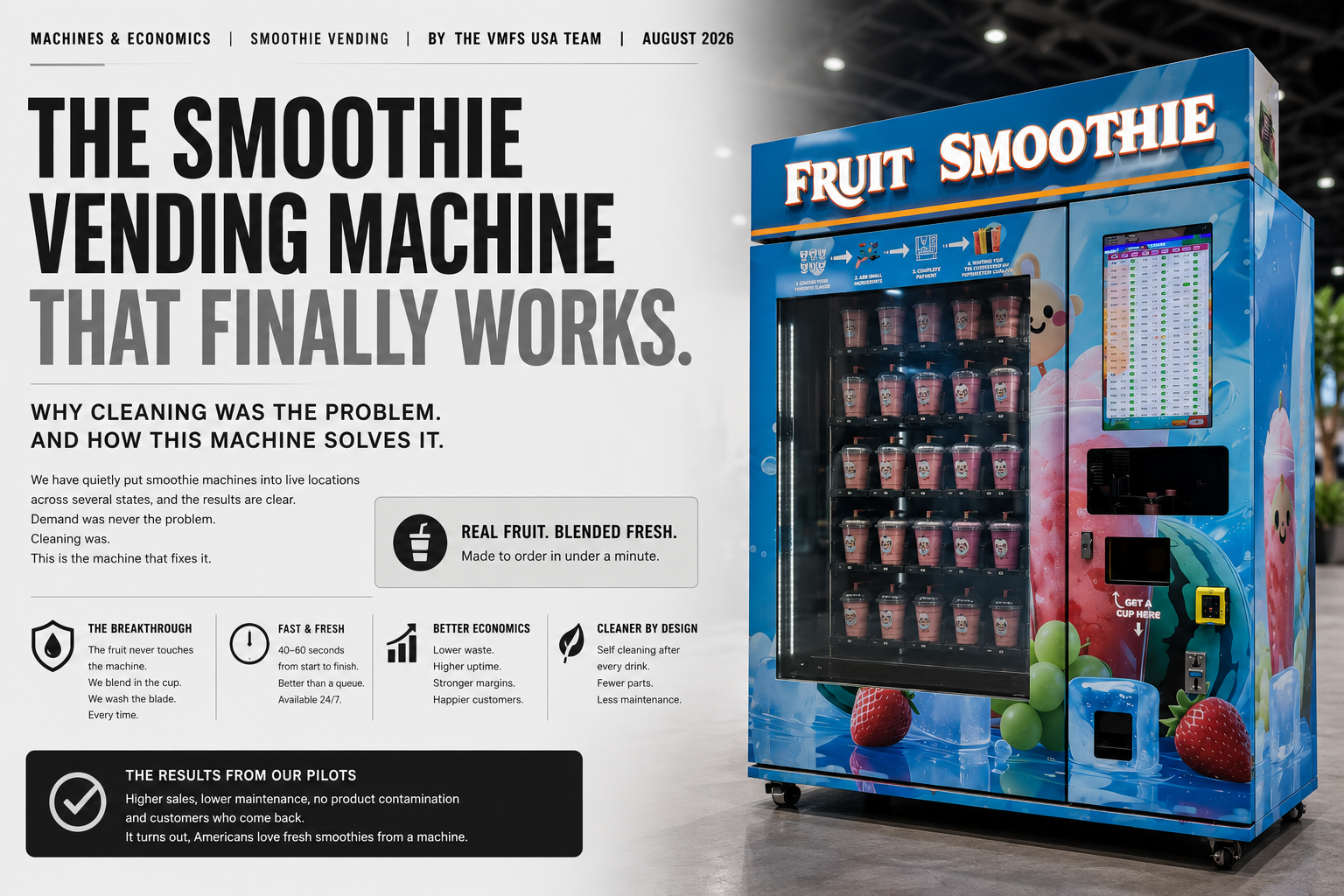
Machines & Economics | Smoothie Vending | By the VMFS USA Team | August 2026
We have quietly put smoothie machines into live locations across several states, and we want to talk about why, because the reasoning goes against most of what the vending industry has believed about fresh drinks for the last twenty years.
The received wisdom is that fresh beverage vending does not work in America. Plenty of companies have tried it, most have quietly stopped, and the assumption settled that Americans will not buy a fresh drink from a machine.
That assumption is wrong, and it has been wrong for years. Demand was never the problem. Cleaning was the problem. And the machines now entering our pilot programme solve it in a way that is almost embarrassingly simple once you see it.
Where this comes from: we supply and operate vending machines across the United States, and we currently have private smoothie pilots running in multiple states across fitness, campus, corporate and public venue categories. What follows is the hardware, the economics and what we are learning.

Picture the obvious way to build a smoothie machine. Hoppers of loose frozen fruit. Tanks of liquid. A blender jug in the middle. Customer selects, machine drops fruit into the jug, adds liquid, blends, pours into a cup.
It works beautifully in a showroom. Then it goes into a gym and runs eighty drinks on a Monday, and the trouble starts. Fruit pulp coats the jug. Dairy or plant milk residue sits in the lines. Sugar collects in places nobody designed access to. Within a fortnight you have a machine that needs stripping down by hand, and the person who has to do it is a route driver with eleven other stops that day.
That is the whole story of why this category stalled. Not consumer resistance. A cleaning burden that unattended equipment could not carry, and a hygiene risk that no serious operator wanted to gamble on.
The blend in cup approach turns the problem inside out. Instead of the machine handling loose ingredients, the portioned frozen fruit arrives already sealed inside its own cup, prepared and measured off site.
The sequence at the machine is genuinely different from anything else in vending:
Read that fifth step again, because it is the entire breakthrough. The only part of the machine that contacts food is the blade, and the blade gets washed after every single drink. The fruit never enters the mechanism at all. That single design decision removes the contamination pathway that killed every previous attempt at this category.
Well specified units complete the whole cycle in around forty seconds to a minute, which is faster than the queue at a staffed smoothie counter and available at five in the morning when that counter is shut. You will recognise the interface style from across our touch screen vending machines, though the mechanism underneath is unlike anything else in the range.
If you are evaluating one of these, these are the specifications that actually determine whether it survives in the field. Most of them never make it into a sales conversation.

Everything here is illustrative rather than a promise, since your numbers depend on sourcing, location and pricing. But the structure of this category is worth understanding because it differs from ordinary vending in two important ways.
The first is your price ceiling. A smoothie from a counter is a familiar purchase at a familiar price, and it is not a cheap one. Your machine is competing against that reference point rather than against a two dollar bottle of soda, which puts your selling price in a completely different bracket from anything else on a typical route. Meanwhile your input is a portioned cup of frozen fruit and a measured pour of liquid.
The second is waste, or rather the absence of it. Frozen product does not spoil the way chilled fresh product does. A cup that does not sell today sells next week, which removes the single largest hidden cost in fresh vending and is the reason frozen categories tend to behave better financially than refrigerated ones.
| Bottled drinks machine | Blend in cup smoothie | |
|---|---|---|
| Price benchmark | The shop downstairs | A smoothie counter |
| Spoilage risk | Real, dated stock | Minimal, product is frozen |
| Restock weight | Heavy, mostly water | Lighter, fruit only |
| Venue acceptance | Refused by health focused sites | Welcomed by them |
| Maintenance | Very light | Real, scheduled |
| Cold chain | Simple refrigeration | Freezer, end to end |
Look at the fourth row, because that is where the real money hides. A machine that health conscious venues actively want is a machine that gets into buildings your competitors were turned away from. That is worth more than a few points of margin, and you can see the same dynamic across our healthy vending machine range.
The honest counterweight is the last two rows. This machine needs scheduled attention and it needs a working freezer chain from your supplier to the cabinet. Neither is difficult, but both are real commitments that a bottled drinks machine does not ask of you.
Location matters more in this category than in almost any other we supply, because you need three things at once: enough traffic to justify the machine, an audience willing to pay a premium price, and a venue that welcomes rather than tolerates a health product.
Finding and securing sites like these is its own discipline, and our partners at VPlaced handle that side, while venue owners can list space directly through their location owners page.

We are running these privately rather than launching a product, and that is deliberate. A specification written for another market tells you very little about what an American gym at six in the morning actually demands, and the gaps show up in details that never appear on a datasheet.
What we are measuring across the pilot sites:
That final point has been the most valuable by a distance. Partner venues keep raising operational requirements nobody had anticipated, and every one of those notes feeds into the specification we are assembling. We would rather build the version this market needs than ship the version that happened to arrive here first.
Automated fresh beverage retail is growing at a double digit rate, and North America already represents the largest share of that market globally. Gyms, hospitals, campuses and offices come up consistently as the strongest environments for fresh vending.
Underneath those numbers is a shift in what people will accept from a machine. Consumers who once assumed vending meant packaged snacks now expect the same fresh, ingredient led, transparent options they look for everywhere else. Operators who can supply that are getting into venues that refused vending outright a few years ago, and that access is the real prize rather than the drink itself.
If you are considering this category, get the order right. Settle the location first, because a premium product in a weak site does not work and no amount of pricing rescues it. Sort the food compliance and labelling with VAdviced before switching on rather than afterwards. Then plan the launch properly, because members and staff need to know the machine exists and what it does, which is where VMarketed earns its keep in the first month.
On our side, you can explore the beverage vending machine and specialty vending machine ranges, see what is ready to move in in stock units, or browse and buy from the full lineup. In stock units typically ship within 7 to 21 days and carry a one year parts warranty.
And if you run a gym, campus, hospital or high traffic venue and would make a genuinely good pilot site, we would like to hear from you. That is not a throwaway line. The specification we are building is being shaped by the venues already running these machines, and we are still adding locations to the programme.
The best current systems use blend in cup technology. Portioned frozen fruit arrives sealed in its own cup, the machine identifies that cup, adds a measured quantity of water or milk, blends the contents inside the cup itself, then runs an automatic cleaning cycle before the next order. The whole process takes roughly forty seconds to a minute.
The structure is favourable because your product is benchmarked against a smoothie counter rather than a bottled drink, which sets a much higher price ceiling, while frozen product means minimal spoilage. Against that, the machine costs more upfront and requires scheduled maintenance and a working freezer chain. Results depend heavily on getting the location right.
Considerably less than earlier fresh drink machines, because blending happens inside the sealed cup and only the blade contacts food, with an automatic wash after every order. It is not zero, though. Any machine producing a wet consumable needs a documented manual schedule alongside the automated cycles, and you should be sceptical of any supplier who claims otherwise.
Gyms are the strongest fit, followed by university campuses, hospitals, corporate offices, airports and recreation centres. What these share is a health aware audience, real traffic, and a venue that actively welcomes a fresh product rather than merely tolerating a machine.
Around forty seconds to a minute on a well specified machine, which is faster than most staffed counters and available at hours when no counter is open. That speed matters commercially, because a queue at a gym at seven in the morning disperses quickly if each drink takes too long.
Talk to Us About Smoothie Vending
We have private pilots running across the country and we are specifying smoothie machines around what American venues actually need. Tell us about your site and let us talk.
Browse the Machines
Compartir:
Vending Machine Revenue Split - Operator vs. Location Owner vs. Supplier