




Design the perfect vending solution for your location and customers.

Join the VMFS newsletter and step into a thriving network dedicated to collective success.
One signup. Endless possibilities.
Narcan vending machines are secure, self-service machines that dispense naloxone nasal spray, the medication that reverses opioid overdoses, usually free, anonymously and around the clock, in places such as jails, libraries, hospitals, campuses and shelters.
This guide explains how they work, what a program costs, who deploys and funds them, what published evaluations show, and how to start one with VMFS hardware. If someone may be overdosing, call 911 right away and give naloxone if you have it.
A Narcan vending machine, also called a naloxone vending machine, harm reduction vending machine or public health vending machine, is a locked, self-service cabinet that hands out naloxone nasal spray to anyone who walks up, usually at no cost and without staff involvement. Narcan is the best-known brand of naloxone. The machine itself is ordinary vending hardware; what makes it a harm reduction tool is the program behind it: who stocks it, where it sits, how people get access and what support information comes with each kit.
Naloxone is an opioid antagonist. The CDC describes it as a life-saving medication that quickly reverses an overdose from opioids such as fentanyl, heroin and prescription opioids by blocking their effects, and notes that breathing can return to normal within 2 to 3 minutes in a person whose breathing has slowed or stopped. More than one dose may be needed when stronger opioids like fentanyl are involved. Naloxone does not harm someone who is overdosing on a non-opioid drug, which is why the CDC advises giving it whenever an opioid overdose is suspected.
The legal landscape changed on March 29, 2023, when the FDA approved Narcan 4 mg naloxone hydrochloride nasal spray for over-the-counter use. Before that, programs relied on prescriptions, standing orders or pharmacist arrangements. Today the CDC notes that naloxone is available over the counter in all 50 states, so a health department, nonprofit or hospital that can buy Narcan can stock a machine with it.
In an emergency: naloxone is a temporary treatment. If someone may be overdosing, call 911 and give naloxone. The CDC advises staying with the person until emergency help arrives or for at least four hours.
Communities use vending machines because they put naloxone where people need it at hours when clinics and pharmacies are closed, without the stigma of asking someone for it. The scale of the problem explains the urgency: the CDC reports that nearly 80,000, or about 76%, of the 105,007 drug overdose deaths in the United States in 2023 involved an opioid, and that a potential bystander was present in nearly 43% of those deaths. Every one of those bystanders could have acted faster with naloxone already in hand.
Price is one barrier. When OTC Narcan launched in 2023, the manufacturer set a suggested retail price of $44.99 for a two-dose carton, which is a real cost for many of the people most likely to witness an overdose. Programs that buy at the $41 public interest price and give it away remove that barrier entirely.
Privacy is another. In NACo's coverage of Michigan's program, the program manager explained that pharmacy-based giveaways could add a note to a patient's medical record, which some people did not want, while the machines collect no identifying information. Timing is the third factor. In a study of 15 MATTERS Network machines in New York State, the University at Buffalo found nearly half of all items were dispensed outside regular business hours. A survey at an emergency department machine, published in the Journal of Emergency Nursing, found 46.2% of respondents would not otherwise have had access to naloxone.
Vending does not replace outreach workers, pharmacies or treatment services. It adds an always-open, low-barrier access point, and that is the gap it is best at filling.
Narcan vending machines are deployed mostly by public agencies and health organizations rather than by private businesses: county and city health departments, syringe services programs and other harm reduction nonprofits, hospitals, universities, jails and police departments. The program owner sets policy, buys the naloxone and reports results; the machine is the delivery channel.
The range of operators is wide. Wisconsin's list of state-funded vending machine grantees includes county health departments, police departments, a sheriff's office, a human services agency and tribal nations. Wayne State University's Center for Behavioral Health and Justice reports 55 machines in 35 Michigan counties, placed in jails, community treatment centers, probation and parole offices and harm reduction agencies. A national survey summarized by RTI International found that 16.8% of 529 syringe services programs offered syringes or naloxone through vending machines in 2023.
Health departments
County and city agencies run most programs, often with settlement or federal grant money, and place machines in libraries, transit stations and service centers.
Harm reduction nonprofits
Syringe services programs already serve people who use drugs and add machines to extend their hours and reach.
Jails and courts
Release areas give people naloxone at a moment of very high risk, and release vestibules are often open 24/7.
Hospitals and EDs
Emergency departments reach patients, families and visitors, including people who would not ask staff for a kit.
Universities
Student health services and student advocates install health vending machines that combine naloxone with other time-sensitive products.
Police and fire departments
Police departments are among Wisconsin's grantees, Milwaukee County uses police stations as sites, and New York's MATTERS sites include fire halls.
A person walks up, selects naloxone on a keypad or touchscreen, enters a code if the program uses one, and the machine releases a boxed kit to a pickup door, often in about a minute. Behind that simple interaction sit four design decisions: the access model, the dispensing mechanism, restocking and data, and storage conditions.
Most programs dispense naloxone free. The differences are in how much information they ask for. Some machines are fully open. Others use a public code that acts as a light speed bump: the MATTERS Network in New York asks users to enter a posted code plus their year of birth and zip code, then dispenses up to three items free. Chicago's public health vending machines let anyone get Narcan by keying in a published code and the item number, while other supplies require a PIN that people request online or through partner agencies. Registration models assign each user an ID and can cap how much someone takes per day, week or month. RTI's review of 12 syringe services programs found half used low-barrier machines that asked for no information at all.
| Access model | How it works | Best fit | Trade-off |
|---|---|---|---|
| Open, free | Select item, collect kit; no code or data | Naloxone-only machines, jails, libraries, EDs | No per-user limits or demographic data |
| Public code | Posted code, sometimes year of birth and zip code | Multi-item machines that need light usage data | Small extra step at the machine |
| PIN or registration | User registers and receives a code or card | Machines with syringes, test strips or limited stock | Higher barrier; some people will not register |
| Paid or mixed | Card or cash payment for some or all items | Cost recovery, campus health machines with OTC products | Price excludes people with no money on hand |
Paid models exist but are the exception for naloxone. Michigan State University's student-run health vending machine, for example, sold reduced-price emergency contraception and other over-the-counter products while keeping naloxone free.
Naloxone comes in a rigid box, so many purpose-built machines use elevator or conveyor delivery that lowers the kit instead of dropping it from a spiral coil. That protects the packaging, prevents jams and keeps a failed vend from turning someone away. Our explainer on how elevator vending machines work covers the mechanics, and the full range of elevator vending machines shows other cabinets with the same system. Security matters too: machines often sit in unstaffed lobbies or outdoors, so a steel cabinet, strong locks and secure anchoring are basic requirements.
Restocking is usually handled by the host agency or a partner on a regular schedule, and connected machines report inventory so staff refill before a machine runs empty. In Milwaukee County, a health nonprofit restocks machines and liaises with host agencies while a local vending company services the hardware. In Michigan, host agencies monitor supply, reorder kits from the state and hold the keys. Remote telemetry, such as VMFS Cloud, shows stock levels, machine status and dispensing counts by product, which is also the data most funders ask for in grant reports. For background on connected machines, see our guide to remote monitoring in vending machines.
Narcan nasal spray should be stored at room temperature, between 59°F and 77°F (15°C to 25°C), according to the patient information published by the Louisiana Department of Health. It may be stored for short periods up to 104°F (40°C), must not be frozen, and should stay in its box, protected from light, until use. Replace any kit before the expiration date on the box.
This matters for placement. Many naloxone machines, including the VMFS model, are ambient units with no refrigeration or heating, so the building or enclosure provides the temperature control. Vermont's 2024 state grant for harm reduction vending allowed indoor or outdoor machines but required outdoor ones to be temperature-controlled. For an outdoor site in a hot or cold climate, plan for a conditioned vestibule, shade, or a climate-controlled enclosure, and rotate stock so the oldest kits leave first.
Naloxone is the core item, and many programs add other harm reduction and health supplies that are legal in their state. Milwaukee County's machines carry Narcan, fentanyl and xylazine test strips, gun locks, medication lock bags and medication deactivation pouches. Chicago's five machines distributed Narcan along with fentanyl, xylazine and nitazene test kits, hygiene and menstrual kits, socks and underwear, wound care kits, pregnancy tests, sexual health kits, Plan B and gun locks. Johns Hopkins' Opioid Principles project lists sterile injection equipment, condoms, sharps containers, first aid kits and pregnancy tests as other common items.
State law sets the limits. Johnson County, Iowa cannot distribute fentanyl test strips or sterile needles from its machines because Iowa restricts items deemed drug paraphernalia, according to Global Health NOW. Winnebago County, Wisconsin's grant memo limited its machines to Narcan and fentanyl test strips and excluded syringes. Vermont's grant required naloxone in every machine and sharps disposal nearby. Before adding anything beyond naloxone, confirm the rules with your state or county health department. VMFS also covers related categories in our guides to medicine vending machines and Plan B vending machines.
Education travels with the kit. Wayne State's Michigan program puts a QR code on each kit linking to an app with overdose recognition steps, naloxone instructions and local treatment resources. A simple insert or label with "Call 911" and how to use the spray costs little and turns every dispense into a short training.
A Narcan vending machine typically costs a few thousand to about $11,000 for the hardware, and naloxone itself runs about $41 to $45 per two-dose carton, so first-year costs depend mainly on how many kits the program gives away. NACo reported in 2023 that Michigan's vendor sold machines for $3,400 to $11,000 each, and Johnson County, Iowa's machines cost about $5,000 each, according to Global Health NOW. The VMFS Narcan Vending Machine is listed at $7,694.
| Cost item | Documented figure | Source |
|---|---|---|
| Machine (VMFS Narcan Vending Machine) | $7,694 | VMFS product page |
| Machine (Michigan program vendor) | $3,400 to $11,000 each | NACo, 2023 |
| Machine (Johnson County, Iowa) | About $5,000 each | Global Health NOW, 2025 |
| Narcan, public interest price | $41 per two-dose carton | CBS News, 2023 |
| Narcan, suggested retail price | $44.99 per two-dose carton | CBS News, 2023 |
| County grant example | $80,083 to fund two machines (Winnebago County, WI) | County board memo, 2024 |
| State grant size example | Up to $100,000 per grantee for up to two years (Vermont) | Vermont Department of Health RFP, 2024 |
Naloxone is usually the largest ongoing line. As a worked example, filling 150 kit slots at the $41 public interest price comes to $6,150 per full load; Wayne State's machines hold up to 150 two-dose kits each. A busy site turns that inventory over many times a year, so the naloxone budget scales with demand, not with the machine. Some states remove that cost by supplying kits: Michigan's health department provides naloxone kits free to Wayne State's host agencies.
Other costs to plan for include delivery and installation, electricity (the VMFS machine draws about 30W on a standard outlet), cellular data if the site has no reliable Wi-Fi, ancillary supplies, signage and wraps, and staff time for restocking and reporting. Organizations that want to spread the hardware cost can review vending machine financing options, although most public programs pay from grant funds.
Strengths of vending distribution
Limitations to plan for
See the VMFS Narcan Vending Machine
Elevator delivery, 72 adjustable slots, free, paid or mixed access, and VMFS Cloud reporting for grant-funded programs.
View the machinePublished evaluations show that naloxone vending machines are heavily used, reach people outside business hours and, in the best-studied case, were associated with fewer opioid deaths than forecast. Johns Hopkins' Opioid Principles project notes that the first US harm reduction vending machines launched in San Juan, Puerto Rico in 2009, and that studies have found implementation is not associated with adverse events or syringe litter.
The strongest outcome study comes from Clark County, Nevada. Trac-B Exchange installed three public health vending machines in 2017 and began dispensing naloxone from them in 2019. In the 12 months after naloxone dispensing began, researchers' model forecast 270 opioid-involved overdose deaths, but 229 occurred, suggesting 41 deaths averted. Johns Hopkins summarizes this as a 15% reduction in the first year. In Hamilton County, Ohio, fatal overdoses fell 10% in the first year after naloxone machines were introduced, while fatal opioid overdoses rose 5% statewide.
| Program | Period | Documented result |
|---|---|---|
| Clark County, NV (Trac-B Exchange) | 12 months after naloxone dispensing began in 2019 | 229 opioid-involved deaths vs. 270 forecast (41 fewer) |
| Hamilton County, OH | First year after introduction | Fatal overdoses down 10% vs. a 5% statewide increase |
| Cincinnati machine outside Caracole | Since 2021 | Naloxone from the machine linked to the reversal of more than 3,000 overdoses (University of Cincinnati, Dec 2024) |
| MATTERS Network, New York (15 machines) | 14 months | 13,655+ supplies; average 529 naloxone kits per month; nearly half dispensed after hours |
| Chicago Department of Public Health (5 machines) | Nov 2023 to May 2025 | 2,556 boxes of Narcan; 21,983 products in total |
| Wayne State CBHJ, Michigan | 2022 | 7,075 kits distributed |
| Frederick County, MD Health Department | Since March 2024 | 5,100+ naloxone doses provided to the public |
| Public Health Seattle and King County (5 machines) | Program to date (2025) | 10,700+ items; users reported using machine naloxone at 800+ overdoses |
| Emergency department pilot (Journal of Emergency Nursing) | Oct 2023 to May 2024 | 1,470 boxes dispensed; 46.2% of surveyed users had no other access |
| Michigan State University health vending machine | Oct 2024 to May 2025 | 297 naloxone units, the most dispensed product |
These results need careful reading. Most are dispensing counts or self-reported uses, not controlled trials, and user-level follow-up is rare because the machines are anonymous by design. The University at Buffalo team noted that, without user data, the link between machine use and later treatment cannot yet be measured. In RTI's analysis of the 2023 national survey of syringe services programs, programs with naloxone machines distributed doses at a 12% higher rate, a difference that did not reach conventional statistical significance (p=0.08). The consistent finding is reach: machines get naloxone to people at times and in places that staffed distribution does not.
Community impact also shows up in day-to-day reports. Staff at King County's Compass Day Center said they used to respond to several overdoses every month before their machine was placed, and fewer than 10 in all of 2025.
Place a Narcan vending machine where overdose risk is high, access is possible for as many hours as possible, and the host is comfortable being publicly linked to the program. Lessons from the Clark County program stress putting machines where clients can easily reach them, ideally at agencies that already serve people who use drugs, and asking those clients which hours the machines should be open.
Jails are a priority site. NACo reported that about 60% of Michigan's grant-funded machines were in county jails, where release vestibules are open 24/7, and that overdose rates after release from jail are 129 times higher than in the general population. Emergency departments reach patients and visitors at a moment of contact with the health system. Libraries, transit stations and community centers are trusted, familiar spaces: Chicago placed machines in two libraries, a Red Line CTA station, a community service center and a triage center. Shelters and day centers reach people directly, and campuses reach students through student health services.
Practical checks matter as much as risk data. The site needs a standard 110 to 120V outlet, a level floor that can take a heavy cabinet, lighting and ideally camera coverage, and a temperature range that keeps naloxone within its label limits. Controls that users operate should sit within the ADA reach range of 15 to 48 inches, per the US Access Board's guide to operable parts. Outdoor sites need a weather-resistant cabinet and a plan for heat and cold; our outdoor vending machine security guide covers anchoring and lighting, and outdoor vending machines lists weatherproof cabinets. For help identifying and approaching host sites, VPlaced offers location matching.
Signage tip: post "If someone may be overdosing, call 911" on the machine itself, with short naloxone instructions and local treatment contacts. People reading the machine at 2 a.m. may be helping someone right then.
Most Narcan vending programs are paid for with opioid settlement funds, federal grants passed through states, and health system or university budgets, rather than by the people using them. The mix varies by state, so start with your state health department and county opioid settlement committee.
Opioid settlement funds are the largest new source. Wisconsin's Department of Health Services directed $2,000,000 of its state fiscal year 2023 settlement projects to a public health vending machine program and awarded grants to 28 agencies to purchase, install and stock machines with Narcan. The state expects more than $874 million in settlement funding from 2022 through 2038. Johnson County, Iowa funds its naloxone and machines from its share of national opioid settlements, and Milwaukee County used its 2023 settlement funds alongside state grants.
SAMHSA State Opioid Response (SOR) grants go to states and territories, which subgrant to local agencies. Cuyahoga County's ADAMHS Board used $1,148,724.75 in State Opioid Response funds to buy five naloxone vending machines and 447 emergency naloxone cabinets, and Milwaukee County lists SOR funds among its sources. CDC Overdose Data to Action grants also support distribution: Public Health Seattle and King County cites that grant for its work, and Allegheny County, Pennsylvania funded naloxone stands with CDC grants, according to Vending Times.
State programs can also fund machines directly through competitive grants. Vermont's Department of Health offered $700,000 in 2024 for up to ten harm reduction vending grants. Many states supply naloxone itself at no cost, which lowers the ongoing budget. For the paperwork side, from host-site agreements to local requirements, VAdviced supports organizations setting up regulated vending programs, and our overview of vending machine permits in the United States explains general placement rules.
Starting a Narcan vending program means securing naloxone supply and funding first, then choosing a host site and access model, and only then ordering the machine. Planning takes time: staff at syringe services programs surveyed by RTI said it took about a year to plan and launch their machines. These steps follow the order most programs use.
Promotion is part of the program, not an extra. A machine only helps if people know where it is, which is why public program pages like those in Chicago, Milwaukee and New York publish maps and how-to videos.
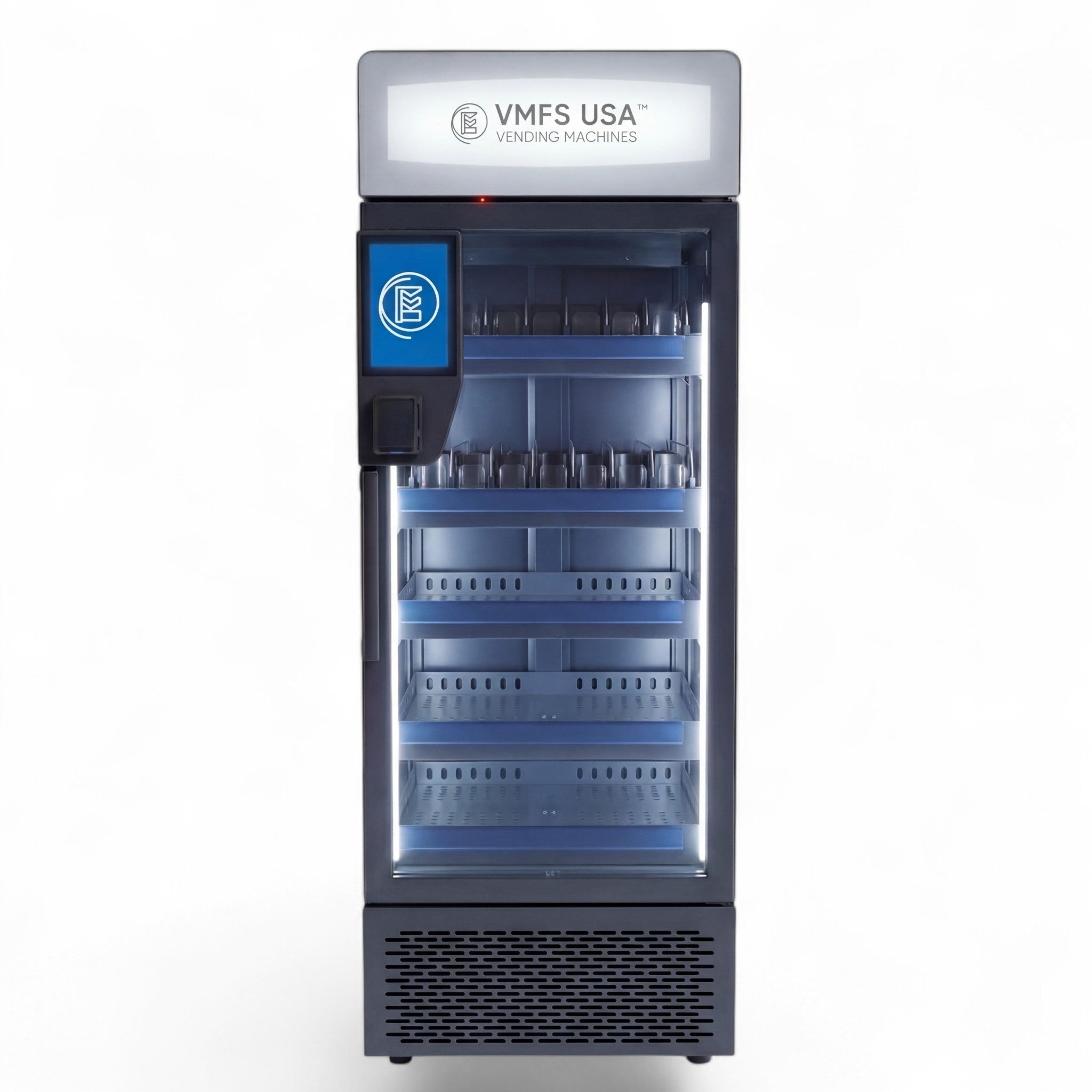
The VMFS Narcan Vending Machine is a secure, elevator-delivery cabinet built for naloxone kits and companion supplies, priced at $7,694 and sold as an active product on vmfsusa.com. It is configured before shipping for the program's funding model and access policy.
| Specification | VMFS Narcan Vending Machine |
|---|---|
| Price | $7,694 |
| Capacity | 72 adjustable slots, up to 600 products |
| Delivery | Soft-drop elevator with sensor-verified delivery; conveyor trays |
| Temperature | Ambient (no refrigeration) |
| Access models | Free vend, paid or mixed; optional QR code or ID scan |
| Payment options | Credit, debit, contactless, Apple Pay, Google Pay, bill and coin acceptors |
| Monitoring | VMFS Cloud inventory, status and usage; optional cellular data |
| Power | About 30W on a standard 110 to 120V outlet |
| Dimensions and weight | 31.5 in W x 39.2 in D x 72.2 in H; about 672 lbs |
| Build and security | Powder-coated, rust- and corrosion-resistant steel; triple anchor lock |
| Warranty and lead time | 1-year standard warranty; lead time confirmed at quote |
Tool-free adjustable trays let one machine carry naloxone boxes, test strips and other supplies of different sizes, and custom wraps let a health department or university brand the cabinet with clear instructions. Programs that want to pair naloxone with refrigerated over-the-counter products can compare the Pharmacy Vending Machine ($14,275), and the wider specialty vending machines collection covers other purpose-built cabinets. Hospital teams can also read our hospital vending machines guide, and campus teams our article on the benefits of vending machines in schools. If you are new to the equipment side, our overview of types of vending machines and the main range of vending machines are good starting points.
Plan a Narcan vending program
Tell us about your site, funding model and access policy, and the VMFS team will quote a configured machine.
Request a quote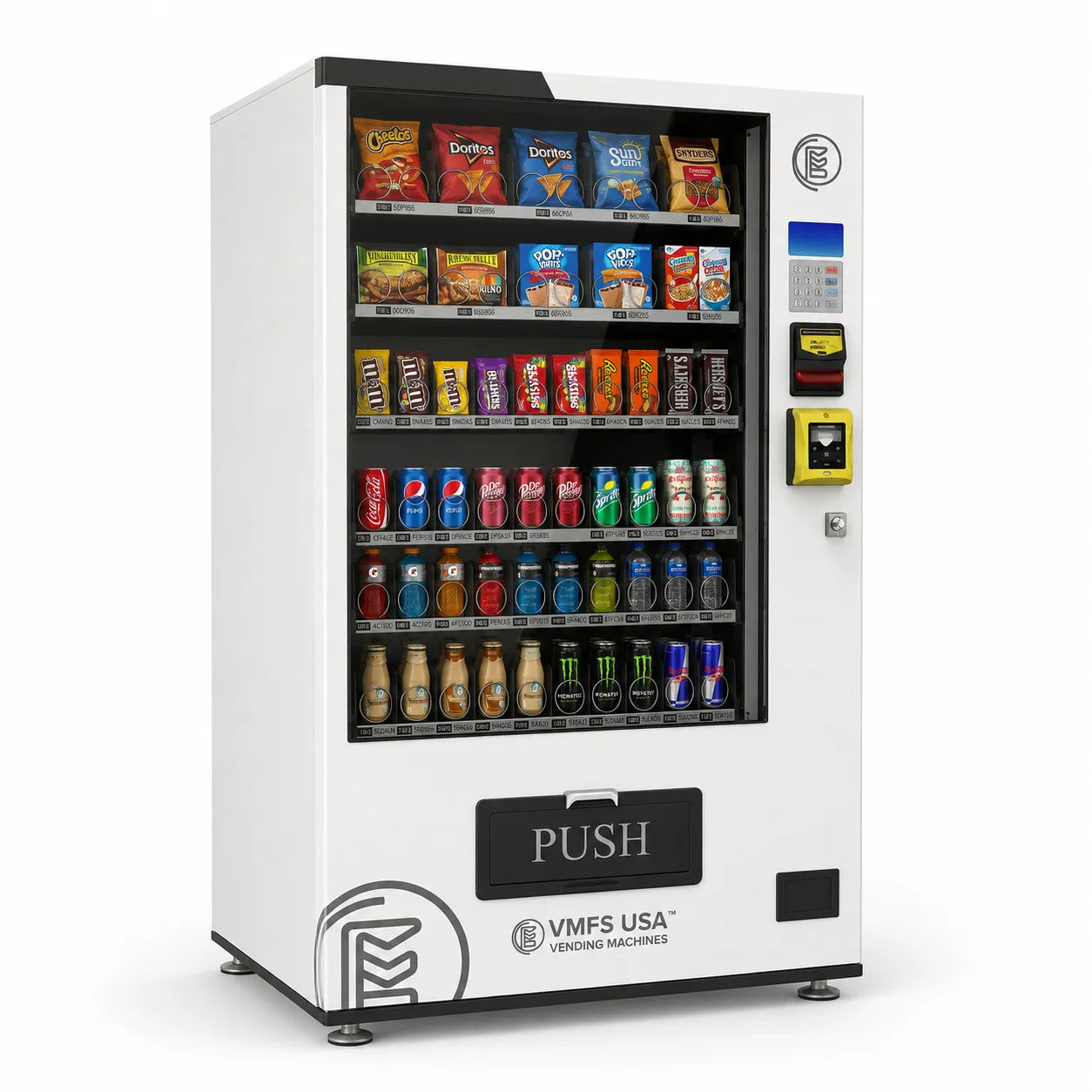
Share:
Vending Machine Cage Guide For Security And Damage Protection
How to Setup and Activate a Nayax Card Reader for Your Vending Machine