




Design the perfect vending solution for your location and customers.

Join the VMFS newsletter and step into a thriving network dedicated to collective success.
One signup. Endless possibilities.
No Alabama statute or ABC Board rule authorizes alcohol vending machines, and the rules that govern every sale of beer, wine and liquor, from accepted forms of ID to a 21+ person in charge, assume a licensee or its employee completes each sale. An unattended machine selling alcohol to the public does not fit Alabama law today.
This guide applies Alabama alcohol laws to vending: the Code sections and ABC rules that matter, how self-pour taps and hotel minibars fit, license types and fees, the official wet and dry county list, local zoning and Sunday rules, penalties and a step-by-step compliance checklist.
Not legal advice: This page summarizes the Code of Alabama, Alabama ABC Board administrative rules and ABC Board guidance as published in October 2026. Laws, rules and local ordinances change, so confirm your plan in writing with the Alabama ABC Board and a licensed Alabama attorney before you buy equipment or sign a placement agreement.
Not as a stand-alone, unattended business. Alabama has no license category for a machine that sells beer, wine or liquor, and every sale must be made by an ABC Board licensee on its licensed premises, with the age check and intoxication check that state law places on the licensee, its employees and agents. A vending company that owns a machine and places it in a host's building cannot hold the alcohol sale itself, and selling without the right license is a crime under Section 28-3A-25 of the Code of Alabama (Code of Alabama § 28-3A-25).
The law is also not a flat ban, which is why so much online advice contradicts itself. A search of the Code for vending provisions turns up an outright ban in Section 28-11-6.1 for tobacco and nicotine and in Section 28-12-46 for consumable hemp, which says hemp products "may not be sold using a vending machine or other self-service display and payment system" (Code of Alabama § 28-12-46). The alcohol chapters contain no equivalent sentence. The Legislature knows how to ban vending in so many words and has not done so for alcohol; instead, the ABC Board's operating rules make the unattended model unworkable.
That leaves one narrow question worth asking the ABC Board: can an existing licensee, such as a hotel, bar or private club, use a locked, staff-authorized dispensing unit inside its own licensed premises? Alabama already allows close cousins of that idea, including automatic liquor dispensing systems, locked in-room minibars for registered adult guests and card-activated self-pour taps after a staff ID check. None of them is a public vending machine, and each keeps a licensee in control of the sale.
| Setup | Fits Alabama law? | Why |
|---|---|---|
| Unattended alcohol machine in a lobby, gas station or public space | No | No licensee is present to check ID and intoxication; sales must occur inside a licensed premises |
| Vending operator selling alcohol from its own machine at a host's bar | No | The operator is not the licensee; unlicensed sales are a misdemeanor and the stock is contraband |
| Machine anywhere in a dry county outside a wet city | No | Alcohol sales are illegal there regardless of equipment |
| Licensee's locked unit, unlocked by staff after an ID check, inside its licensed premises | Possible; get written ABC approval | Mirrors staff-authorized self-pour and locked-minibar models |
| Non-alcoholic beer, mocktails or soda in a standard drink machine | Yes | No ABC license involved; normal vending licenses and sales tax apply |
If you are researching the national picture first, VMFS USA's guide to whether alcohol vending machines are legal across the United States explains why answers differ so much from state to state. The rest of this page stays on Alabama.
Alabama alcohol laws route every legal sale through the Alcoholic Beverage Control (ABC) Board, which licenses retailers, wholesalers and manufacturers under Title 28 of the Code of Alabama and writes the operating rules in Chapter 20-X of the Alabama Administrative Code. Alabama is also a control state for spirits: under ABC Rule 20-X-6-.04, retail licensees must buy any beverage containing distilled spirits, other than table wine, only from an ABC Board wholesale store (Ala. Admin. Code ch. 20-X-6).
Three layers decide whether a sale is lawful. The first is local option: a county or city must be "wet" before any license can be used there, and dry areas stay dry until voters change them. The second is the license itself, which is issued to a person or business for one physical location and one type of privilege, such as on-premises beer or off-premises table wine. The third is how the sale is conducted: who may handle the product, which IDs count, when sales may happen and where on the premises they take place.
The minimum age sits underneath all three. Section 28-1-5 makes it unlawful for anyone under 21 to attempt to purchase, purchase, consume, possess or transport alcohol in Alabama, and it limits what under-21 employees of a licensee may do: they may not handle, serve or dispense alcohol except in defined roles, and an adult representative of the licensee must be in attendance whenever they work (Code of Alabama § 28-1-5). The law expects a trained adult between the product and the customer, and that is the core problem for any vending concept.
The vending privilege license that every Alabama operator needs for snack and drink machines sits outside this system. It covers the business of running machines, not the right to sell alcohol, and it is explained in VMFS USA's guide to the vending machine license in Alabama. Holding it does not authorize a single alcohol sale.
An unattended machine fails Alabama law because several ABC rules require a human decision at the point of sale, not because one rule says "no vending." Read together, they describe a sale that a licensee's employee completes face to face, inside a licensed building, with an approved ID in hand.
| Requirement | Where it comes from | What it means for a machine |
|---|---|---|
| A designated person at least 21 must be present and in actual charge whenever the business is open | ABC Rule 20-X-6-.06 | A machine cannot be the business; a staffed licensee must be on site |
| A licensee, employee or agent may accept only four forms of proof of age | ABC Rule 20-X-6-.09(1)(d) | Valid driver's license of any state, U.S. uniformed service ID, passport, or state-issued photo ID with date of birth |
| No service to anyone who appears, under the totality of the circumstances, to be intoxicated | ABC Rules 20-X-6-.02(4) and 20-X-6-.14(1) | A scanner reads an ID but cannot judge intoxication |
| All sales and service must take place inside buildings on the licensed premises, with listed exceptions such as patios | ABC Rule 20-X-6-.01(14) | No exterior or sidewalk-facing alcohol machines |
| No beverage locker or storage service for customers' alcohol | ABC Rule 20-X-6-.01(11) | Rules out "smart locker" storage of patrons' bottles |
| No sale to anyone under 21; no unlicensed sales | Code § 28-3A-25(a)(3) and (a)(14) | Liability lands on whoever sells, licensed or not |
The ID rule is the one most vending pitches skip. Rule 20-X-6-.09 frames age verification as something a licensee, employee or agent does, and the ABC Board's newer rules for remote sales keep a person in the loop: when a licensee sells through a drive-up or walk-up window or by curbside pickup, an employee must check one of the approved IDs before handing over beer or wine (Ala. Admin. Code ch. 20-X-6). Liquor cannot be sold through those exterior windows at all.
The intoxication rule creates a second gap that technology does not close. Even a machine with flawless age verification confirms only that a document matches a face and a birth date. It cannot decide that a 35-year-old customer has had too much, and the rule makes that a refusal duty for every sale.
Watch for this in sales pitches: claims that Alabama "allows alcohol vending with an ID scanner" or that "the ABC Board must approve your machine" describe processes we could not find in the Code or the ABC rules. There is no machine approval program in either; the question is always whether a licensee's sale complies.
Alabama does allow some automation, as long as the licensee stays in control of who gets the drink. Three existing models show where the line sits, and any alcohol dispensing unit you propose to the ABC Board should look more like these than like a public vending machine.
The ABC rules expressly recognize automated pouring for liquor licensees. Rules 20-X-6-.03 and 20-X-6-.04 limit a licensee to one open bottle of each brand per serving station, "provided however" that licensees may dispense from a pre-mix dispenser or "from an automatic dispensing system." That language covers metered liquor systems that bartenders operate. It does not mention customers operating the system themselves.
Self-pour taps operate in Alabama under a staff-controlled model. When The Plains Taproom opened in Auburn in 2023, WTVM reported that staff scan each customer's ID and credit card and issue a pour card, and that customers hit a two-drink limit, 32 ounces of beer or 10 ounces of wine, before a staff member must re-authorize them (WTVM). The limits are that venue's practice, not a state formula, but the structure is the point: a person checks ID and sobriety before any pour is unlocked, and again at intervals.
Other ABC rules show how cautious the Board is about customer self-service. Wine sold in approved to-go containers must come from a dispenser that is "not within reach of a customer," with every container filled and sealed by the licensee or an employee at the point of sale. Draft beer growlers may be filled only by the licensee or employees who are 21 or older, only at the time of an in-person sale, and a licensee "shall not allow a consumer to fill or refill a container" (Rules 20-X-6-.18 and 20-X-6-.20). Off-site winery tasting rooms are told outright: "No self-service permitted" (Ala. Admin. Code ch. 20-X-5).
The closest thing to vending that Alabama already regulates is the hotel minibar. Rule 20-X-6-.17 lets lodging licensees with retail liquor privileges stock alcohol for registered guests 21 or older in storage cabinets inside private rooms. Each cabinet must be locked, the key or combination may go only to the registered guest responsible for the room, the sale is deemed to occur when that key or combination is used, all containers must be unopened, and the licensee must pull the alcohol if it believes the guest is letting minors drink from the cabinet.
That rule is the best template for a hotel-lobby or guest-floor proposal. A unit that unlocks only for a registered adult guest whose ID the front desk has checked, with unopened containers and a licensee who controls access codes, tracks the minibar rule far more closely than a card-reader machine open to anyone in the building. It is still a proposal to put to the ABC Board, not a right.
The license belongs to the business that sells the alcohol, so a hotel, bar, club or store needs the ABC retail license that matches what it sells and where it is consumed. A dispensing unit does not get its own license. These are the state fees the ABC Board lists for the retail licenses most relevant to a machine placement (ABC Board license types and fees):
| ABC license (type code) | Typical use | Annual state fee |
|---|---|---|
| 010 Lounge Retail Liquor, Class I | Bars and lounges serving liquor, wine and beer on premises | $300 |
| 020 Restaurant Retail Liquor | Hotels, restaurants and dinner theaters serving on premises | $300 |
| 031 Club Liquor, Class I | Private clubs serving members and guests | $300 |
| 032 Club Liquor, Class II | Private clubs, Class II | $750 |
| 040 Retail Beer (on or off premises) | Beer for drinking on site or to go | $150 |
| 050 Retail Beer (off premises only) | Packaged beer to go | $150 |
| 060 Retail Table Wine (on or off premises) | Wine for drinking on site or to go | $150 |
| 070 Retail Table Wine (off premises only) | Packaged wine to go | $150 |
| 140 Special Events Retail | Licensed events | $150 |
| 150 / 160 Special Retail | 30 days or less / more than 30 days | $100 / $250 |
The fees above are set by statute in Section 28-3A-21, which also lets counties and cities where alcohol sales are permitted levy their own license taxes on ABC-licensed businesses (Code of Alabama § 28-3A-21). Budget for both layers, plus a $50 filing fee per license that the ABC Board collects at application.
The ABC Board's pre-application checklist (Form LCD-2) lists the documents a retail applicant must bring, and several of them matter for a vending-style project (ABC Board Form LCD-2). The applicant must prove control of the property with a lease, deed or use agreement in its exact name and address, with a lease term of at least one year for an annual license. It must provide a letter of approval from the local governing authority naming the license type, a state sales tax license, federal tax ID documentation and a liquor liability insurance certificate showing at least $100,000 in coverage. Background checks run through the Alabama Law Enforcement Agency for anyone with a 10% or greater interest, and on-premises applicants add a health permit and an architectural rendering or sketch of the proposed licensed premises.
That sketch is where a dispensing unit should appear. If a licensee plans to install one, showing it on the premises drawing and describing how staff control it gives the local ABC division office something concrete to approve or reject. The ordinary vending licenses still apply to the business that owns the machine, as covered in VMFS USA's national overview of vending machine permits in the United States.
Alcohol sales in Alabama are legal in 44 of the state's 67 counties countywide, and in the other 23 only inside specific wet cities. The ABC Board's wet cities list marks every dry county as "Dry - Contains Wet Cities," so no county is dry from border to border, but outside the named cities no alcohol can be sold (ABC Board wet cities list). Section 28-3A-25(a)(13) makes selling alcohol in a dry county, except in wet municipalities or as otherwise authorized, a misdemeanor.
| Dry county | Wet cities listed by the ABC Board |
|---|---|
| Bibb | Brent, Centreville, West Blockton, Woodstock |
| Blount | Blountsville, Hayden, Oneonta, Cleveland, Snead, Susan Moore |
| Cherokee | Cedar Bluff, Centre, Leesburg, Cherokee Ridge |
| Clarke | Grove Hill, Jackson, Thomasville |
| Clay | Ashland, Lineville |
| Coffee | Elba, Enterprise, New Brockton |
| Cullman | Cullman, Good Hope, Hanceville |
| DeKalb | Collinsville, Henagar, Fort Payne, Rainsville, Mentone, Sylvania |
| Fayette | Fayette |
| Franklin | Russellville |
| Geneva | Geneva, Samson, Slocomb, Hartford |
| Jackson | Bridgeport, Scottsboro, Stevenson, Hollywood |
| Lamar | Sulligent |
| Lauderdale | Rogersville, Florence, St. Florian, Lexington, Killen |
| Lawrence | Moulton, Town Creek |
| Limestone | Athens |
| Marion | Guin, Haleyville, Hackleburg, Hamilton, Winfield |
| Marshall | Albertville, Arab, Boaz, Guntersville, Grant |
| Monroe | Frisco City, Monroeville |
| Morgan | Decatur, Hartselle, Priceville, Trinity |
| Pickens | Aliceville, Reform, Carrollton |
| Walker | Jasper, Cordova, Dora, Sumiton |
| Winston | Haleyville, Double Springs |
The other 44 counties, including Jefferson, Madison, Mobile, Montgomery, Tuscaloosa, Baldwin, Shelby and Lee, are listed as wet. Earlier versions of this guide named some dry counties' wet cities incompletely, so rely on the ABC Board list, and check it again before you commit, because the map moves. Under Section 28-2A-1, any city of 1,000 or more people can switch from dry to wet, or back, through a municipal option election triggered by a petition signed by 30 percent of the voters in the last general city election, and at least 720 days must pass between such elections (Code of Alabama § 28-2A-1).
City limits matter more than the county name. The Alabama League of Municipalities notes an Attorney General opinion that land a wet city annexes inside a dry county generally stays dry, with a separate referendum process for larger cities, so a site with a wet-city mailing address can still sit in dry territory (Alabama League of Municipalities). Confirm the exact parcel with the city clerk and the ABC division office.
Local government decides much of where and when alcohol can be sold in a wet area, so zoning and city approval come before any equipment purchase. According to the Alabama League of Municipalities, lounge, restaurant and club liquor licenses require the consent of the city's governing body, while retail beer and table wine licenses do not need that consent but remain subject to the city's zoning and police-power ordinances, and Class 1 and Class 2 cities must consent to every ABC license issued within them (Alabama League of Municipalities). In practice the ABC Board's application checklist asks retail applicants for a local approval letter either way.
Alabama has no single statewide buffer that keeps every retail alcohol license a set distance from churches and schools. The League explains that some municipalities have adopted ordinances barring alcohol establishments within a minimum distance of churches or schools, giving 500 feet as an example, and that courts have upheld them and refused to grandfather existing businesses inside the distance. It also lists violating such a distance ordinance, improper zoning and traffic problems as valid reasons for a city to deny consent. The only state-level siting language in the ABC rules we reviewed is narrower: patio and pool-area service must not be "readily visible from a church or school premises." Ask the zoning office for the exact rule at your address and measure before signing a lease.
Can you buy alcohol on Sunday in Alabama? Only where local law allows it. Section 28-3A-25(a)(19) makes it unlawful to sell or serve alcohol for consumption on or off the premises in any cafe, restaurant, hotel dining room or other public place on Sunday after 2 a.m., unless a local act or Section 28-3-25 authorizes it. Section 28-3-25 lets a wet county commission or a wet city's governing body permit Sunday sales by resolution or ordinance, or put the question to a referendum (Code of Alabama § 28-3-25). That is why Sunday alcohol sales in Alabama vary by county and city.
Weekday closing times are local too. The League cites an Alabama Supreme Court decision holding that a municipality may regulate the hours of alcohol sales by ordinance, so "what time can you buy alcohol in Alabama" has a different answer in Birmingham than in a small town. Any dispensing unit must stay locked during hours when its licensee cannot sell, and a unit that keeps dispensing after closing time puts the license at risk, so ask the supplier exactly how a unit is disabled outside legal hours before you buy.
The realistic options in Alabama all keep an ABC licensee in charge of the sale, so the vending operator's role shifts from seller to equipment supplier, or to a different product. These are the models worth evaluating, from most to least alcohol exposure.
Licensee-owned locked unit
A bar, club or hotel buys the unit, stocks it under its own license and unlocks it only after staff check ID and sobriety. Get written ABC sign-off first.
Guest-only hotel access
A lodging licensee restricts access to registered guests 21+, following the locked-minibar rule's logic for keys, unopened containers and minors.
Staff-authorized self-pour
Tap walls that unlock only on a staff-issued card after an ID check, with pour limits and re-authorization.
Non-alcoholic drinks
Non-alcoholic beer, mocktails, craft soda and energy drinks in standard drink machines, with no ABC license at all.
Alcohol vending in other states
Alabama-based operators can place alcohol machines where another state's law allows age-verified sales.
The licensee-owned model changes the business relationship more than most operators expect. Alabama law ties alcohol privileges to the licensed business, and the ABC application screens anyone with a 10% or greater interest in the applicant. A vending company that takes a share of each alcohol sale starts to look like a participant in the license, so structure any deal as an equipment sale, lease or service agreement and have an Alabama attorney review it. Revenue-share contracts that work for snack routes do not transfer cleanly to alcohol.
Non-alcoholic drinks are the easiest legal path and often the better business. Drink vending machines stocked with non-alcoholic beer and mocktails can go into the same hotels, gyms and apartment buildings without ABC involvement. For true alcohol vending, compare how other states handle it: VMFS USA explains how to run a beer can vending machine in Florida and in New York.
Licensee-controlled dispensing in Alabama
Limits to plan around
Compare alcohol vending hardware
Refrigerated beer, wine and bottled-drink machines with age verification support, for licensed venues and states that allow age-verified sales.
View alcohol vending machinesHardware matters only after the legal model is settled, and in Alabama the right machine is one a licensee can lock, unlock and audit. Any unit you propose should support staff-controlled release, ID capture, a reliable way to disable sales outside legal hours and transaction logs the licensee can produce on request; ABC Rule 20-X-6-.04 already requires retail licensees to keep purchase receipts for three years.
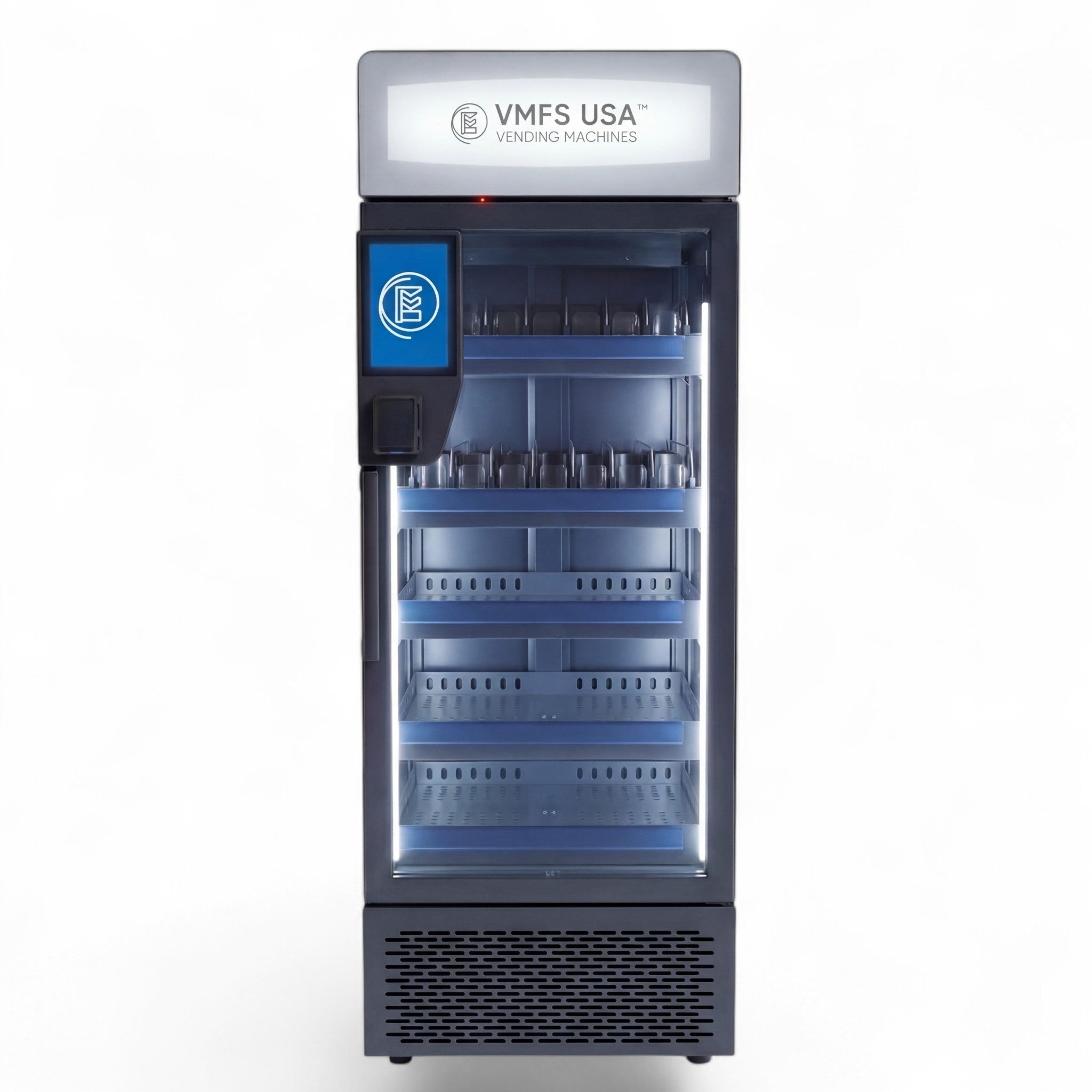
VMFS USA's alcohol vending machines include four refrigerated models with elevator delivery:
| Model | Built for | Age verification | Price |
|---|---|---|---|
| ChillDrop Vending Machine | Adult-only venues; large touchscreen | Integrated | $7,975 |
| Alcohol Drinks Vending Machine | Bottled alcoholic drinks; remote monitoring | Integrated | $10,950 |
| Beer Can Vending Machine | Canned beer in stadiums, bars and event spaces | Supported | $12,450 |
| Wine Vending Machine | Wine and champagne bottles; precise temperature control | Supported | $12,950 |
The ChillDrop and the Beer Can model also appear among VMFS USA's beer vending machines. Age-check options range from ID scanning to facial matching and staff unlock; the age verification methods page compares them, and the wider range of age verification vending machines includes models for other restricted products. In Alabama, configure staff unlock as the final step, because the ABC rules put the ID and sobriety decision on a person.
Telemetry is where an Alabama licensee gets the most record-keeping value. VMFS Cloud works with every VMFS machine; plans start at $7.99 per machine per month. The Basic plan includes live inventory and slot stock, real-time sales and fault and low-stock alerts, which gives a licensee a transaction history to produce when an ABC agent asks for records. Its optional ID scanning can be scheduled by day and time for other products, but for alcohol in Alabama, keep the ID and sobriety check with staff on every sale.
Product descriptions written for multiple states may describe "unattended" alcohol sales. That language reflects states that allow age-verified vending; it does not change the Alabama analysis above. If your route spans several states, VMFS USA's location matching service can help you find hosts where the model you want is legal.
Selling alcohol without the right license, selling to anyone under 21 or selling in dry territory is a misdemeanor in Alabama, and the alcohol itself can be confiscated. Section 28-3A-25(b)(1) sets a fine of $100 to $1,000 for violations of subdivisions (a)(1) through (a)(17), with up to six months in jail available at the court's discretion on a first conviction, three to six months on a second and six to 12 months on a third or later conviction, in addition to the fine (Code of Alabama § 28-3A-25).
| Violation under § 28-3A-25(a) | Typical vending scenario | Consequence |
|---|---|---|
| (3) Selling, delivering or furnishing alcohol to anyone under 21 | Machine accepts a borrowed or fake ID | Misdemeanor; $100–$1,000 fine; jail possible |
| (13) Selling in a dry county outside wet municipalities | Unit placed in unincorporated dry territory | Misdemeanor; $100–$1,000 fine; jail possible |
| (14) Selling or possessing for sale without a proper license | Vending operator stocks alcohol in its own machine | Misdemeanor; alcohol is contraband subject to confiscation |
| (16) Selling alcohol on which Alabama taxes were not paid | Stock bought outside the licensed supply chain | Misdemeanor; $100–$1,000 fine; jail possible |
For a licensed host, the bigger risk is administrative. The ABC Board has full authority to suspend or revoke any license it issues, and Rule 20-X-6-.01 holds licensees accountable for criminal conduct allowed on any part of the licensed premises. A single underage sale through a poorly controlled unit can cost a hotel or bar the license that supports its whole beverage program, which is why most Alabama venues will want staff unlock, logs and written ABC approval before they agree to any dispensing equipment.
The same caution applies to other age-restricted products. Alabama has gone further for nicotine than for alcohol: the Alabama vape ban prohibits tobacco, vape and nicotine pouch vending machines outright, even in 21+ venues.
Work through these steps in order before you buy an alcohol dispensing unit or sign an agreement with an Alabama venue. Each step reflects the Code of Alabama, ABC rules and ABC Board guidance described above.
If your Alabama plan does not involve alcohol, most of this list drops away. Snack, drink and combo vending machines need only the normal registration, sales tax and local license steps covered in VMFS USA's guide on how to start a vending machine business in Alabama.
Need age-verified machines for a licensed venue?
Compare machines with ID scanning and staff-unlock options for alcohol and other age-restricted products.
Browse age verification machines
Share:
Alabama Vape Ban: Are Vape and Zyn Vending Machines Legal?
How Many Vending Machines Are Needed To Make $100K A Year