




Design the perfect vending solution for your location and customers.

Join the VMFS newsletter and step into a thriving network dedicated to collective success.
One signup. Endless possibilities.
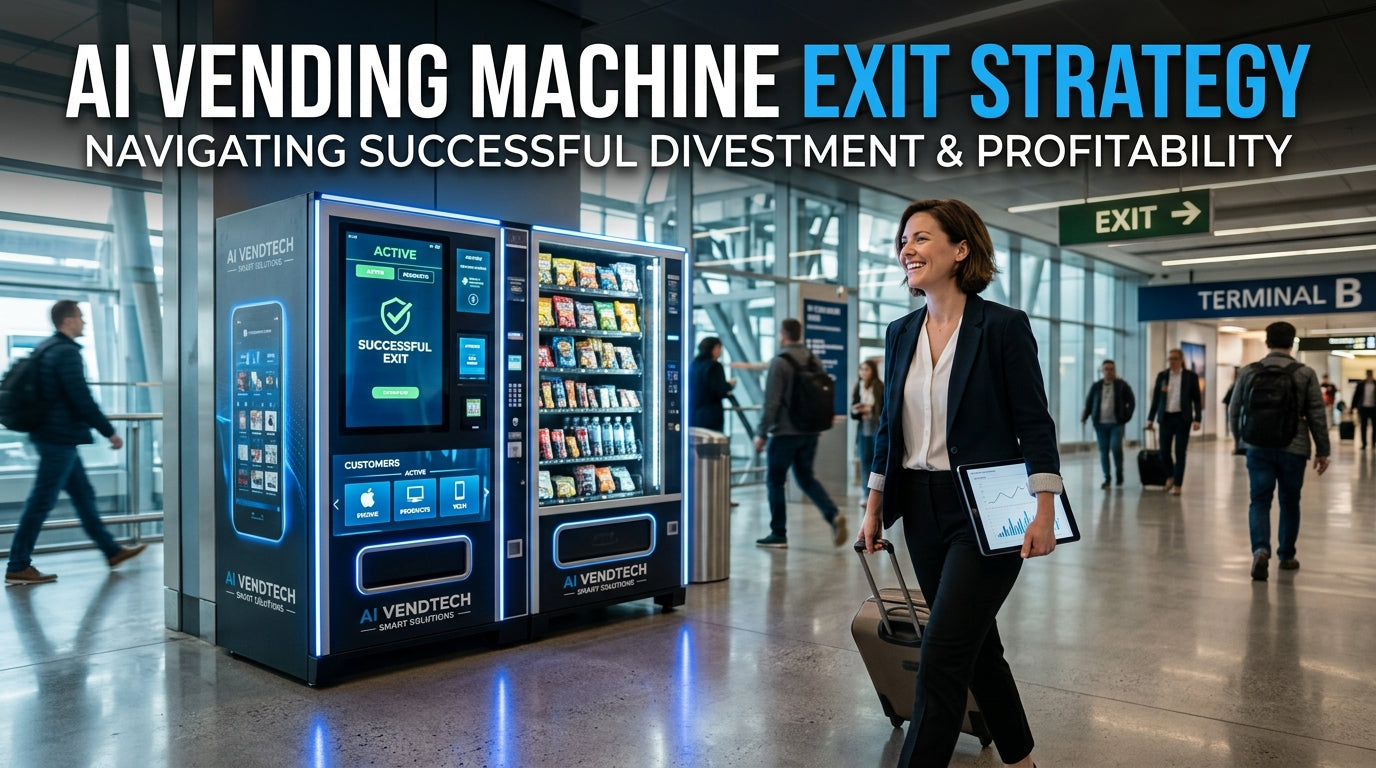
An AI vending machine exit strategy is the plan for eventually selling a route — the collection of machines, locations, and placement agreements an operator has built — for a return that reflects its actual earning power, not just the resale value of the equipment. Vending routes typically sell for a multiple of annual net profit, commonly 2x to 4x, and AI-equipped routes increasingly command a premium over legacy coin-op routes because buyers can verify sales history through the machine's cloud dashboard instead of relying on the seller's self-reported numbers. Planning an exit early, well before an actual sale is imminent, materially affects the final valuation, since clean documentation and stable placement agreements are what separate a route that sells quickly from one that sits on the market.
This guide covers how vending route valuation actually works, what buyers scrutinize during due diligence, the sale process itself, and the mistakes that most commonly reduce a route's final sale price.
Table of Contents
A vending route's sale value is shaped by decisions made years before any listing goes up, because buyers pay for demonstrated stability — consistent net profit, long remaining terms on placement agreements, and clean sales records — not for potential. An operator who treats every placement contract, financial record, and maintenance log as something a future buyer might scrutinize tends to build a materially more sellable business than one who runs the same route purely for monthly cash flow. This applies whether the eventual exit is a full sale, a partial sale of select machines, or simply the operator's own retirement timeline.
Most small vending route sales price using a multiple of Seller's Discretionary Earnings, or SDE — net profit plus the owner's own compensation and any non-recurring expenses added back — because SDE reflects what a new owner could realistically extract from the business each year. Vending routes typically trade at 2x to 4x annual SDE, with stronger multiples going to routes with long-term placement agreements, diversified locations, and machines under five years old.
An asset-based approach values the route primarily on the depreciated worth of the machines themselves, largely ignoring location value and earnings history, and typically produces a lower number than an earnings-based approach for any route with performing locations. This method applies mainly to distressed sales or routes with weak, short-term placement agreements where future earnings can't be reliably projected.
| Valuation Method | Basis | Best Fit For |
|---|---|---|
| SDE multiple | 2x – 4x annual discretionary earnings | Stable, profitable routes |
| Asset-based | Depreciated machine value | Distressed or short-term-contract routes |
| Per-machine comparable sale | Recent similar-machine sale prices | Single-machine or small-lot sales |
AI vending machines generate a verifiable, timestamped sales and inventory history through their cloud dashboard, which lets a buyer confirm revenue claims directly rather than relying on bank statements or the seller's own bookkeeping alone. This transparency reduces a buyer's perceived risk, which in practice supports a stronger multiple than an equivalent legacy route with only manual sales logs — a dynamic rooted in the same real-time reporting covered in How AI-Powered Vending Machines Optimize Sales. A seller preparing to exit should export and organize at least 12 to 24 months of this dashboard data well before listing the route, since gaps or inconsistencies in the record raise buyer suspicion regardless of the underlying business's actual performance.
A serious buyer verifies the remaining term and transferability of every placement agreement first, because a route with strong historical earnings but only six months left on its site contracts carries substantially more risk than the sales numbers alone suggest. They'll also review machine age and maintenance history, since aging refrigeration compressors and sensor hardware represent near-term capital expenditure a buyer has to price into their offer — the component-level factors worth documenting are covered in AI Vending Machine Parts Breakdown. Finally, buyers check whether placement agreements are assignable to a new owner without requiring the property owner's separate approval, since a non-assignable contract can effectively void a location's value the moment ownership changes.
Compile 24 to 36 months of profit and loss statements, machine-level sales exports, placement agreements, and maintenance logs into a single due diligence package before approaching any buyer, since a disorganized seller signals a disorganized business regardless of the underlying numbers.
A business broker or accountant experienced in small business sales can calculate SDE accurately and benchmark the route against comparable recent sales, providing a defensible asking price rather than a number pulled from general industry multiples alone.
Existing vending operators looking to expand their route, first-time buyers seeking an established cash-flowing business, and in some cases the property owners hosting the machines themselves are the three most common buyer categories, each with different priorities during negotiation.
Offering a short transition period — 30 to 60 days of seller support introducing the buyer to each location contact — is a common deal term that reduces buyer risk around relationship continuity and can materially help close a sale at the asking price.
Selling a route as a single package typically achieves a higher aggregate price than selling machines individually, because a buyer acquiring an entire operating business — with existing relationships and cash flow already proven — pays a premium over a buyer purchasing standalone equipment with no attached location. Individual machine sales make more sense when only a subset of a route is underperforming or the operator wants to retain the strongest locations while divesting weaker ones, a distinction that connects directly to the location-quality analysis in AI Vending Machine Location Data and Case Study: Finding the Sweet Spot.
Whole-Route Sale
Higher aggregate sale price for a proven, cash-flowing operation.
Single transaction and buyer relationship to manage.
Requires stronger documentation and due diligence readiness upfront.
Individual Machine Sales
Flexibility to divest underperforming locations while keeping strong ones.
Faster to execute for a single machine than a full business sale.
Lower total return compared to selling as an operating business.
A route where most placement agreements have lapsed into informal, month-to-month arrangements looks materially riskier to a buyer than one with two or three years remaining on written terms, even if actual location performance is identical. Renewing agreements before listing the route for sale is one of the highest-leverage moves a seller can make in the months leading up to an exit.
Commingled bank accounts and undocumented cash transactions make it difficult for a buyer or their accountant to verify true SDE, and the resulting uncertainty typically gets priced into a lower offer rather than resolved in the seller's favor.
Skipping routine maintenance in the final year before a sale can temporarily boost reported profit but tends to backfire during buyer inspection, since visible wear or documented service gaps on refrigeration and sensor hardware get discounted directly from the offer. The component reliability factors a buyer will scrutinize are the same ones covered in AI Vending Machine Parts Breakdown, and comparing pre-made versus custom equipment life expectancy is useful context from AI Vending Machine Payback: Pre-Made vs. Custom Build.
Build a Route Worth Exiting Well
Start with AI vending machines that generate the verifiable data buyers look for.
Explore AI Vending Machines
Share:
AI Vending Machine Franchise Opportunities: What to Know Before Investing
AI Vending Machine Manufacturers in the USA: How to Evaluate One