



Design the perfect vending solution for your location and customers.

Sales, inventory and alerts for your whole route, from one machine to a fleet.
Answer a few questions about your location, products and budget and get a shortlist.
Estimate revenue, payback period and margin before you buy.
Sales, setup help, warranty and parts from the VMFS USA team.
Join the VMFS newsletter and step into a thriving network dedicated to collective success.
One signup. Endless possibilities.
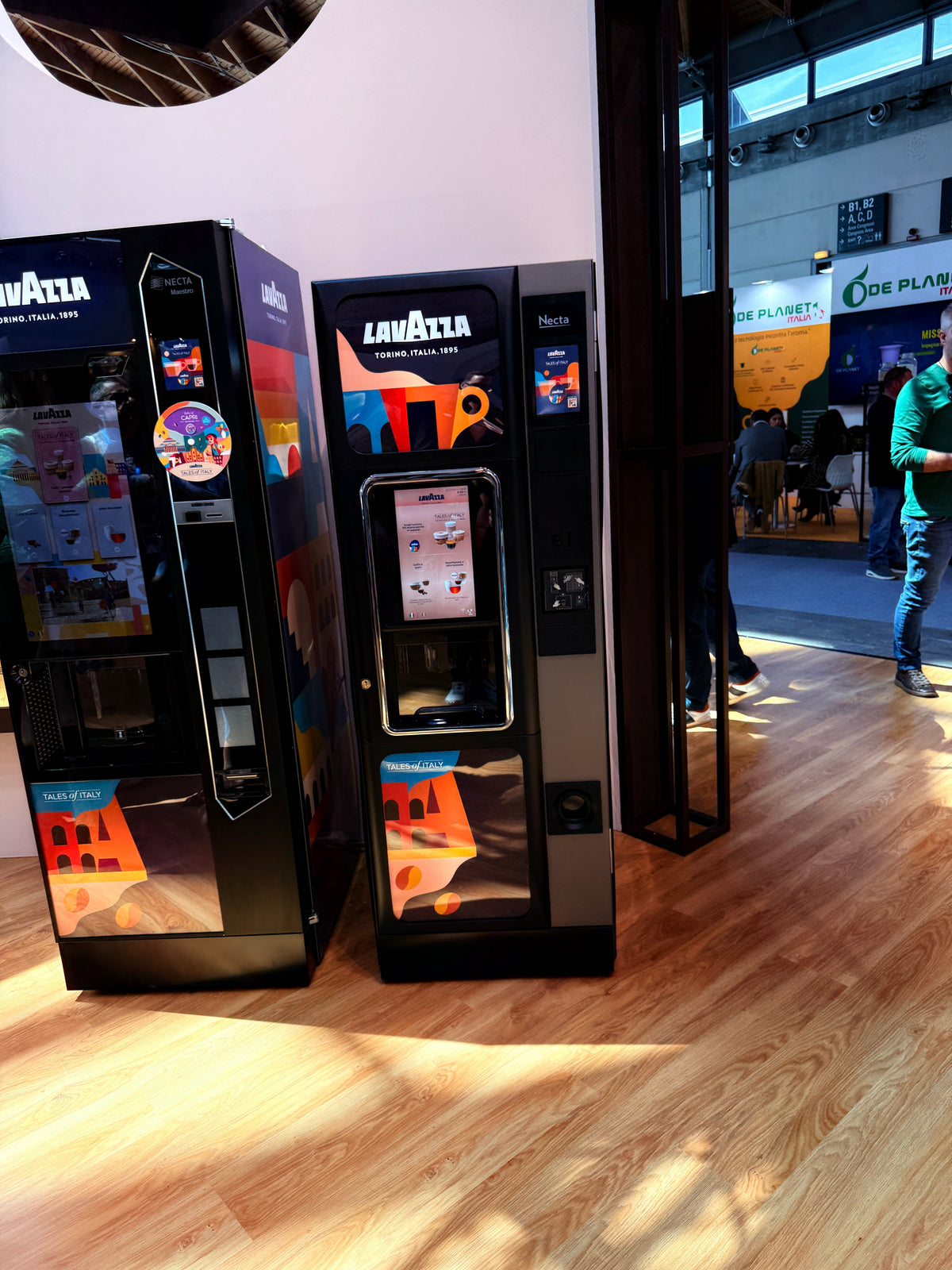
We went to Venditalia to look at machines. We came home thinking about menus.
Venditalia runs every two years in Italy and it is the largest vending exhibition in the world, which means three days walking past hardware finished better than most of what sits in American break rooms. Quiet grinders. Brew groups that come out in seconds.
And then somewhere in the second hall you stop looking at the engineering and start reading the screens, and you notice that every machine on the floor offers roughly the same eight drinks. Espresso. Lungo. Cappuccino. Macchiato. Small cups, short pours, no ice, nothing over six ounces.
That is not a limitation. It is one shared national coffee culture and seventy years of machines built precisely for it. An Italian manufacturer can safely assume the drink.
We flew home to a country where you cannot assume anything, and where the same assumption made quietly by an operator is the reason a machine sits half used for a year. What follows is the map we use instead: nine American regions, what they actually drink, and what each one does to the settings before a machine ships.

American coffee culture was never standardized, because it never arrived once. It arrived in waves, and each wave landed somewhere specific and stayed there.
Cuban espresso came ashore through Tampa and Miami with the cigar industry. Chicory took hold in New Orleans during a wartime blockade, when the roasted root stretched a short coffee supply, and it stayed long after the shortage ended because people had come to prefer the taste. Diner drip and the bottomless cup grew out of the industrial Northeast, where coffee was fuel served by the pot. Italian espresso landed in Seattle in the 1970s and mutated on its way down the coast into something with syrup in it. Mexican cafe de olla came north through Texas and never went anywhere.
None of those waves replaced the one before. They stacked, geographically, and they are still stacked today. Which is why the phrase coffee vending machine describes a piece of equipment and tells you almost nothing about what belongs inside it.
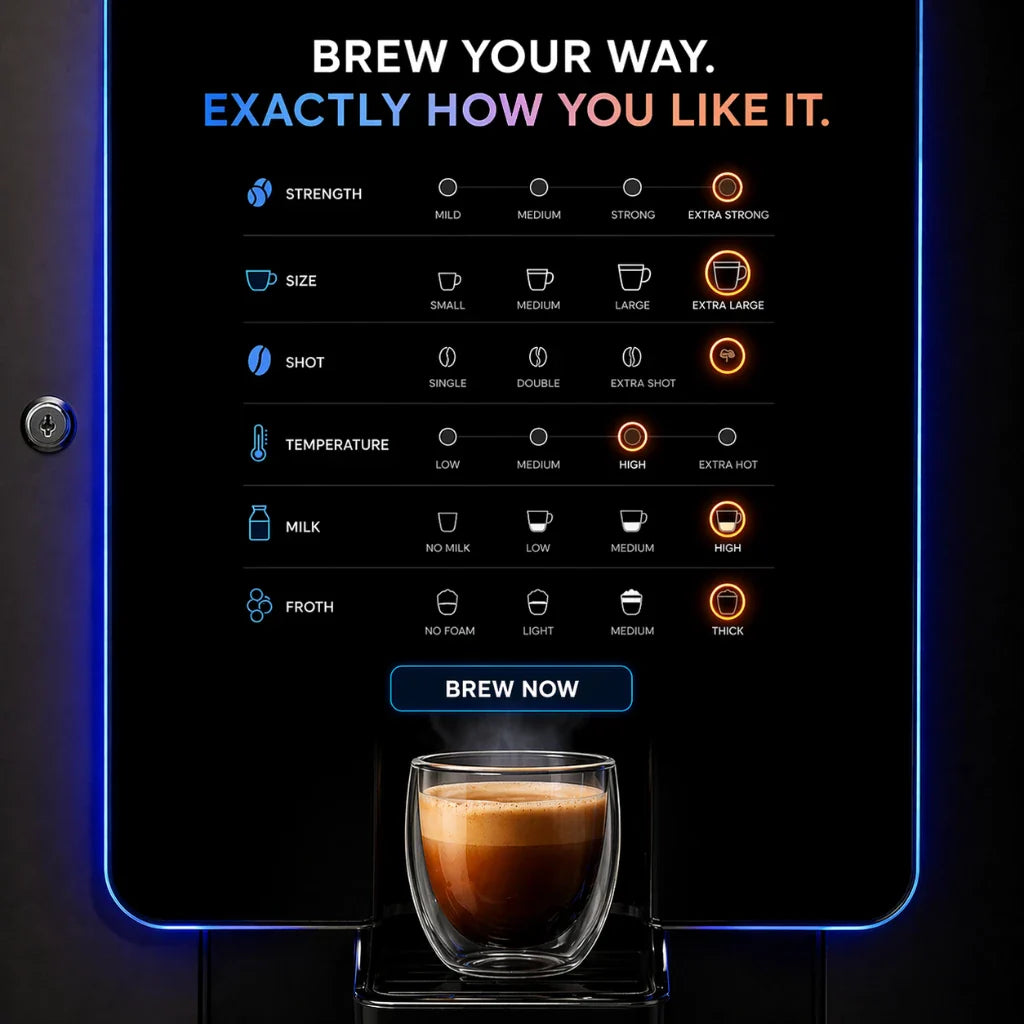
The good news is that regional coffee preferences are a settings problem, not a hardware problem. Every unit in our coffee vending machine lineup grinds whole beans on demand and pushes hot water through them under pressure. That process is regionally neutral. It makes an excellent cortadito and an excellent 20 ounce sweet iced coffee with total indifference. What changes between them is the recipe file, the sugar and milk dosing, the default cup size, and whether the machine needs a chilled path at all.
Nine in ten underperforming coffee placements we get called about are configuration problems wearing a location costume.
Region oneStart here, because it is our home market and because it breaks the most rules.
Walk into a warehouse break room in Hialeah at ten in the morning and the thing you notice is that nobody is drinking alone. Someone bought a colada, it came with a sleeve of thimble cups, and it is making its way around the floor. That is the unit of consumption here. Not a cup, a round.
The rest follows from that. The cortadito is espresso cut with steamed milk. The cafe con leche carries the morning. And the espuma, the whipped sugar and espresso paste that gives Cuban coffee its caramel colored crown, is not a garnish. A cafecito without it is a failed cafecito, and people will tell you so.
What that does to a machine is specific and slightly counterintuitive. You want a short, dense extraction rather than a long pour. Sugar dosing has to run well above any national default, which is the single most common thing we correct on a machine that shipped configured for a generic US menu. The milk canister carries more weight per drink than the bean canister. And because the ritual is social and repeated, one person may hit the machine three times a day, so cycle speed and a low unit price beat a high margin single serve every time.
Every year an operator expands into Massachusetts with a hot only cabinet, and every year it goes the same way.
New England drinks iced coffee in February. This is not a minority habit or a mild seasonal overlap. Across large parts of Massachusetts, Rhode Island, and Connecticut it is the default order, and the temperature outside has very little to do with it. Ask for a "regular" here and you will be handed cream and sugar already in it, which is worth knowing before you name a button on a screen.
The style is drip forward rather than espresso forward. Large cup, medium roast, sweetened by default, consumed by volume instead of in small ceremonial servings. This is also the most price sensitive coffee buyer in the country, because a national chain trained the entire region on a specific price point and people will do the arithmetic standing in front of your machine.
On routes through Boston, Providence, Worcester, or the Hartford corridor, pairing a hot unit with an iced coffee vending machine almost always outperforms deploying two hot units into the same square footage. Hospitals, universities, municipal buildings, and older manufacturing sites are where it lands hardest.
The New York coffee buyer is not evaluating your crema. They are evaluating how long this is going to take, because four people are standing behind them and everyone has somewhere to be.
Bodega coffee set that baseline decades ago: fast, hot, "light and sweet" spoken as a single word, in a paper cup, at a price nobody has to think about. The standard survived the specialty boom intact, because the two things serve different moments. The specialty shop is a decision you make. The bodega cup is a reflex. Vending competes for the reflex, and it competes on seconds.
Philadelphia, Baltimore, and the DC corridor behave similarly with more espresso weight from dense office employment. The whole region also has a genuine second peak around three in the afternoon that most operators never build into a restock schedule, and it is usually the difference between a machine that runs dry on Thursday and one that does not.
Office tower and hotel lobbies are the prize here, and they are exactly the placements where a large screen earns twice, once as a menu and once as an advertising surface through the advertising network. The coffee and hot beverage vending machine is the floor standing unit built for that job.
Across Georgia, the Carolinas, Alabama, Tennessee, and most of the Gulf, sweet iced coffee occupies the same psychological slot as a soda. It is cold, it is sweet, it gets bought two or three times a day, and it is not attached to a morning ritual with a fixed hour.
For an operator that is quietly excellent news, because soft drink behavior is the most machine friendly behavior that exists. It is impulsive, it repeats, and it requires no planning from the customer.
Louisiana keeps its own tradition on top of the regional one. Chicory coffee and cafe au lait came out of scarcity and stayed out of preference, and offering a chicory option anywhere near New Orleans or the river parishes reads as a local signal rather than a novelty.
Worth saying plainly: your competition here is sweet tea, not other coffee. A machine that also pours a proper iced tea captures a customer you were losing to the fridge anyway.
From Houston through San Antonio, El Paso, Phoenix, and Albuquerque, cold is not a seasonal upgrade. It is the base configuration for most of the calendar, and hot drinks are the exception you build around it.
Sitting on top of that is a Mexican coffee tradition that national menus ignore almost entirely. Cafe de olla is brewed with piloncillo and cinnamon, and it trains a palate that expects sweet, spiced, and aromatic rather than bitter and black. Horchata sits right beside it as the reference point for what a cold sweet drink should taste like. A cinnamon forward option in San Antonio speaks the local language in a way that a plain latte does not.
There is a physical consideration operators from cooler states forget. Ambient temperature affects both machine and product, and an uninsulated warehouse in Phoenix in August is nothing a Chicago break room will ever present. Raise it during site assessment, not after the first service call.
Chicago, Detroit, Cleveland, Minneapolis, and the industrial corridor between them buy coffee the way they buy most things. Steadily, in quantity, without ceremony. Drip forward, large cup, flavored creamer, and a real appetite for sweetened options. Hot chocolate is not a novelty from October through March, it is a revenue line. Tea holds genuine share rather than existing as a courtesy.
The feature that defines this region operationally is shift work. A plant running three shifts peaks at six in the morning, again at two, and again at ten at night, and the machine has to survive all three between service visits. That makes servings per fill the number that matters most, ahead of how many recipes the screen can display.
This is where the high capacity end of the lineup earns its price. The Pro coffee vending machine is built for the heaviest daily cup counts, and at large facilities a micro market beside it covers the food that a three shift workforce actually needs.
Denver, Boise, Salt Lake City, and the Front Range office parks carry a specialty literacy imported from the coast, with one local variation that catches out operators who have never worked the region.
In parts of Utah and Idaho, a meaningful share of the workforce does not drink coffee at all. That is not a footnote when you are building a menu. It is potentially a third of the building. In those placements the hot chocolate, herbal tea, and steamed milk options are not filler at the bottom of the screen, they are the only route you have to customers a coffee only machine will never serve.
The rest of the region skews americano and drip, with an outdoor culture that produces a strong early peak and a light afternoon. The compact end of the lineup usually fits better than a floor standing unit.
Seattle, Portland, and the Bay Area are the only places in the country where your beans are being actively evaluated. People here will notice a stale bean, ask where it came from, and form an opinion about your roast before they form one about your machine.
You do not beat that audience on convenience. You beat it by making quality visible, and the strongest asset a bean to cup machine has here is the grinder itself. Put the machine where people can hear it run, source from a specialty roaster rather than a commodity blend, and say so on the screen. Lead with flat white, cortado, and espresso.
One honest constraint while we are here. Plant milk demand is higher in this region than anywhere else in the country, and vending milk systems are powder based. Plant based powder options exist and support varies by unit, so confirm what your specific build handles rather than assuming. We would much rather set that expectation now than have you walk it back with a property manager in month two.
Los Angeles, Orange County, and San Diego combine year round cold demand with a buyer who reads a label before a price. Cold brew and iced latte lead. Sweetness runs noticeably lower than in the South or Texas, and "less sweet" functions as a positive product attribute here rather than as a compromise.
Studios, logistics facilities, hospitals, universities, and the enormous coworking market are all live placements. Because the buyer is health conscious, a machine that lets someone control sugar level and milk ratio per drink is doing real commercial work. Surface that on the first screen instead of burying it three taps deep in a settings menu.
| Region | Menu weight | Cold path | Typical fit |
|---|---|---|---|
| South Florida and Latin metros | Small, sweet, espresso based | Useful | Countertop or CorePro |
| New England and Northeast | Large drip, iced year round | Essential | Iced plus hot unit |
| New York and Mid Atlantic | Fast drip, light and sweet | Seasonal | Floor standing flagship |
| South and Gulf | Sweet iced, tea, chicory | Essential | Iced unit or combo |
| Texas and Southwest | Iced, sweet and spiced | Essential | Iced unit |
| Midwest | Large drip, hot chocolate | Seasonal | High capacity Pro |
| Mountain West | Americano plus non coffee | Optional | Countertop or tabletop |
| Northwest and Bay | Espresso, flat white, cortado | Moderate | Premium countertop or CorePro |
| Southern California | Cold brew, lower sweetness | Essential | Iced unit |
If your placement does not sit cleanly on a row, build around your own numbers. The coffee vending machine system builder prices a configuration as you set volume, drink mix, footprint, and payment options, and the ROI calculator runs the payback first.
Regional coffee preferences get you to a strong starting menu. They do not get you to the right one, because a hospital and a warehouse in the same zip code will disagree with each other and both will be correct.
Load exactly what the region says and resist customizing past it. You need a clean baseline, and a menu tuned on a hunch produces numbers you cannot read a month later.
Pull per drink counts from the dashboard instead of asking anyone what they like. Stated preference and machine data disagree constantly. The drink someone describes and the button they press at 7:40 in the morning are frequently different drinks.
Find your worst performing selection and replace it with a variant of your best. If cappuccino is carrying the machine, add a larger or stronger cappuccino rather than reaching for a mocha.
Change price on one drink at a time so you can attribute the result to something. Push it remotely rather than driving out, then leave the configuration alone for a full month so the data means something.
The snack side of a combo placement runs the same loop through the plannogram tool. Payment mix is worth settling in the same window, since card, contactless, mobile wallet, and cash acceptance are configurable per placement rather than fixed. Details sit on the payment system page.

Reading a region correctly only pays if the machine reaches the right building, with the right agreement behind it, and enough visibility that people find it. Each of those is a separate piece of work rather than something folded into the price of a cabinet.
VPlaced handles location scouting and site matching, which is where everything above turns practical: putting the menu you built into a building whose traffic actually wants it. VAdviced covers placement agreements and the permit requirements that shift from state to state and sometimes city to city. VMarketed handles the launch push and the campaign artwork that ends up on the wrap. A VMFS Cloud subscription is what makes the thirty day test possible in the first place, since the whole method depends on reading per drink data without driving to the site.
They change the configuration more than the cabinet. The one hardware decision regional taste genuinely drives is the chilled path. In New England, the South, Texas, the Southwest, and Southern California, cold demand is large enough that a hot only machine loses money every day it runs. Everywhere else it affects recipes, dosing, and cup sizing, all of which are settings.
Espresso and americano as the base, cappuccino and latte for volume, hot chocolate for the people who do not drink coffee, and at least two teas. Then apply the regional adjustments above before it ships.
For any site with daily repeat traffic, yes. Fresh grinding is what turns a machine into a habit, and habit is the entire economic model of a coffee placement. It also removes recurring pod cost from your unit economics. Pods make sense for genuinely low volume sites only.
In stock machines ship in 7 to 21 days. Configured or wrapped builds run longer depending on the specification. What is ready to move now sits in the in stock collection, and support terms are on the warranty page.
Walking an Italian trade show as an American operator is humbling for about an hour. Then it flips, because the thing that country has and we do not is uniformity, and uniformity turns out not to be the prize. Nine sets of regional coffee preferences inside one set of borders is not a problem to be flattened into a national default. It is nine separate chances to be the machine that finally gets it right in a building where every previous machine served something nobody asked for.
Start with the region. Then the building. Then the cabinet.
We map the recipe list, canister layout, and cup sizing to your region during configuration, before it ships.
Build your configuration Browse coffee machines

Share:
How Does a Smart Combo Vending Machine Work? Step-by-Step Guide
When to Upgrade to a Custom Vending Machine: Signs Your Business Has Outgrown Standard Equipment