


Design the perfect vending solution for your location and customers.

Join the VMFS newsletter and step into a thriving network dedicated to collective success.
One signup. Endless possibilities.
Brands & Retail | Branded Vending | By the VMFS USA Team | September 2026
Think about what a brand actually buys when it buys retail distribution. You pay to be listed. You pay for the position. You accept the planogram somebody else drew. You sit beside three competitors chosen by the retailer, at a price the retailer sets, and at the end of it you receive a sales report rather than a customer.
Then one quarter the category gets reviewed, your facings drop from four to two, and there is nothing you can do about it.
We keep coming back to one simple point about branded vending machines, and it is about ownership. A machine is the only retail space a brand can own outright. There is no rent to pay, no listing to negotiate, and no shelf to share.
Every advantage of this format follows from that one fact.
Where this comes from: we supply branded and custom vending machines to brands across the United States, from wrapped standard units to machines built to a full specification with our manufacturing partners.

Share of shelf is one of the most important numbers for any retail team. A strong brand in a competitive category might hold fifteen or twenty percent of the facings, and it has to defend that share every year.
In your own machine you hold all of it. There is no competitor adjacency, no private label sitting beneath you at a lower price, no end cap somebody else bought. The customer arrives, and the only decision available is which of your products to buy.
Because of this, several things that are hard or impossible in retail become simple:
The way we would put it to a brand team: in somebody else's store you are a supplier. In your own machine you are the retailer. This is a real change in your position in the value chain, and it comes with the retail margin that position normally carries.
Data is often the benefit that interests brand teams most, even though it is rarely the reason they first ask about a machine.
Sell through a retailer and you receive aggregated sell out data, weeks late, at whatever granularity they choose to share. You do not know what time of day your product sells. You do not know what else that customer considered. You do not know whether a price change moved anything, because you did not make the price change.
A machine connected to a monitoring service such as VMFS Cloud records every transaction as it happens:
We have seen brands justify an entire machine program on the research value alone and treat the revenue as a secondary benefit. Machines in three contrasting locations work as a permanent, always-on test environment. They can cost less than a single round of conventional market research, and they record what people actually buy rather than what they say they would buy.

Work out roughly what a brand spends on out of home advertising in a single city for a month. Then consider that a branded machine stands in a location you choose, lit and seen by everybody who passes, for as long as you own it.
The difference is that a billboard costs money every month and returns impressions. A machine is a one time purchase plus servicing, and it returns impressions, revenue and data. That makes it a strong alternative to paid outdoor advertising.
1. Reaching places retail cannot go.
Office lobbies, gyms, campuses, hospitals, hotels, studios and industrial sites have no shop and never will. There is no shelf to buy in any of them. A vending machine is the only way a brand reaches those people at the moment they want the product. For many categories, that is the strongest reason to invest.
2. Product launches and sampling.
Getting a new product into national retail is slow, expensive and frequently refused. A machine puts it in front of real buyers immediately, generates genuine purchase data, and gives you something concrete to take into the buyer meeting. Proving demand before asking for a listing is a considerably stronger position than asking first.
3. Events, pop ups and activations.
A machine is a self-contained retail unit that arrives on a truck, needs a power outlet and sells without staffing. Compared with a temporary retail space plus fit out plus staff, the machine usually costs far less, and it keeps working after the event ends.
4. Flagship and brand experience.
Some brands build machines that people visit on purpose, where the purchase is an experience rather than a simple transaction. These machines use custom shapes, unusual dispensing, lighting, sound and screen content to create a moment people want to record and share.
5. Internal and employee facing.
This use gets less attention than it deserves. Companies place branded machines inside their own buildings to dispense uniforms, safety equipment, IT accessories or company merchandise. Access can be controlled, each item can be tracked to the person who took it, and a stocked cabinet replaces a storeroom that someone has to staff.
6. Franchise and dealer extension.
A branded machine extends a location's trading hours to 24 hours a day, or puts the brand in satellite sites too small for a full outlet. For a franchise system, it adds coverage without opening new outlets.

Most brands assume branded vending means a vinyl wrap on a standard machine. A wrap is the entry level rather than the limit, so it is worth understanding the full range before you decide what you need.
| Level | What it involves | Typical use |
|---|---|---|
| Wrap | Full surface graphics on a standard machine | Fast rollouts, events, testing the concept |
| Finish and color | Painted cabinet matched to the brand color, custom trim and lighting | Permanent placements where a wrap looks temporary |
| Interface | Custom screen design, brand content, your own product imagery and flow | Anywhere the buying moment is part of the brand |
| Configuration | Shelving, lane sizing and mechanism chosen around your actual product | Products that do not fit a standard coil |
| Built to specification | Form factor, dimensions, dispensing method and materials designed around the brief | Flagship, experience and anything genuinely unusual |
That fourth row matters more than brands expect. Many products do not vend from a standard coil, and the right answer is usually to change the mechanism rather than the packaging:
If an AI vending machine suits your product, you can build your AI vending machine online and see each configuration option and its price. For any other format, describe your brief on our custom vending machine page and our team will reply with options.
Brand teams almost always benchmark a machine against the wrong thing. The instinct is to compare it against doing nothing, which makes any capital outlay look like a cost. The useful comparison is against the alternatives you are actually choosing between.
| Retail listing | Pop up or kiosk | Your own machine | |
|---|---|---|---|
| Cost structure | Ongoing, plus margin given away | Rent plus fit out plus staff | One capital purchase, then servicing |
| Share of space | A fraction of a category | All of it, temporarily | All of it, permanently |
| Price control | Suggested only | Full | Full, changed remotely |
| Customer data | Aggregated and delayed | Yours, for the duration | Every transaction, continuously |
| Staffing | None | Every opening hour | Restocking only |
| Trading hours | Store hours | Staffed hours | Whenever the building is open |
| Ends when | A buyer decides | The lease does | You decide |
Look at the last row, because it is the one brand teams feel most sharply in practice. A retail listing ends when somebody else reviews the category. A pop up ends when the lease does. A machine ends when you decide it should, and until then it is an asset on your balance sheet rather than an expense on somebody else's terms.
There is a second point buried in the cost row. With a retail listing you hand over margin on every unit, forever. With a machine, you pay for the equipment once, cover the servicing, and keep the full retail margin on everything you sell through it. Over a few years, that changes the numbers considerably, and it is the part most often left out of the business case.
This is not the right move for every brand, and we would rather say so than sell a machine that ends up in a corridor nobody uses.
We handle the equipment side of all of that, from a single wrapped unit to a fully specified build and a multi site rollout. Every machine we supply is new. You can compare our vending machines for sale to find a starting point, plan a larger rollout through our commercial vending solutions, or request a quote with your brief for a specific proposal.
Site sourcing runs through VPlaced. Once the machine is live, VMarketed explains how to market a branded vending machine, including the screen content customers see, and you can list your machine on VendingFinder so nearby customers can find it.
Because it is the only retail space a brand can own outright. You hold every facing, set the actual price, control the full range, cannot be delisted, and receive every transaction as data. It also reaches locations that have no shop at all, which for many categories is the strongest reason on its own.
Considerably further than most brands assume. Beyond graphics, you can specify cabinet finish and color, lighting, the screen interface and content, shelving and lane configuration, the dispensing mechanism itself, and for flagship projects the form factor and dimensions. Wrapping a standard machine is the entry point rather than the limit.
That is usually a mechanism question rather than a packaging one. Fragile or premium items suit elevator delivery, large or awkward products suit locker compartments, and chilled or frozen goods change the cabinet specification. Changing the machine is almost always better than redesigning the product around a standard coil.
Not planning who restocks it. Brands focus on design and placement and then discover nobody owns the day-to-day operation. The machine then sits empty and hurts the brand instead of helping it. Settle servicing before installation, whether in-house or through an operator partner.
As a pilot, yes. As a channel, no. A single unit tells you whether the format works for your product, but the data and the economics both improve substantially across a handful of contrasting locations, because comparing an office against a gym against a campus is where the useful learning sits.
Own Your Shelf Space Instead Of Renting It
We supply branded and fully custom vending machines to brands across the United States, from a wrapped unit to a fully specified build. Send us the product, the audience and the location and we will tell you what is possible.
Build A Custom Vending Machine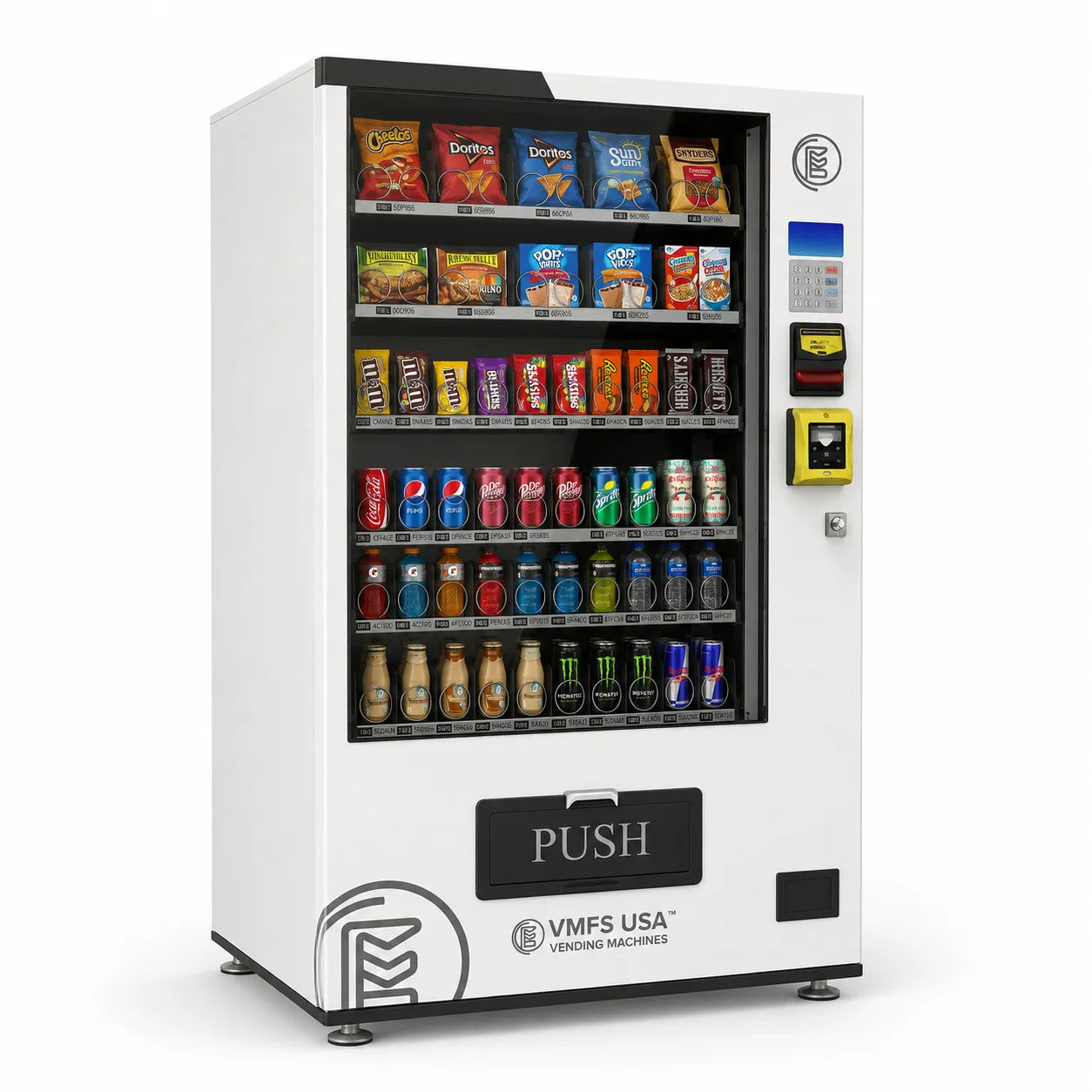
Share:
140 Billion Drinks Containers a Year. This Machine Makes None of Them.
Hot Swappable Vending Machine Parts: The VMFS USA Development Program