



Design the perfect vending solution for your location and customers.

Sales, inventory and alerts for your whole route, from one machine to a fleet.
Answer a few questions about your location, products and budget and get a shortlist.
Estimate revenue, payback period and margin before you buy.
Sales, setup help, warranty and parts from the VMFS USA team.
Join the VMFS newsletter and step into a thriving network dedicated to collective success.
One signup. Endless possibilities.
Machines & Economics | Water Refill Vending | By the VMFS USA Team | September 2026
Every drinks machine in America has the same hidden cost built into it. You buy a bottle of water, you drink it in four minutes, and then a piece of plastic that took resources to manufacture and will outlive everybody reading this goes into a bin. Multiply that by every machine on every route in the country and it is a genuinely uncomfortable number.
We came across a machine that removes the bottle from the transaction entirely, and the more we looked at it the more we thought the interesting part is not the environmental argument, obvious as that is.
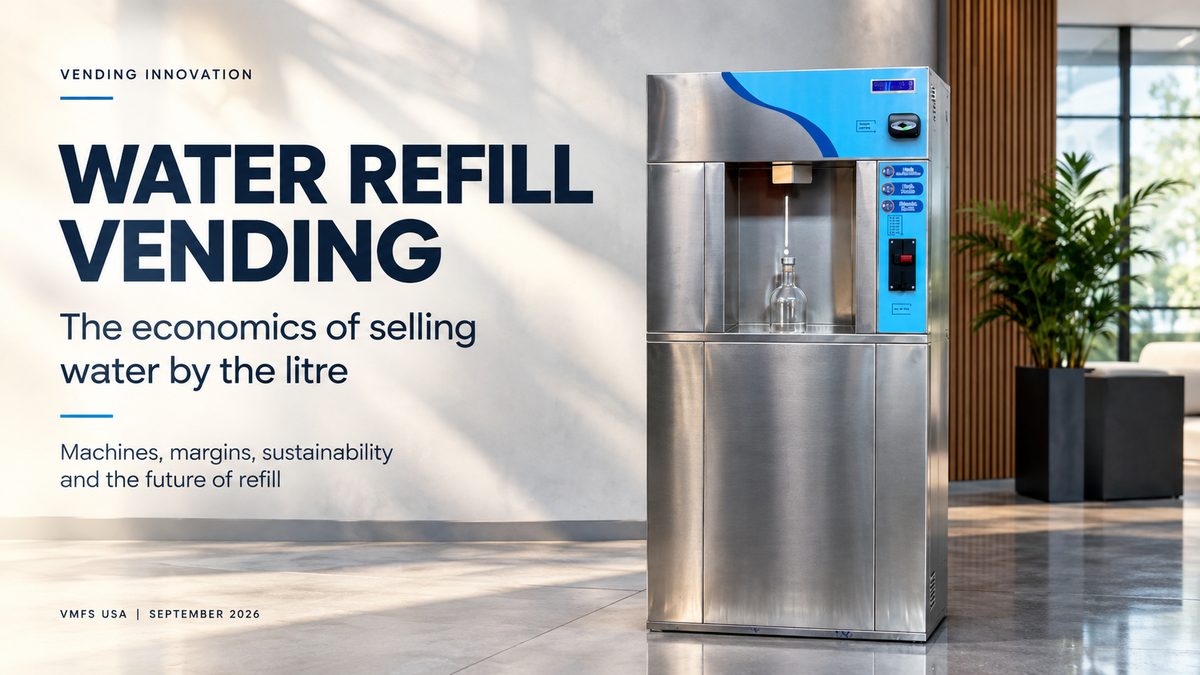
It is that you are no longer selling a product at all. You are selling water, by the litre, from a tap. Your inventory is a municipal supply line, and that changes the economics of a vending machine more fundamentally than anything else we have written about this year.
We have pilot units running on this format in the United States, and this is what we are learning.
Where this comes from: we supply and operate vending machines across the United States and run pilot programmes across several formats. The photographs here are our own from the show floor.

Stop and consider what this does to the operating model, because it inverts almost everything that makes vending difficult.
Every other machine we supply has the same fundamental structure. You buy product, you transport product, you load product, you sell product, you go back and do it again. Almost every operational headache in this industry traces back to that loop. A refill machine simply does not have it.
The structural point: in every other category your margin is the gap between what you paid for a thing and what somebody pays you for it. Here there is barely a thing to have paid for. What you are actually selling is filtration, refrigeration and convenience, and your business is a service business wearing a vending machine's clothes.
That has a consequence worth stating plainly. The route economics on this format are unlike anything else we handle, because a service visit is about maintenance rather than replenishment. You are not driving out because the machine is empty. You are driving out on a schedule you set, which is a materially calmer way to run a route.
Mechanically this is closer to a small water treatment plant than to a vending machine, and the parts that matter are the ones you cannot see.

It is worth putting a figure on the problem, because the scale is larger than most people in this industry realise and it is not only a plastic story.
Published research on US beverage packaging puts the number of drinks containers wasted nationally at more than 140 billion a year. Roughly 74 billion of those are plastic bottles, more than 50 billion are cans, and around 15 billion are glass. That works out at over 400 containers per person per year, which is more than one per person per day.
The cans deserve particular attention, because there is a widespread assumption that aluminium is fine since it gets recycled. Industry data shows the recycling rate for aluminium beverage cans has fallen to around 43 percent, its lowest in decades, against a long term average closer to 52 percent. In 2023 the industry recycled more than 46 billion cans and threw away more than 61 billion, which is roughly fifteen twelve packs per person, and represents close to 1.2 billion dollars of aluminium going into landfill every year.
EPA figures on beverage container recycling put the picture plainly:
| Container | Recycling rate | What that means |
|---|---|---|
| Aluminium cans | Around 43 to 50 percent | The best of the three, and roughly half still discarded |
| Glass bottles | Around 40 percent | Heavy to transport and low scrap value |
| Plastic PET bottles | Around 20 to 29 percent | The most common drinks container and the least recovered |
| Refill into a reusable bottle | No container produced | Nothing to recycle, because nothing was made |
That final row is the entire argument. Every other line on that table is a debate about how much of a container gets recovered after the fact. A refill machine does not produce one, which means the recycling rate is not a number you have to improve, it is a question that does not arise.
There is a second point specific to vending that is worth operators understanding. A meaningful share of that waste comes from drinks consumed away from home, precisely because kerbside recycling programmes cannot reach a can bought and drunk in a corridor. Vending machines sit squarely in that category, which means our industry contributes disproportionately to the problem and is unusually well placed to do something visible about it.
We are wary of leaning on sustainability language in copy, because it is frequently decoration. Here it is not decoration, it is the commercial mechanism, and it works in a specific and useful way.
A great many organisations now have a stated environmental commitment and very few tangible ways to demonstrate it. Universities, hospitals, corporate campuses, municipalities and increasingly office landlords all have targets on paper and a shortage of visible actions to point at.
A refill machine is a physical, countable, photographable thing that reduces single use plastic on their site. Some units will even display a running count of bottles avoided, which is precisely the sort of number that ends up in an annual report.
Which changes who you are talking to and what you are offering:
Positioning that properly is work in itself, and it sits alongside the wider healthy vending proposition rather than competing with it. Our colleagues at VMarketed build those pitches.
An objection worth addressing directly, because operators raise it immediately. Does a refill machine cannibalise your bottled water sales?
Somewhat, and considerably less than you would expect, because the customers are largely different people. Somebody carrying a reusable bottle has already decided not to buy packaged water. They were never your bottled water customer, they were somebody walking past your machine to find a drinking fountain.
In practice we see these working best beside a conventional drinks machine rather than instead of one. The refill unit captures the reusable bottle crowd and satisfies the venue's environmental position, while the machine next to it continues selling everything a refill unit cannot. If you already run something from the drinks vending machine range at a site, adding a refill unit beside it is frequently the strongest configuration.
This format trades one set of problems for another, and the second set is less familiar to most operators.
That first point deserves emphasis because it reshapes your whole approach. Placement for this format is not about foot traffic, it is about which sites can physically accept the machine, and that is a much shorter list. Our partners at VPlaced screen for it specifically.

We are running these privately rather than listing the format broadly, for the same reason we pilot every category. Refill vending is well established in parts of Europe, where bottled water pricing, tap water attitudes and municipal supply all differ from here. Almost none of that transfers cleanly.
What we are measuring across the pilot sites:
Three things have already altered how we talk to operators about this format.
Our position, plainly: refill vending is a genuinely good format in a narrower set of sites than its advocates suggest. We would rather tell an operator that a location cannot take one than sell a machine that needs plumbing nobody costed. The pilots exist so that advice is based on evidence rather than enthusiasm.
Establish the plumbing before anything else, because it determines whether a site exists at all. Then work out what the free alternative on that site is, so you know what you are actually selling. Then sort the water quality and testing requirements before switching on rather than after.
On our side, everything sits in the shop, and what is ready to move now is in in stock units, which typically ship within 7 to 21 days with a one year parts warranty. If a site needs a configuration outside the standard builds, tell us early rather than late.
Once a machine is live, listing it on VendingFinder is worth doing, because people carrying empty bottles genuinely search for somewhere to fill them.
We are also still adding pilot locations, particularly campuses, gyms and sites with existing sustainability commitments. If that describes somewhere you operate, we would like to hear from you.
It connects to the mains supply, filters the water through several stages, and dispenses a metered volume into the customer's own bottle when they pay. Better units offer chilled still, chilled sparkling and ambient filtered, priced by the amount dispensed rather than by the unit.
The margin structure is unusual because your product cost is negligible and there is no stock, no expiry and no waste. Against that, ticket values are low so you depend on repeat volume, and filters plus servicing are the real running cost. It works well at high frequency sites and poorly at occasional ones.
Yes, and this is the format's main constraint. A mains water connection and a drain are required, which is a considerably harder ask than a power outlet and usually involves a plumber and building approval. It is the first thing to establish about any prospective site.
Less than operators expect, because the audiences differ. Somebody carrying a reusable bottle had already decided not to buy packaged water. In practice a refill unit beside a conventional drinks machine tends to be the strongest configuration, capturing a customer the other machine was never reaching.
Because it is a visible, countable environmental action that generates revenue instead of consuming budget. Universities, hospitals and corporate campuses frequently have sustainability commitments and few tangible ways to demonstrate them, which makes this an easier conversation than an ordinary vending pitch.
A Machine That Never Runs Out
We have refill pilots running across the country and we are learning what American sites actually need from this format. Tell us about your location and whether it can take plumbing.
Visit the Shop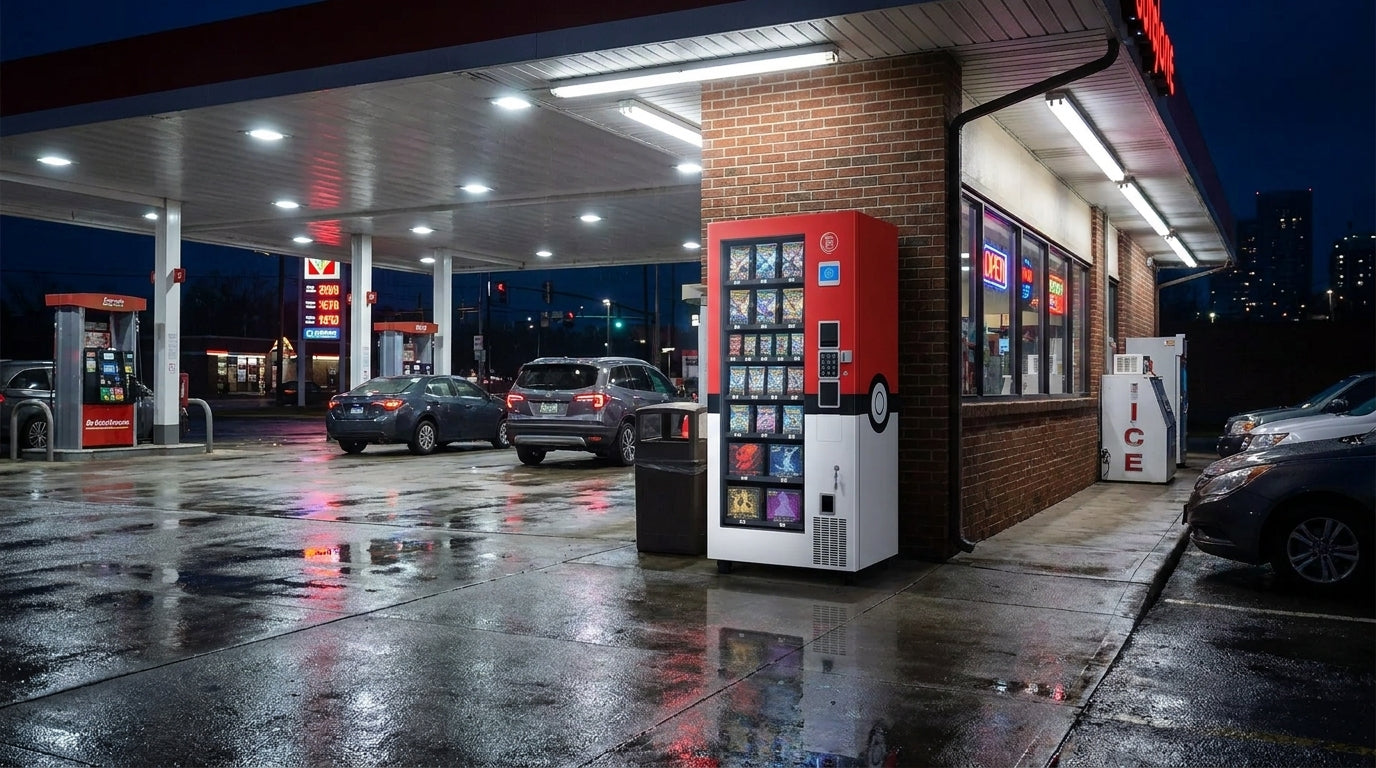
Share:
Do Pokemon Vending Machines Stop Selling at Night?