




Design the perfect vending solution for your location and customers.

Join the VMFS newsletter and step into a thriving network dedicated to collective success.
One signup. Endless possibilities.
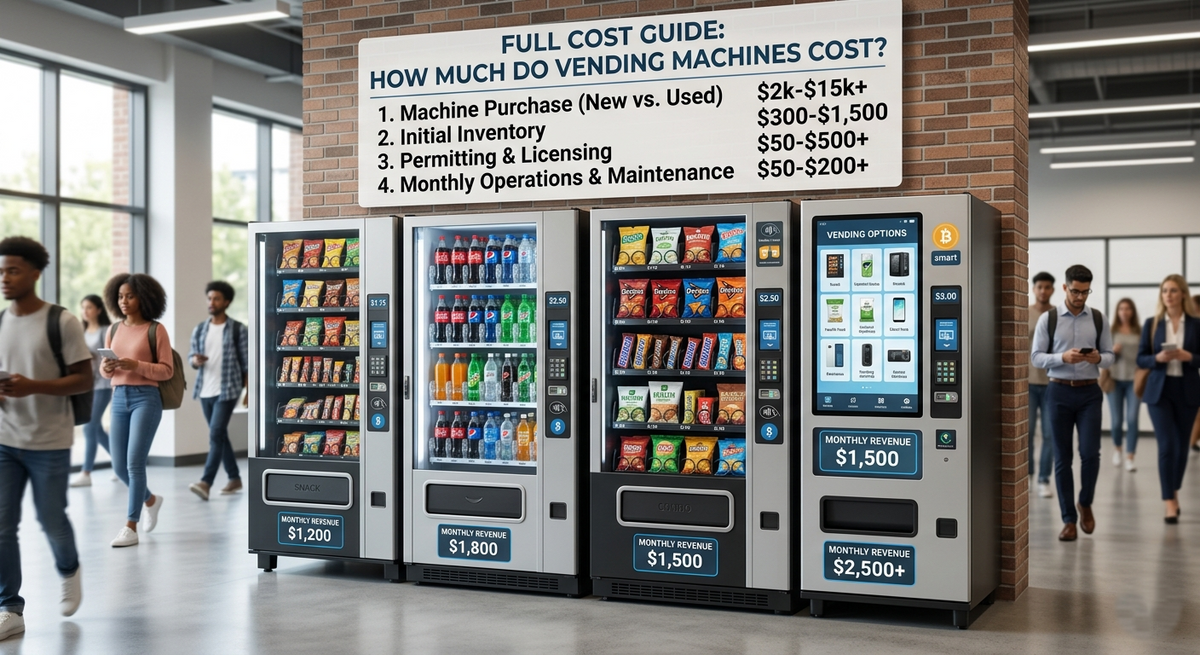
The cost of a vending machine in 2026 is about $1,900 to $19,950 for a new machine, and most first machines, such as snack, drink, combo and AI cooler models, cost $2,950 to $7,000. Plan on another $850 to $2,250 for a card reader, delivery and your first load of stock.
This guide prices every major machine type with live VMFS USA list prices, explains why vending machines cost what they do, and walks through running costs, a one-machine startup budget, payback math and financing.
A new commercial vending machine costs $1,900 to $19,950 in the VMFS USA catalog in October 2026, and most first machines land between $2,950 and $7,000. Countertop units sit at the bottom of that range, full-size snack, drink, combo and AI cooler machines fill the middle, and elevator, hot food and ice cream machines take the top. Broader market guides put new machines at roughly $3,000 to $10,000, which matches where most VMFS models fall.
The price tracks the systems inside the cabinet. A machine that only drops bagged snacks from spiral coils needs a steel box, motors and a control board. Add a compressor for cold drinks, a lift that lowers glass bottles, a touchscreen, a freezer or an oven and each one moves the machine up a tier. That is why the same question, "how much is a vending machine," gets answers from under $2,000 to almost $20,000: buyers are pricing very different equipment.
For budgeting, think in four bands. Many published answers to how much vending machines cost mix these bands together, which is why their figures vary so widely. The table below groups live VMFS prices by band so you can see what each level of spend buys and where each band is usually placed.
| Budget band | Live VMFS price range | What it buys | Typical sites |
|---|---|---|---|
| Entry | $1,900 to $3,500 | Countertop snack units, AI grab-and-go coolers, compact wall units, entry coil machines | Front desks, salons, small offices |
| Core | $3,450 to $7,000 | Full-size snack, drink and combo machines, AI smart coolers, countertop and freestanding coffee | Offices, gyms, warehouses, apartments |
| Premium | $7,000 to $12,000 | Elevator delivery, outdoor combos, trading card, electronics, frozen and premium coffee machines | Hotels, hospitals, busy lobbies |
| Specialty | $12,000 to $19,950 | Hot meals, pizza, soft serve, large ad screens, pharmacy and bakery machines | Campuses, transit hubs, venues |
Quick rule: pick the least expensive machine that fully serves the people at your location. Revenue comes from the location, not the price of the machine, so an extra $3,000 of hardware only pays off where the traffic and product mix can use it.
The price to buy a vending machine is its list price. At VMFS USA that starts at $1,900 for the Countertop Snack Vending Machine, the lowest priced new model in the catalog, and reaches $19,950 for an elevator ice cream machine. Most first machines cost $2,950 to $7,000. The list price covers the cabinet, the delivery mechanism, the controller and a 1-year parts warranty, and every VMFS machine supports QR code payments.
The cost to buy a vending machine and get it selling is larger, because several items sit outside the list price. Payment hardware is an add-on on every machine, freight is quoted to your address, and the first load of stock, permits and insurance come from your own budget. The table shows what the buy price covers and what you add on top.
| Item | In the buy price | Added to the cost to start |
|---|---|---|
| Cabinet, delivery mechanism and controller | Yes | Nothing extra |
| 1-year parts warranty | Yes | Optional 2-year ($250) or 3-year ($400) extension on eligible models; Pro and Seaga lines keep a fixed 1-year term |
| QR code payments | Supported on every machine | Nothing extra |
| Card reader, contactless tap or bill acceptor | Add-on | $450 to $650 for a card reader, plus about $7.95 to $18.95 a month in reader service |
| Freight and delivery | Quoted separately | About $200 to $1,000; white glove delivery on request |
| VMFS Cloud monitoring | Optional | From $7.99 a month per machine |
| First inventory | Your purchase | About $200 to $800 for one full fill |
| Entity, permits and insurance | Your purchase | Varies by state, county and city |
Put together, the cost to start is the buy price plus about $850 to $2,250, before permits and insurance. A $1,900 countertop machine becomes roughly $2,750 to $4,150 ready to sell, and a $3,650 Slim Combo Vending Machine becomes about $4,500 to $5,900. Compare list prices across all vending machines for sale, then add the lines above to get your own start up total.
Budget tip: set aside a small launch budget for signage and promotion before the machine arrives. Clear signage helps people notice a new machine in its first weeks, and VMarketed's vending machine marketing ideas give operators low cost ways to promote one or two machines.
Vending machine prices by type range from about $1,900 for a countertop snack unit to $19,950 for an elevator ice cream machine. Every price below is the live list price of an active VMFS USA product in October 2026, shown as the lowest and highest model in each category, so you are comparing real equipment rather than survey averages.

| Machine type | VMFS price range | Example model and price |
|---|---|---|
| Countertop and mini | $1,900 to $2,489 | CounterCompact, $1,950 |
| Snack (coil) | $2,999 to $5,950 | Seaga QB2200, $2,999 |
| Drink and soda | $4,200 to $7,550 | Seaga Prosper Beverage, $5,450 |
| Combo (snack and drink) | $3,450 to $14,500 | Slim Combo Vending Machine, from $3,650 |
| Wall mount | $3,450 to $6,450 | WallMount, from $3,450 |
| AI and smart coolers | $2,950 to $12,650 | AI Smart Cooler, $4,950 |
| Coffee and hot drinks | $4,470 to $11,950 | CorePro Coffee, $4,950 |
| Outdoor | $6,450 to $7,950 | Smart Outdoor Combo, $6,950 |
| Elevator delivery | $8,650 to $17,950 | Smart Elevator, from $8,650 |
| Touchscreen and advertising | $3,800 to $17,950 | MaxScreen, $6,550 |
| Hot food and meals | $9,750 to $14,950 | Mini Hot Food, $12,450 |
| Ice cream and frozen | $8,990 to $19,950 | Frozen Ice Cream, $9,950 |
| Trading card | $3,800 to $13,275 | Trading Card, $9,395 |
| Vape and age-restricted | $2,400 to $12,850 | MultiChoice, $8,325 |
| Specialty retail | $3,000 to $15,800 | Electronics, $7,950 |
Prices are vmfsusa.com list prices for active products in October 2026 and can change. "Build Your" configurator listings start at the low end of several rows and rise as you add options. Payment hardware and software plans are priced separately, as covered further down.
A snack machine is the cheapest full-size format because it has no refrigeration and a simple coil delivery. The Seaga QB2200 at $2,999 and the Seaga ENV4S at $3,950 cover most break rooms, and our snack vending machine cost guide compares snack machine prices in more detail. A soda or drink machine costs more, about $4,200 to $7,550 at VMFS, because it needs a compressor, insulation and a sturdier mechanism for heavy cans and bottles. Branded cola machines are normally placed by bottlers in their own accounts rather than sold, so independent operators buy unbranded drink vending machines and stock whatever sells.
One cabinet that chills drinks and holds snacks is the most common first purchase for a site with room for a single machine. VMFS combo machines run from the Seaga SM2300 at $3,450 and the Slim Combo Vending Machine at $3,650 to the Seaga QuickBreak QB4000 at $4,450 and the Smart Combo Vending Machine from $4,650. The Seaga Envision IQ Combo at $14,500 sits at the top for operators who want a premium glass-front unit. Compare sizes and payment options across all combo vending machines.
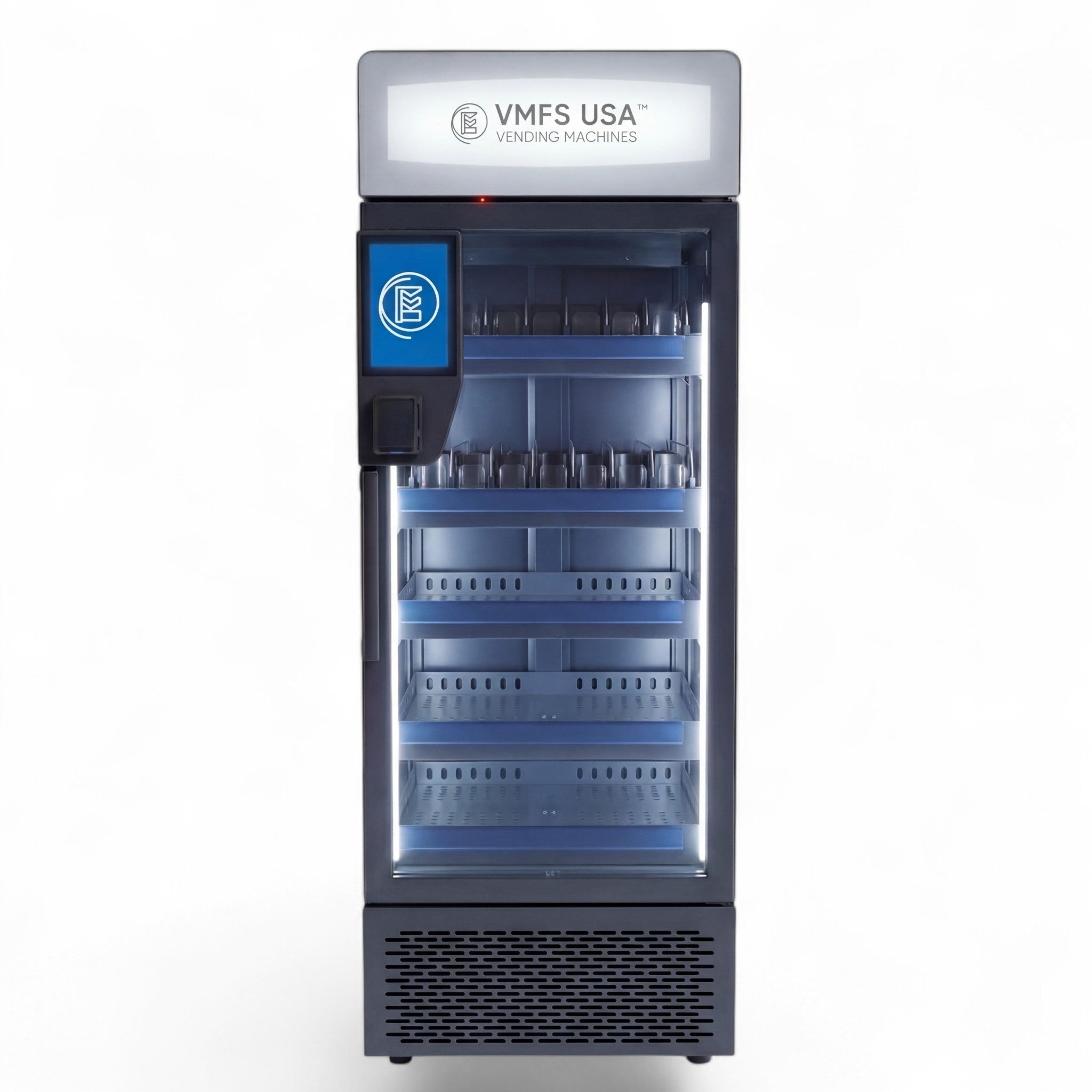
Smart machines are no longer automatically the expensive option. The AI Grab and Go Cooler at $2,950 and the AI Smart Combo Vending Machine at $3,950 cost less than many coil machines, because an open-door cooler with cameras replaces spirals, motors and a delivery bin. Larger formats such as the AI Smart Fridge ($9,950 to $12,650) and big-screen elevator machines cost more. For a deeper breakdown, see our guide to smart vending machine prices.
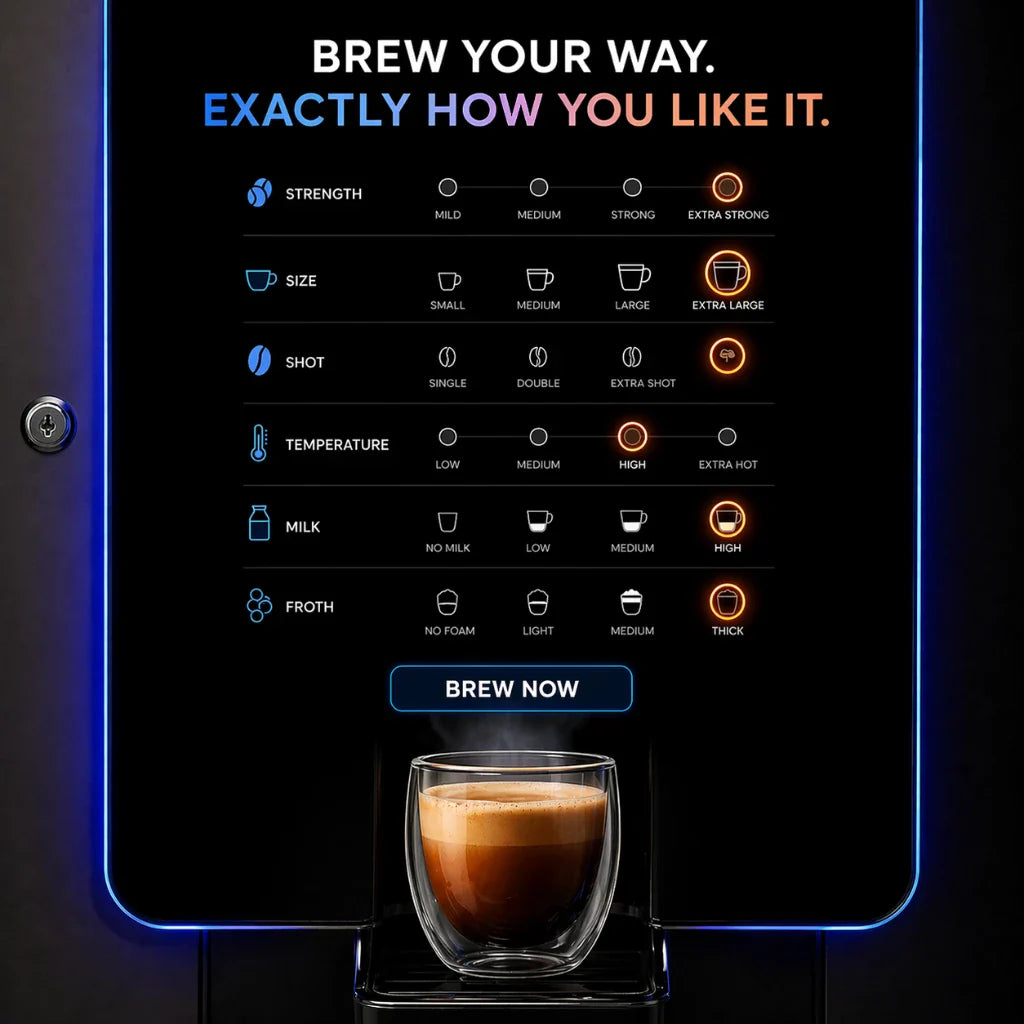
Coffee machines start at $4,470 for a configurable unit and reach $11,950 for iced coffee and coffee-plus-snack systems; our coffee vending machine price guide covers each one. Elevator delivery adds a lift that lowers glass, boxed and fragile products instead of dropping them, so these machines start at $8,650. Adding a large advertising display raises the Smart Elevator from $8,650 to $10,650 for the AD version, so the screen alone adds $2,000 to the price.
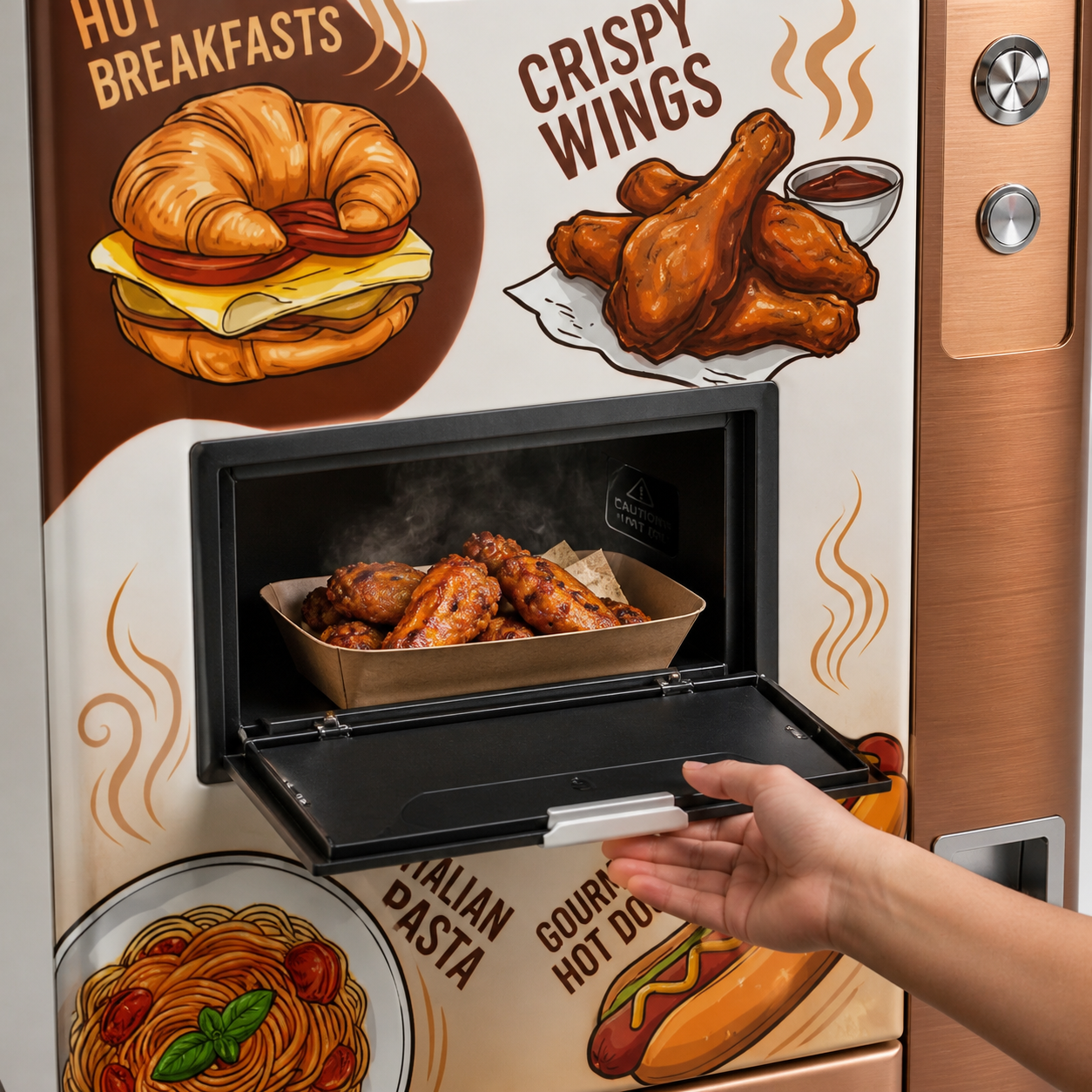
Heating and freezing systems carry the highest prices. The Ramen Noodle machine is $9,950, the Mini Hot Food machine is $12,450 and the Hotlo Pizza machine is $14,950; our guide to pizza vending machine cost covers that format in detail. Ice cream runs from $8,990 for a configurable build to $19,950 for the Elevator Pro. Age-restricted machines start at $2,400 for a configurable vape unit and reach $12,850 for large cabinets; these age verification vending machines are age verification ready, and the ID scanner is an optional paid add-on that needs a VMFS Cloud plan to work. Fully bespoke builds follow a different pricing model, explained in our custom vending machine cost guide.
Vending machines are expensive because each one is an unattended, secured store that has to keep products at the right temperature, take payment and survive years of daily use without staff. Steel, refrigeration, delivery mechanics, payment electronics and freight for a heavy cabinet all carry real cost, and the live VMFS catalog shows how much each system adds.

Cooling is the first big step. On the VMFS configurators, the base drink build is $4,200 against $3,595 for the base snack build, a gap of roughly $600 for the compressor, insulation and controls. Freezing costs more again: the Frozen Ice Cream machine is $9,950. Better insulation and efficient compressors raise the purchase price but lower the power bill for the life of the machine.
Spiral coils are the cheapest way to vend, which is why coil snack machines anchor the low end. Elevator and lift systems protect glass bottles, collectibles and boxed food, and they explain why a machine like the Smart Elevator starts near $8,650 while a Slim Combo starts at $3,650. Collectors and premium-drink buyers expect items to arrive undamaged, so the gentler mechanism can justify its cost at the right site.
Touchscreens, cameras and cashless readers add hardware and software. The $2,000 step from the Smart Elevator to the Smart Elevator AD is the price of a large ad display. Card readers are sold separately as add-ons, and software plans bill monthly. Card payment is worth the cost because most shoppers now pay that way: Cantaloupe's 2026 Micropayment Trends Report found that 78% of vending sales in 2025 were cashless, up from 73% a year earlier.
Reinforced steel, shatter-resistant glass and anti-pry locks protect stock and cash at sites with no staff. Outdoor duty costs more again: the outdoor version of the Seaga ENV5C combo is $7,950 against $6,495 for the indoor model, a $1,455 premium for weather sealing on the same platform. Using an indoor model outside also voids the VMFS warranty, so the premium is not optional for outdoor placements.
Wraps, custom layouts and special trays add design and production time; custom builds and wraps typically ship in about 45 days against 7 to 21 days for in stock units. Regulated products bring their own cost. Federal law sets 21 as the minimum age for tobacco and e-cigarette sales and bars tobacco vending in facilities where people under 21 can enter, so age-restricted machines need ID verification and careful placement. Finally, freight for a cabinet that can weigh hundreds of pounds adds a delivery bill that buyers often forget.
That cost is spread over a long service life. VMFS rates its machines for an expected operating life of 10 years or more with normal care, so a $3,650 Slim Combo Vending Machine works out to about $30 a month of equipment cost over ten years, often less than its card fees.
Most full-size traditional coil machines cost $2,999 to $6,495 at VMFS, while smart machines span $2,950 for an AI cooler to $17,950 for a large elevator touchscreen. The old assumption that smart always means $8,000 or more no longer holds; what you pay depends on the format, not the label.
| Feature | Traditional coil machine | Smart or AI machine |
|---|---|---|
| Live VMFS price | $2,999 (Seaga QB2200) to $6,495 (Seaga ENV5C) | $2,950 (AI Grab and Go) to $17,950 (Pro Combo Elevator AD) |
| Product range | Bagged snacks, candy, cans and bottles | Fresh food, glass bottles, premium and fragile items |
| Checkout | Keypad selection, card reader added separately | Touchscreen or open-door with camera checkout |
| Inventory tracking | Manual counts unless telemetry is added | Live stock, sales and alerts through a cloud plan |
| Marketing | Front graphics only | Screen ads, promotions, remote pricing |
| Best for | Budget placements, steady break rooms | High traffic, fresh food, premium sites |
The cost gap that matters is usually in operating expenses. Smart machines report stock remotely, which means fewer wasted trips and fewer empty slots. A traditional machine with a card reader and a basic VMFS Cloud plan gets much of the same visibility for a few dollars a month, which is why many operators start with a coil combo and add an AI cooler at their busiest site.
A used vending machine typically costs about $1,200 to $5,000 depending on type, age and condition, while new machines generally run $3,000 to $10,000. The savings are real, but older cash-only controllers, tired compressors and discontinued parts can turn a low price into a large repair bill.
Used pricing varies more than new pricing because condition does. A snack machine with a sound control board and working motors may need only cleaning and a card reader. A refrigerated machine with an aging compressor may need a major part within the first year. Before you compare a used price against new, add the cost of a card reader, any missing keys or trays, and a realistic repair allowance. Our used vending machine buying guide lists what to inspect.
Buying new
Buying used
Refurbished machines sit between the two: restored and tested, often with new wear parts and a short warranty, priced above used and below new. VMFS sells new machines only, each backed by a vending machine warranty and support from the team that sold it.
Beyond the sticker price, plan on roughly $850 to $2,250 per machine for a card reader, delivery and a first load of stock, plus local permits and insurance. These are one-time costs, and buyers who leave them out of the budget often run short of cash in the first month.
| One-time cost | Typical range | Notes |
|---|---|---|
| Card reader hardware | $450 to $650 | Nayax or Cantaloupe about $450, PAX $500 to $650 (VMFS payment page) |
| Freight and delivery | $200 to $1,000 | Depends on distance, liftgate, stairs and inside placement |
| First inventory | $200 to $800 | One full fill; more for coffee, frozen and premium products |
| Extended warranty | $250 to $400 | Optional 2- or 3-year coverage on many models; not offered on Pro and Seaga lines |
| Business setup and permits | Varies by state and city | LLC, sales tax registration, machine permits or decals |
| Insurance | Quote-based | Many sites ask for a $1 million per occurrence liability certificate |
No payment system comes standard on any machine, so you choose the reader and plan that fit your site. The VMFS card reader comparison lists the hardware and monthly fees for Nayax, Cantaloupe and PAX. Delivery is by freight carrier with liftgate or inside delivery, and white glove service is available on request. The VMFS shipping information page explains what to prepare before the truck arrives.
Licensing varies by state, county and city, so read our guide to vending machine permits for your area, and price a vending machine insurance policy before you sign a placement agreement. If you need help with the paperwork, VAdviced can form an LLC for your vending business and handle registrations such as your seller's permit.
One compliance cost applies only once you grow: the FDA requires operators who own or operate 20 or more vending machines to disclose calorie information for covered foods. Plan for it before you reach that size rather than retrofitting labels later.
Not Sure Which Machine Fits Your Budget?
Answer six quick questions about your site and get matched to machines in your price range.
Take the Machine Finder QuizA refrigerated vending machine typically costs about $50 to $140 a month in fixed costs, including the VMFS Cloud Basic plan, before insurance and driving, plus product and any location commission, which are paid out of sales. The fixed costs are what you carry even in a slow month, so they are the number to watch when choosing a site.
| Monthly cost | Typical range | Notes |
|---|---|---|
| Card reader service | $7.95 to $18.95 | Per device, depending on provider and plan |
| Card processing | About 2% to 6% of card sales | VMFS-listed plans run about 5.95% flat or 2.5% + $0.10 |
| Electricity | About $16 to $50 | Refrigerated machines; snack machines far less |
| Maintenance reserve | About $17 to $50 | Routine service of $200 to $600 a year |
| VMFS Cloud plan | $7.99, $16 or $39.99 | Works with every VMFS machine; Basic, Advertising or AI plan, per machine |
| Cellular data (optional) | $15 | Only where the site has no stable WiFi |
| Location commission | About 5% to 25% of sales | Negotiated per site; some hosts waive it |
| Mileage | 72.5 cents per mile | IRS 2026 business standard rate |
The $50 to $140 fixed range adds the card reader, electricity and maintenance rows to the Basic plan, plus cellular data only where a site has no stable WiFi. VMFS Cloud works with every VMFS machine; plans start at $7.99 per machine per month, and the Advertising or AI plan adds about $8 to $32 a month to those figures.
Product cost depends on what you sell and how you buy it, so model it as a share of sales rather than a fixed bill. Our guide to the cost to stock a vending machine breaks this down item by item. Commission works the same way: it scales with revenue, so a 10% commission at a busy site can still beat a commission-free site with little traffic.
An ENERGY STAR refrigerated beverage vending machine uses about 1,354 kWh a year, according to the U.S. Department of Energy. At the July 2026 U.S. average commercial electricity price of 14.53 cents per kWh reported by the Energy Information Administration, that is about $197 a year, or roughly $16 a month. Older or less efficient refrigerated machines use more, and frozen and hot food machines run higher again, which is why many cost guides budget $20 to $50 a month for a cold drink machine. A snack machine with lighting and a control board costs only a few dollars a month to power.
Driving is the hidden running cost. At the IRS rate of 72.5 cents a mile, every 20-mile round trip costs $14.50 in vehicle expense before your time. Remote stock data lets you skip trips to machines that do not need a refill, which is the main reason operators pay for telemetry. One avoided trip a month covers the $7.99 VMFS Cloud Basic plan almost twice over.
The cost to start a vending machine business with one new machine is about $2,750 to $12,200 before permits and insurance, depending on the machine. Starting with a Slim Combo Vending Machine costs about $4,500 to $5,900, and a combo machine is where most first-time operators begin.
| Machine | Machine price | Reader, freight, first fill | Total to start |
|---|---|---|---|
| Countertop Snack | $1,900 | $850 to $2,250 | $2,750 to $4,150 |
| CounterCompact | $1,950 | $850 to $2,250 | $2,800 to $4,200 |
| Slim Combo | $3,650 | $850 to $2,250 | $4,500 to $5,900 |
| Smart Combo | $4,650 | $850 to $2,250 | $5,500 to $6,900 |
| AI Smart Cooler | $4,950 | $850 to $2,250 | $5,800 to $7,200 |
| CorePro Coffee | $4,950 | $850 to $2,250 | $5,800 to $7,200 |
| Smart Elevator | $8,650 | $850 to $2,250 | $9,500 to $10,900 |
| Frozen Ice Cream | $9,950 | $850 to $2,250 | $10,800 to $12,200 |
Add-on range assumes a $450 card reader, $200 to $1,000 of freight and $200 to $800 of opening stock. Some smart models use a specific payment option, so confirm the right reader on the product page before you budget for one.
Over five years, owning one Slim Combo Vending Machine costs roughly $7,500 to $14,300 in total: $4,500 to $5,900 to start plus $50 to $140 a month in fixed running costs, before product, commission and insurance. A machine that sells steadily covers that comfortably, which is why the location you choose matters more than saving a few hundred dollars on hardware. Secure a strong site before you buy. Our list of the best vending machine locations compares site types, and you can find locations through VPlaced, which matches verified operators with businesses that want a machine.
Payback time depends almost entirely on monthly sales: the same combo machine can pay for itself in about a year at a busy site or take more than five years at a quiet one. The table runs one machine through four sales levels so you can see the effect before you sign a placement agreement.
| Monthly sales | Monthly net | Payback on $5,200 start |
|---|---|---|
| $400 | About $84 | About 62 months |
| $600 | About $156 | About 33 months |
| $1,000 | About $300 | About 17 months |
| $1,500 | About $480 | About 11 months |
| $1,000, no commission | About $400 | About 13 months |
These are worked examples, not forecasts. They assume a Slim Combo start of $5,200 (the middle of the range above), product at 50% of sales, a 10% location commission, card fees of 4% of sales and $60 a month of fixed costs. If any assumption changes, the payback changes too. The location sets the sales, and the sales set the payback. Run your own numbers in the vending ROI calculator, and see how profitable vending machines are for monthly earnings, margins and route income.
Visibility also affects sales. When you list your machine on VendingFinder, people nearby can see its location and products on the map they use to find vending machines.
You can buy a vending machine outright, finance it so your payments build ownership, or rent one for a short-term need. Buying costs the least over the life of the machine, and financing keeps cash free for inventory and your next placement.
| Option | Upfront | Monthly | You own it | Best for |
|---|---|---|---|---|
| Buy outright | Full price | None | Immediately | Lowest total cost |
| Finance | Low or none | Fixed payments | When paid off | Keeping cash for growth |
| Rent | Low | Ongoing fee | Never | Events and short trials |
VMFS USA offers vending machine financing through PayPal, Klarna and ClickLease, with terms that typically run 6 to 48 months and payments that go toward full ownership. PayPal plans cover $49 to $10,000, and ClickLease approves up to $30,000 with credit scores down to 500. VMFS does not offer leasing. As simple math before interest or fees, a $5,200 combo start spread over 24 months is about $217 a month, or about $108 over 48 months. Larger routes often add bank or credit union equipment loans, and SBA microloans provide up to $50,000 for small businesses.
Tax treatment can lower the real cost. Vending machines are business equipment, and IRS Publication 946 explains the Section 179 deduction and special depreciation allowance that may let you write off much of a machine in the year you place it in service. Ask your accountant how they apply to your purchase before year end. If you only need a machine for a few months, compare the options to rent a vending machine; for longer placements, ownership almost always costs less.
Every budget has a strong option. Start with the people at your location, then pick the machine that serves them best for the money.
Under $2,500
The Countertop Snack Vending Machine at $1,900, the CounterCompact at $1,950 and the Seaga SM1600 at $2,489 fit front desks, salons and small offices where floor space is tight.
$2,500 to $5,000
The most common range for first machines: AI Grab and Go Cooler ($2,950), Seaga QB2200 ($2,999), Slim Combo Vending Machine ($3,650), Smart Combo Vending Machine ($4,650) and AI Smart Cooler ($4,950).
$5,000 to $10,000
Seaga ENV5C Combo Merchandiser ($6,495), Smart Outdoor Combo ($6,950), Pro Coffee ($7,450), Smart Elevator ($8,650) and Frozen Ice Cream ($9,950) for busier or specialty sites.
$10,000 and up
Hot food, pizza, soft serve, pharmacy and big-screen machines such as the Pro Combo Elevator AD for venues with heavy, steady traffic.
If the site has captive, steady traffic such as staff, patients or students, a combo or AI cooler usually earns the fastest payback. Coffee suits offices with early shifts. Frozen and hot food machines need high traffic and longer dwell time to justify their price. Each product page lists capacity, delivery type and payment options, so you can compare vending machines on the details that matter at your site.
Building a vending machine from scratch rarely costs less than buying one, because you still have to source a cabinet, refrigeration, a control board, motors, payment hardware and safety testing, and you lose the warranty. For most operators, configuring an existing platform is the cheaper way to get a machine that fits a specific product.
VMFS configurator listings show the starting point: a configurable vape machine starts at $2,400, touchscreen, advertising and trading card builds start at $3,800, a snack build at $3,595, a drink build at $4,200 and a food build at $9,750. You choose the cabinet, temperature, delivery and payment options, and the price rises with each system you add. Branding and wraps add design and production time but use a machine that is already tested and supported.
A true ground-up build for a new product type is a separate project with its own prototyping costs. If your product does not fit a standard format, start with a custom vending machine request. Before you settle on any build, check the product against local rules: perishable food usually needs a health permit, and age-restricted products need ID verification and careful placement.
Run Your Numbers Before You Buy
Plug in machine price, expected sales, commission and running costs to see your monthly profit and payback.
Open the ROI CalculatorPrices reflect vmfsusa.com list prices and typical US market ranges in October 2026 and may change. Worked examples are illustrations, not guarantees. This guide is not tax or legal advice.
Share:
Comparing Vending Machine Costs: New vs. Used Machines
Can you put a vape vending machine in a bar?