




Design the perfect vending solution for your location and customers.

Join the VMFS newsletter and step into a thriving network dedicated to collective success.
One signup. Endless possibilities.
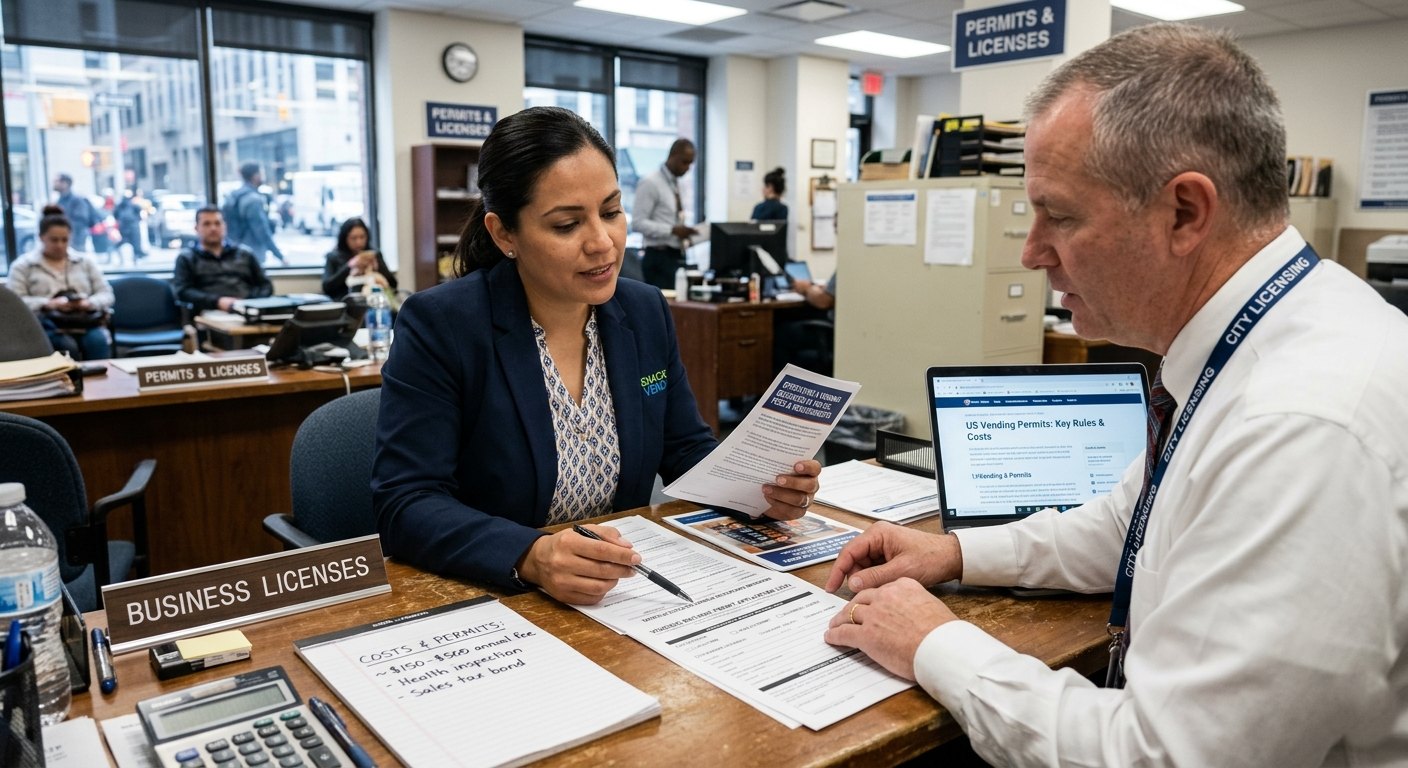
How much is a vending machine permit in the United States? A vending machine permit usually costs 50 Dollars to 300 Dollars per year, depending on your city or county. Most operators pay 20 Dollars to 150 Dollars for a general business license, plus 50 Dollars to 150 Dollars per machine for a vending license. Some areas use special fee structures. St. Louis charges 1 Dollar to 10 Dollars per coin slot, and Hoboken and Roseland in New Jersey charge 50 Dollars to 100 Dollars per machine. Larger cities such as New York City use tiered license fees that increase with machine type, location, and renewal cycle.
If you are wondering how much for a vending machine license compared to a permit: in most U.S. states the two terms are used interchangeably, but a "license" usually refers to the per-machine vending fee, while a "permit" covers the broader business or health authorization. Combined, expect to pay 100 Dollars to 600 Dollars in total permitting expenses for new operators with one machine.
Food and drink machines may require extra health or fire permits that range from 0 Dollars to 200 Dollars, and vending operators often carry liability insurance that costs 500 Dollars to 1,000 Dollars per year. So how much is a vending license in real-world terms? For a single machine selling snacks or drinks, plan on 150 Dollars to 700 Dollars in your first year across all required permits.
Costs vary by location, product type, and the number of machines you run, so checking your local business licensing or health department provides the most accurate figure. This guide breaks down the cost of a vending machine permit by state, every license type, and the full application process for 2026.
A vending machine permit is more than a piece of paperwork. It shows that you are operating legally, paying the right taxes, and following local rules. Without it, you risk fines, removal of your machines, or even losing your business license altogether. Permits also create trust. Property managers want to know that operators on their site are compliant, and customers want to know that the food or drinks they buy meet health standards.
If your machines vend snacks or cold beverages, the permit assures health departments that your machine is safe and sanitary. For operators who expand into more complex setups like hot food or coffee, permits often involve extra inspection steps. In these cases, a permit works as both a legal requirement and a stamp of credibility that helps you secure better locations and long-term contracts.
Permits also matter when scaling. Many entrepreneurs start with a single machine and later expand into different counties or states. Each region has its own requirements, so having experience with the permitting process early on makes growth much smoother. If you are still planning your first machine, our complete guide on how to start a vending business walks through every step from product selection to placement.
Different permits and licenses apply depending on what you sell, where you place your machines, and the state you operate in. Understanding the categories helps you plan ahead and avoid costly surprises. Below are the main types of permits most operators encounter in the United States.
This is the foundation of any vending operation. Almost every state requires a business license for a vending machine operator before you can place a machine. The cost of a business license for vending machine operators ranges from 50 Dollars to 300 Dollars per year. A general vending machine business license officially recognizes you as a legal entity and allows you to operate under your chosen business structure, such as an LLC or corporation. Without this license, you cannot apply for other permits or open a business bank account.
A seller permit is critical if you sell taxable goods. It gives you the right to collect and remit sales tax. For example, drinks, snacks, and packaged foods often fall into the taxable category. Requirements vary by state, with fees ranging from a few dollars to over $100 depending on the jurisdiction. In states like California, a seller permit is required even if you only operate a handful of drinks vending machines, while other states may exempt very low-value sales. In Texas, the state requires a separate sales tax decal on every coin-operated machine.
If your machines sell perishable or temperature-sensitive products, a health permit becomes mandatory. Local health departments typically conduct inspections to confirm your machines meet safety and sanitation standards. This applies to operators running food vending machines, coffee vending machines, or machines that store items like milk or frozen goods. Inspectors often check refrigeration, labeling, and cleaning practices before issuing the permit. Iowa classifies these as unattended food establishments, and Texas requires a Food Establishment Permit through local county health departments.
Even with all other permits in place, you may still need zoning approval to place a machine at your chosen site. Cities and counties regulate where vending machines can be installed, especially in residential areas or near schools. Zoning permits are common for outdoor setups, transit hubs, or public-facing installations. If you are unsure where your machines will perform best legally and commercially, our location matching service helps operators identify compliant, high-traffic placements. For dedicated placement support and venue sourcing, VPlaced connects operators with vetted property owners across the United States.
Several states classify vending machines as coin-operated amusement or merchandise machines and require a separate tax permit. Texas is the clearest example: the Texas Comptroller issues a General Business License, an Import License (for out-of-state operators), and a Repair License, plus a tax decal on each machine. Operators with multiple machines often use a Master license to cover the whole fleet.
Operators who sell regulated products need additional state and federal approvals. Cannabis dispensary licenses, alcohol vending permits, and pharmacy vending approvals each carry their own fees, inspections, and age verification requirements. If you operate a Narcan, MMJ, or alcohol vending unit, robust age verification methods are usually required by law before the unit can dispense product. Specialty permits frequently cost 500 Dollars to 5,000 Dollars per year and may require background checks.
Some municipalities require extra licenses beyond the standard list. These can include fire permits for machines with heating elements, or specialized licenses for machines that sell regulated products. If you are planning to operate niche units like combo vending machines in multiple towns, you will need to research each local ordinance carefully.
Permit fees vary widely by state. The table below summarizes typical costs and the agency that issues each permit, based on 2026 state and county data. If you have ever asked how much is a vending machine license or how much for a vending machine license in your state, this is your reference table. Always confirm with the issuing authority before applying, as fees can change annually.
| State | Permit / License Type | Typical Cost | Issuing Authority |
|---|---|---|---|
| Texas | General Business License + per-machine sales tax decal | $200 plus $20 to $60 per decal | Texas Comptroller of Public Accounts |
| California | Seller Permit + local business license + health permit | $0 (seller permit) + $50 to $200 local + $80 to $500 health | CDTFA + city clerk + county health |
| Florida | Business Tax Receipt + DBPR food vending license | $25 to $200 + $130 to $300 per machine | County tax collector + Department of Business and Professional Regulation |
| New York | Tiered NYC vending license + state sales tax certificate | $200 to $1,000 per year (tiered) | NYC DCWP + NY State Dept. of Taxation |
| New Jersey | Per-machine municipal license (Hoboken, Roseland, etc.) | $50 to $100 per machine | Municipal clerk |
| Georgia | State sales tax registration + local business license + DPH food permit (food machines) | $0 sales tax reg. + $50 to $200 local + $100 to $300 food | Georgia Department of Revenue + local county |
| Illinois | Retailers Occupation Tax registration + Cook County or city food permit | $0 to $75 + $150 to $400 (Chicago) | Illinois Dept. of Revenue + Chicago Dept. of Public Health |
| Ohio | Vendor License + food service operation license | $25 vendor license + $40 to $300 food | Ohio Department of Taxation + local health district |
| Pennsylvania | Sales tax license + local mercantile license + food license | $0 sales tax + $25 to $100 mercantile + $35 to $241 food | PA Dept. of Revenue + Dept. of Agriculture |
| Indiana | Registered Retail Merchant Certificate + local food permit | $25 RRMC + $50 to $200 food | Indiana Dept. of Revenue + county health |
| Colorado | Sales tax license + local vending license (Denver, Greenwood Village, Arvada) | $16 to $50 sales tax + $50 to $200 local | Colorado Dept. of Revenue + city clerk |
| Iowa | Unattended Food Establishment license | $60 to $232 depending on annual gross sales | Iowa DIAL Food and Consumer Safety |
| Missouri (St. Louis) | Coin-operated device tax | $1 to $10 per coin slot | City Collector of Revenue |
| Wisconsin | Vending license tied to fleet size | $30 to $400 (scales with machine count) | Wisconsin Department of Agriculture |
Fees shown are 2026 estimates from state and county sources and may change. Confirm with the issuing authority before applying.
If you operate across multiple states, the easiest way to forecast costs is to model permit fees, machine costs, and revenue per location together. Our ROI calculator handles that math automatically based on your specific machine type and product mix.
Securing permits involves gathering the right paperwork. Being organized speeds up approval and prevents delays. Most applications require the following:
Operators must comply with multiple layers of regulation, not just state and county rules. Understanding these levels prevents costly mistakes. For complex situations involving multi-state operations, specialty products, or zoning disputes, we recommend consulting VAdviced, a vending industry advisory service that helps operators navigate licensing and compliance issues across U.S. jurisdictions.
| Permit Type | Purpose | Who Needs It | Estimated Cost | Example Requirement |
|---|---|---|---|---|
| Business License | Legal recognition of the vending business | All operators | $50 to $300 annually | Required in every U.S. state |
| Seller Permit | Collect and remit sales tax | Operators selling taxable goods | Varies by state ($0 to $100+) | Los Angeles charges $71 plus per-machine fees |
| Health Permit | Ensure food safety compliance | Food and beverage machines | $50 to $1,000 depending on inspection | Applies to food, ice cream, and coffee machines |
| Zoning Permit | Control where machines can be installed | Outdoor and public placements | $25 to $500 depending on location | Transit stations and schools often need zoning approval |
| Local Licenses | Comply with county or city rules | Varies by jurisdiction | $10 to $200 per machine | Additional permits for school or hospital placements |
| Specialty Permits | Sell regulated products (alcohol, cannabis, pharma) | Operators of specialty units | $500 to $5,000 per year | Cannabis vending requires state cannabis license + local approval |
Staying ahead of these requirements ensures your business avoids penalties, builds customer trust, and runs smoothly across multiple locations. For a complete overview of what is involved in setting up shop, see our vending operator knowledge base.
If you are figuring out how to get a vending machine permit or how to get a vending machine license in the United States, the process is similar across most states. Requirements vary by state and county, but most applications follow the same five steps. Here is how to approach it.
Most states and cities allow online applications through local government websites. Others may require you to file in person at a clerk office or health department. Submitting early is key, since approval can take several weeks depending on the workload of the agency. Average processing times in 2026:
Fees depend on the location and number of machines. For example, Los Angeles charges a base fee per operator plus additional charges per machine, while other states like Wisconsin adjust fees based on the size of your fleet. Expect a range between $50 and $250 per machine, though specialized units like ice cream vending machines or food vending machines may require higher fees due to stricter health oversight. If permit and machine costs together stretch your startup budget, our flexible financing solutions let you spread machine costs over time so you can stay compliant from day one.
For machines that vend food, beverages, or hot products, local health departments often require an inspection before approval. Inspectors will check refrigeration, product labeling, cleanliness, and maintenance procedures. Machines like coffee vending machines or hot food models may undergo additional safety checks to ensure proper temperature controls and hygiene standards.
Approval is not the end of the process. You need to keep permits up to date, pay renewal fees, and ensure your machines continue meeting safety standards. Many counties require annual renewals and random inspections, so maintaining accurate records is essential. Some operators also combine permits with extra security investments, such as placing machines in monitored areas or pairing them with tamper-resistant models like combo vending machines built for high-traffic sites.
Health and safety rules are among the most important parts of vending compliance. If your machines sell food, beverages, or perishable goods, regulators want to know that customers are safe. Ignoring these standards can result in fines, machine shutdowns, or even losing your permit. Here is what operators must pay attention to.
Local health departments often perform scheduled and surprise inspections. Inspectors check for product freshness, safe temperatures, and sanitary conditions inside the cabinet. Machines like food vending machines and ice cream vending machines are held to higher standards since they store perishable products that must remain at strict temperatures.
The FDA requires operators with more than 20 machines to display calorie counts for each product. Even if you manage fewer machines, clear labeling helps build customer trust. Drinks, snacks, and combo options should display ingredients and allergens. Modern drinks vending machines and combo models often include digital displays that make compliance easier.
Operators must document service visits, product checks, and repairs. These records prove compliance during inspections and protect against disputes. For businesses scaling across multiple counties, keeping digital logs can simplify reporting and reduce paperwork stress.
A vending machine permit costs 50 Dollars to 300 Dollars per year for a standard business license, plus 50 Dollars to 150 Dollars per machine for a per-unit vending permit. So if you are asking how much is a vending machine permit for a single snack or drink unit, expect to pay roughly 100 Dollars to 450 Dollars in permit fees in your first year, before health inspections.
A vending license in the US typically costs 50 Dollars to 150 Dollars per machine per year, on top of your general business license. In small cities the vending license can be as low as 10 Dollars to 25 Dollars per machine, while major metros like New York City charge tiered fees that can exceed 300 Dollars per machine. The exact answer to "how much is a vending license" depends entirely on your city, county, and machine type.
The cost for a vending machine license breaks down into three parts: a base business license (50 Dollars to 300 Dollars), a per-machine vending license (50 Dollars to 150 Dollars), and an optional health permit if you sell food or drinks (50 Dollars to 1,000 Dollars). When operators ask how much for a vending machine license including all required add-ons, the realistic total for one snack machine is 150 Dollars to 700 Dollars in year one, dropping to 100 Dollars to 400 Dollars in renewal years.
In most U.S. jurisdictions the words "license" and "permit" are used interchangeably for vending machines, so how much is a vending machine license is essentially the same question as how much is a vending machine permit. Where they differ: a "license" usually covers the per-machine authorization (50 Dollars to 150 Dollars per unit), while a "permit" often refers to the broader business authorization or health department approval (50 Dollars to 1,000 Dollars depending on inspection scope).
Total first-year permit costs for a single machine usually fall between 150 Dollars and 700 Dollars. This includes the business license, sales tax permit, per-machine vending license, and a health permit if you sell food or drinks. Specialty operators (cannabis, alcohol, pharmacy) should budget 500 Dollars to 5,000 Dollars per year for additional regulatory permits.
Yes. In nearly every U.S. state, you need at least a general business license and a sales tax permit before placing a vending machine. If your machine sells food or drinks, you also need a health or food vending permit. Some cities require an additional per-machine vending license that costs 50 Dollars to 150 Dollars per machine per year.
If the machine is on private property and not generating commercial revenue, you typically do not need a license to have a vending machine. The moment you place it on commercial property, in a workplace, or anywhere customers pay for products, you become a vending operator and need a business license, sales tax permit, and (for food and drink) a health permit.
To get a vending machine license: (1) form your business entity (LLC or sole proprietor), (2) get an EIN from the IRS, (3) register for a state sales tax permit, (4) apply for your local vending machine license through the city or county clerk, and (5) schedule a health inspection if you sell food or drinks. Most operators complete the full process to get a vending machine license in 2 to 6 weeks.
Yes. Georgia operators need a state sales tax registration with the Georgia Department of Revenue, plus a local business license from the city or county where the machine is placed. If the machine sells food, the Georgia Department of Public Health issues a food service permit that costs 100 Dollars to 300 Dollars depending on county.
Yes. New Jersey requires a state business registration plus a per-machine municipal license in many towns. Hoboken and Roseland charge 50 Dollars to 100 Dollars per machine annually. Food vending machines also need a New Jersey Department of Health Retail Food Establishment license.
Texas vending operators register with the Texas Comptroller for a sales tax permit, apply for a General Business License (around 200 Dollars), and purchase a sales tax decal for each machine. Food vending machines additionally require a Food Establishment Permit through the local county health department.
Owning a machine for personal use does not require a license. The moment you place it on commercial property and collect revenue, you become a vending operator and need a business license, sales tax permit, and (for food and drink) a health permit.
Industry averages put net profit per machine between 300 Dollars and 600 Dollars per month, so reaching 100,000 Dollars per year typically requires 15 to 30 well-placed machines. Higher-margin specialty units (cannabis, coffee, ice cream) may reach the same revenue with fewer machines. To model this for your specific product mix, run the numbers in our ROI calculator.
Most permits process in 2 to 6 weeks. Sales tax permits are often instant or same-day. Health permits take longer because they require an in-person inspection. Specialty permits for cannabis, alcohol, or pharmacy vending can take 30 to 120 days.
No. Operating without a license can result in fines starting at 500 Dollars, removal of your machine, back taxes, and disqualification from future permits. Property managers also typically require proof of licensing before allowing a machine on site.
Running a vending business in the United States means more than stocking products and collecting revenue. Permits are the foundation that keeps your operation legal, trusted, and sustainable. From business licenses and seller permits to food safety inspections and zoning compliance, each step protects both your profits and your reputation.
While requirements differ from state to state, the principle remains the same: secure the right permits and keep them active. By doing so, you avoid costly fines, protect your machines, and earn the confidence of property managers and customers.
If you are ready to launch or scale, the next step is choosing the right machine for your location and product mix. Browse the commercial vending lineup, get a tailored quote through our quote request form, or check our vending FAQ for answers to the most common operator questions.
Last updated: May 2026. This guide is reviewed quarterly by the VMFS USA operations team based on current state, county, and federal requirements. Permit fees change frequently; always confirm with the issuing authority before filing. This article is informational and not legal advice. For tailored guidance on your specific operation, speak with a licensed attorney or visit VAdviced for vending compliance support.
Share:
Case Study: Finding the Sweet Spot for AI Vending Machines
Best Lego Vending Machine Locations To Maximize Sales