


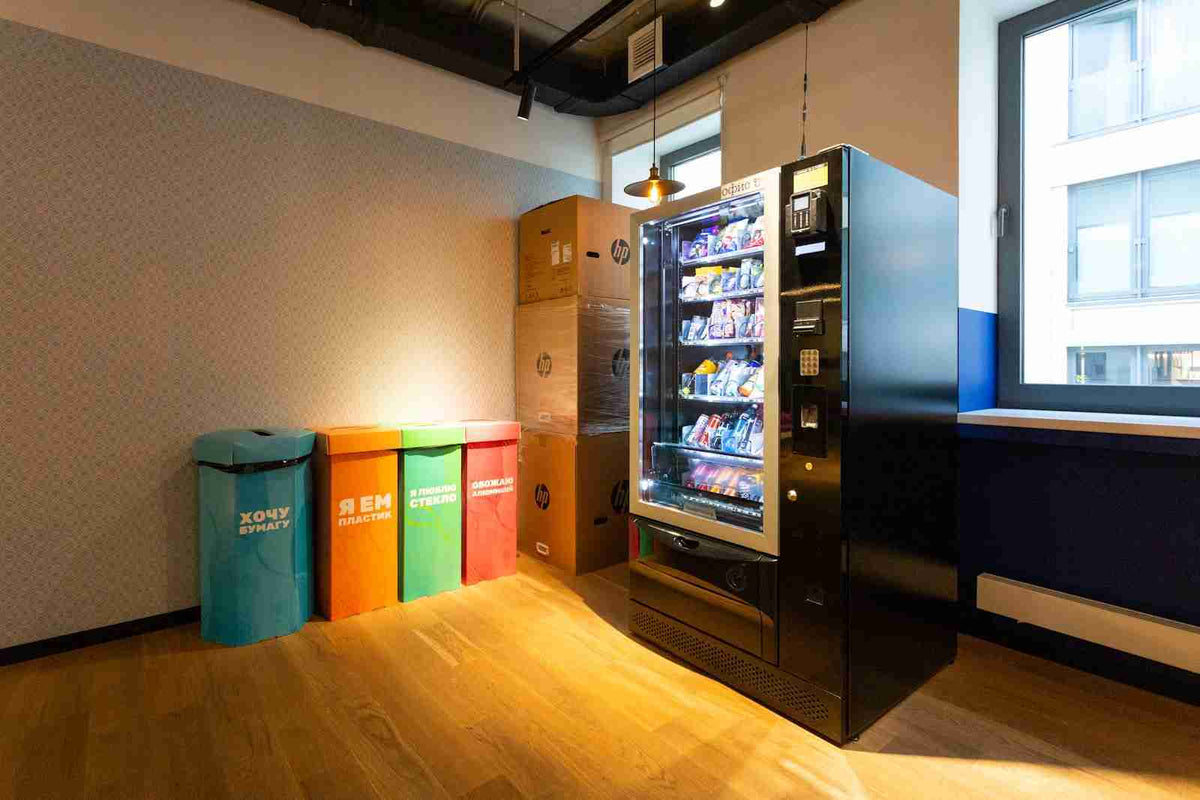


Design the perfect vending solution for your location and customers.

Join the VMFS newsletter and step into a thriving network dedicated to collective success.
One signup. Endless possibilities.
Real numbers on how much a vending machine makes, true profit margins, cash flow, ROI, business models and what a vending route is worth, built from industry data and the field experience behind 1,200+ machines deployed.
Yes, vending machines are profitable when they sit in the right location with the right products. Most machines gross $300 to $1,500 a month and keep 20% to 35% of that as net profit after product cost, location commission, card fees, fuel and upkeep. That works out to roughly $100 to $500 of profit per machine each month, and a vending machine business grows its income by adding machines on a dense, well chosen route.
So do vending machines make money? They do, and a vending machine business is profitable over the long run when each placement is chosen on traffic rather than convenience. That answer is honest, and it is also the beginning of a much more exciting story. Vending is one of the few businesses where a single, well placed asset can sell around the clock with no staff on the floor, where every machine you add stacks on top of the last one, and where a mature route becomes a sellable asset that buyers pay real multiples for. The operators who thrive are the ones who treat their machines like a portfolio: they measure every location, move the weak performers, and double down on the winners.
So how profitable are vending machines in practice? Here is how the outcomes actually spread across placements, based on the operator benchmarks we see across 1,200+ machines deployed and cross checked against national industry data.
| Placement Quality | Monthly Gross Sales | Net Margin | Monthly Net Profit | Verdict |
|---|---|---|---|---|
| Weak site (under 50 people a day) | $150 to $300 | 10% to 20% | $15 to $60 | Relocate or replace |
| Typical site (small office, shop, gym) | $300 to $700 | 20% to 30% | $60 to $210 | Solid building block |
| Strong site (100+ daily users) | $700 to $1,500 | 25% to 35% | $175 to $525 | Core of a profitable route |
| Top tier site (hospital, plant, transit hub) | $1,500 to $3,000+ | 25% to 35% | $375 to $1,050+ | Anchor location |
Vending machines make $300 to $700 a month in gross sales at a typical location, $700 to $1,500 at a strong one, and $1,500 to $3,000 or more at a top tier site such as a hospital or a large plant. The average connected machine in the US lands near $470 a month in sales.
So how much can a vending machine make in a month at your site? Vending machine revenue is simply vends multiplied by the average ticket. Cantaloupe's 2026 Micropayment Trends Report, built on 2025 data from about 621,000 connected devices, puts the average cashless vending purchase at $2.45 against $1.57 in cash. So a machine selling 15 items a day at around $2.10 brings in close to $950 a month. A machine selling five items a day brings in closer to $300. That spread is why average vending machine revenue figures only mean something next to the traffic behind them.
Breaking the same numbers down by day, week and year makes them easier to plan around. The net figures assume a 25% net margin, the middle of the healthy range.
| Site Type | Per Day | Per Week | Per Month | Per Year | Net Profit Per Year |
|---|---|---|---|---|---|
| Typical site | $16 | $115 | $500 | $6,000 | $1,500 |
| Strong site | $37 | $254 | $1,100 | $13,200 | $3,300 |
| Top tier site | $75 | $519 | $2,250 | $27,000 | $6,750 |
Two identical vending machines can sit a mile apart and produce completely different paychecks. The gap almost always traces back to four things:
Plug in daily traffic, price points and commission to see a realistic monthly projection for your site.
On a machine grossing $900 a month, a realistic monthly profit is about $190, a 21% net margin, after product, a 10% location commission, card fees, software, mileage, insurance, shrink and maintenance. Remove the commission and the same machine keeps about $280, or 31%.
This is the part most vending content skips, so here are the real vending machine economics, every line item, worked out for a Slim Combo Vending Machine at a typical office.
| Line Item | Assumption | Monthly Amount | Share of Sales |
|---|---|---|---|
| Gross sales | About 14 vends a day at $2.10 | $900.00 | 100% |
| Product cost | Blended snacks and drinks | $432.00 | 48% |
| Location commission | 10% of gross | $90.00 | 10% |
| Card processing | 78% cashless at 2.6% + $0.10 per sale | $46.91 | 5.2% |
| Card reader service | Cellular reader plan | $9.99 | 1.1% |
| VMFS Cloud Basic | Optional monitoring plan | $7.99 | 0.9% |
| Mileage | 60 miles at the IRS rate of 72.5¢ | $43.50 | 4.8% |
| Insurance | General liability policy | $40.00 | 4.4% |
| Shrink and spoilage | 2% of gross | $18.00 | 2% |
| Maintenance reserve | Parts and service set aside | $20.00 | 2.2% |
| Net profit | Before your own time | $191.61 | 21.3% |
The biggest line by far. Buying in bulk from a warehouse club or distributor and pricing for convenience keeps it near 45% to 50% of sales.
Many small sites take nothing; busy institutional sites can ask for 15% to 25%. Every point you negotiate drops straight to profit.
A typical 2.6% + $0.10 rate costs about 8.3% of a $1.75 sale but 6.7% of a $2.45 sale, so higher tickets protect margin.
The average vending machine profit margin is about 45% to 55% gross, meaning sales minus product cost, and 20% to 35% net after commissions, card fees, fuel, insurance and maintenance. Coffee and bottled water carry the highest product margins, while energy drinks and fresh food carry the lowest percentage but the biggest dollars per sale.
Your vending machine business profit margin is the sum of every machine on the route, so gross margin tells you whether your pricing works. Net margin tells you whether your business works. Both matter, and they move for different reasons: gross margin is controlled at the shelf through pricing and product choice, while net margin is controlled at the route level through commissions, density and efficiency.
| Product | Typical Cost Per Unit | Typical Vend Price | Gross Margin |
|---|---|---|---|
| Bottled water | $0.20 to $0.40 | $1.50 to $2.25 | 75% to 85% |
| Fresh brewed coffee (per cup) | $0.30 to $0.60 | $2.00 to $3.50 | 75% to 85% |
| Canned soda | $0.45 to $0.75 | $1.75 to $2.50 | 60% to 70% |
| Chips and salty snacks | $0.45 to $0.80 | $1.50 to $2.25 | 55% to 65% |
| Candy bars | $0.70 to $1.10 | $1.75 to $2.50 | 50% to 60% |
| Better for you snacks | $1.00 to $1.75 | $2.50 to $3.50 | 45% to 55% |
| Energy drinks | $1.40 to $2.10 | $3.25 to $4.25 | 45% to 55% |
| Fresh meals and sandwiches | $2.50 to $4.50 | $5.50 to $9.00 | 40% to 50% |
Costs reflect typical bulk purchase ranges in the US in 2026 and vary by region and supplier.
A candy bar at 55% margin earns about $1.10. A fresh sandwich at 45% margin earns about $3.15. Percentage margin is a great health check, but dollars per vend and vends per day are what pay the bills. That is exactly why higher ticket formats like smart vending machines and coffee vending machines keep winning premium placements.
Snack and drink combo machines are the dependable workhorse at $300 to $1,500 a month, coffee machines lead on margin, and AI smart coolers earn the most per sale because they sell fresh food and premium drinks. The right machine is the one that matches what your location's people actually want to buy.
Every format below is part of our range of new vending machines for sale, and choosing between them is less about the machine itself and more about the site it will serve.

| Machine Type | VMFS Starting Price | Typical Monthly Gross at a Good Fit Site | Margin Profile | Best Locations |
|---|---|---|---|---|
| Mini vending machines | $1,900 | $100 to $400 | Moderate | Small offices, salons, waiting rooms |
| Combo vending machines | $3,650 | $300 to $1,500 | Steady | Offices, gyms, warehouses, apartments |
| AI smart coolers | $2,950 | $800 to $2,500+ | Highest dollars per sale | Corporate campuses, hospitals, hotels |
| Coffee vending machines | $4,550 | $500 to $2,000 | Highest product margin | Offices, dealerships, hospitals |
| Elevator vending machines | $8,650 | $700 to $2,000 | Premium, fragile items | Hotels, airports, high end lobbies |
| Trading card vending machine | $3,800 | $1,000 to $3,000+ | High ticket collectibles | Card shops, malls, arcades |
Monthly ranges are VMFS USA operator benchmarks at well matched placements, not guarantees. Prices are starting prices on vmfsusa.com in October 2026; payment hardware and VMFS Cloud are optional add-ons.
Most routes, and nearly every first snack vending machine business, are built on snack vending machines and drink vending machines because demand is universal and products are easy to source. A Smart Combo Vending Machine puts both in one footprint, which is ideal for a site that only has room for one machine.
Open door formats change buying behavior. Cantaloupe's 2025 report found micro market shoppers spent almost 27% more per transaction than traditional vending customers. An AI Smart Cooler Vending Machine brings that grab and go experience to sites too small for a full micro market.
Coffee, ice cream vending machines, food vending machines and trading cards earn more per vend, but they also need more precise placement before those vending machine earnings show up. Age restricted categories such as vape vending machines carry strong tickets too, and they come with extra compliance work plus an optional, paid ID scanner add-on. For a side by side look at which formats earn the most, see our guide to the most profitable vending machines.
A vending machine business with 10 machines typically nets $1,100 to $2,500 a month, a 25 machine route nets $3,000 to $6,500, and a 50 machine route nets $3,700 to $10,600 after paying a part time helper. Vending machine income grows faster than machine count because a dense route spreads driving time, insurance and fixed costs across more sales.
| Route Size | Monthly Gross Sales | Monthly Net Profit | Annual Net Profit | Hours Per Week | Stage |
|---|---|---|---|---|---|
| 1 machine | $500 to $900 | $40 to $180 | $480 to $2,160 | 1 to 2 | Learning |
| 5 machines | $2,500 to $4,500 | $500 to $1,200 | $6,000 to $14,400 | 3 to 5 | Side income |
| 10 machines | $5,000 to $9,000 | $1,100 to $2,500 | $13,200 to $30,000 | 6 to 10 | Serious side business |
| 25 machines | $12,500 to $22,500 | $3,000 to $6,500 | $36,000 to $78,000 | 15 to 25 | Part time to full income |
| 50 machines | $25,000 to $45,000 | $3,700 to $10,600 | $44,400 to $127,200 | 40+ with a helper | Full time company |
Modeled on machines averaging $500 to $900 in monthly gross sales, a 10% commission, 78% cashless sales and the 2026 IRS mileage rate. The 50 machine row includes about $2,500 a month for a part time driver.
To net $100,000 a year you need about $8,333 a month in profit. At $150 net per machine that takes about 56 machines. At $300 per machine it takes about 28. At $500 per machine, which requires strong locations throughout, it takes about 17. Most operators who reach six figures do it with 25 to 50 machines, a tight geographic cluster and a few high ticket anchor sites.
The five main vending machine business models are a traditional route, a specialty route, a smart cooler or micro market route, an owner hosted machine at your own business, and buying an existing route. Each trades startup capital, margin and time in a different way.
| Business Model | Startup Capital | Typical Net Margin | Time Required | Best For |
|---|---|---|---|---|
| Traditional route (snack, drink, combo) | $4,500 to $8,000 per machine | 20% to 30% | Weekly restocks | First time operators building steadily |
| Specialty route (coffee, ice cream, trading cards) | $5,000 to $20,000 per machine | 25% to 40% | Fewer visits, more precise stocking | Operators with niche product knowledge |
| Smart cooler and micro market | $4,500 to $12,000 per site | 20% to 30% | Frequent fresh restocks | Corporate and healthcare accounts |
| Owner hosted machine | $2,500 to $6,000 | 30% to 40% (no commission) | Minutes a week on site | Gyms, shops, hotels, offices |
| Buying an existing route | About 2 to 3 times annual cash flow | Depends on the route | Immediate full workload | Buyers who want income from day one |
Most placements run on a revenue share where the location earns a percentage of sales for the floor space and power. Others take nothing at all because the machine is simply an amenity for their staff or customers. In the P&L above, dropping a 10% commission lifts net margin from 21% to 31%. The placement agreement matters, and VAdviced can structure commission terms, contract length and exclusivity so they protect your margin.
Location is the single biggest profit lever, and it is also the hardest step for most new operators. VPlaced helps operators find and secure high traffic placements, and our own location matching service pairs machine types with the sites where they earn best. If you are a business owner who would rather host a machine than run one, VPlaced also runs a Request a Free Machine program where an operator installs and maintains the machine at your site.
A single machine vending business usually needs $4,500 to $8,000 up front, turns cash flow positive from the first month of sales, and recovers its full investment in roughly 12 to 30 months depending on the location. Card sales settle to your bank within a few business days, and commissions are usually paid monthly in arrears.
| Startup Item | Typical Range | Notes |
|---|---|---|
| Machine | $1,900 to $9,950 | Combo machines start at $3,650 on vmfsusa.com |
| Card reader add-on | $450 to $550 | Plus about $7.95 to $9.99 a month in service |
| Shipping | Varies by ZIP code | Curbside, liftgate or white glove on request |
| Opening inventory | $300 to $800 | One full fill plus a small backup stock |
| Business setup and permits | $100 to $800 | LLC, sales tax registration and local vending permits vary by state |
| Insurance | $30 to $60 a month | General liability, often required by locations |
| VMFS Cloud (optional) | From $7.99 a month | Remote sales, stock and fault monitoring |
Rules for permits and sales tax on vending sales differ from state to state, and VAdviced handles vending business setup including the LLC, permits and sales tax registration. For the full launch checklist, see how to start a vending business.
Here is the first year for a Smart Combo Vending Machine at a busy site. Total investment is $6,350 (machine $4,650, card reader $500, shipping estimate $400, inventory $500, setup $300). Sales ramp over the first quarter as people discover the machine, then settle at $1,500 a month.
| Month | Gross Sales | Net Profit | Cumulative Cash Position |
|---|---|---|---|
| Start | $0 | $0 | ($6,350) |
| Month 1 | $900 | $172 | ($6,178) |
| Month 2 | $1,200 | $276 | ($5,901) |
| Month 3 | $1,400 | $346 | ($5,555) |
| Month 6 | $1,500 | $381 | ($4,413) |
| Month 9 | $1,500 | $381 | ($3,270) |
| Month 12 | $1,500 | $381 | ($2,128) |
| Month 18 | $1,500 | $381 | $157 |
The machine is fully paid back in month 18 and every month after that is profit. If you finance the purchase, the monthly payment comes out of that $381, which is why many operators use flexible financing through partners such as PayPal, Klarna and ClickLease to keep cash free for inventory and the next placement.
Two federal rules make 2026 a strong year to buy equipment. Under the One Big Beautiful Bill Act of 2025, 100% bonus depreciation is restored for qualifying property, and the Section 179 expensing limit is $2,560,000 for 2026, which means a vending machine bought and placed in service this year can often be deducted in full in year one. As an illustration, deducting a $4,650 machine at a 22% federal bracket lowers federal tax by about $1,023. The IRS standard mileage rate for 2026 is 72.5¢ per mile, so a 60 mile weekly route represents about $2,262 a year in deductible mileage. Ask your tax advisor how these apply to your situation.
Vending machine ROI, the return on investment from one machine, usually runs 40% to 100% a year on the total investment, which means most machines pay for themselves in 12 to 30 months. Strong and premium locations pay back in about a year, while typical sites take two years or more.
| Scenario | Total Investment | Monthly Gross | Monthly Net | Annual ROI | Payback |
|---|---|---|---|---|---|
| Slim Combo, typical office, 10% commission | $5,350 | $900 | $192 | 43% | 28 months |
| Slim Combo, commission free site | $5,350 | $900 | $282 | 63% | 19 months |
| Smart Combo, strong site | $6,350 | $1,500 | $381 | 72% | 17 months |
| AI Smart Cooler, premium site, 12% commission | $6,650 | $2,500 | $559 | 101% | 12 months |
Investment includes the machine, a $500 card reader, a $400 shipping estimate, $500 of opening inventory and $300 of setup. The cooler scenario assumes a 52% product cost for fresh items.
Vending machine businesses usually sell for about 2 to 3 times their annual seller's discretionary earnings. BizBuySell data on vending routes sold from 2021 to 2025 shows a median sale price of $83,500, a median cash flow of $39,601 and a median multiple of 2.35 times cash flow, or 1.16 times revenue.
Vending routes sold on BizBuySell, 2021 to 2025.
Median price divided by seller's discretionary earnings (SDE).
Median days for a vending business to sell.
The same data shows a median cash flow of about 56% of revenue, well above the 20% to 35% net margins in this guide. The difference is definitional. Seller's discretionary earnings add back the owner's own pay, vehicle costs, depreciation and interest, so SDE shows what the business pays one owner operator in total. Always rebuild a seller's numbers line by line before you compare them with your own.
Here is how to value a vending machine business in practice. A route with $70,000 in annual revenue and $40,000 in SDE, valued at the 2.35 median multiple, is worth about $94,000, which answers the most common buyer question of how much a vending machine business is worth. A route with long location contracts, modern cashless machines and clean sales records can justify the top of the range. A route with month to month placements, cash only machines and handwritten records belongs at the bottom.
Sales records are the heart of any valuation. A route whose machines report into a dashboard such as VMFS Cloud gives a buyer verifiable history, which supports a stronger price at sale time.
Is a vending machine business profitable enough to be worth your time? A vending machine business is worth it for people who want a scalable, low staff business they can run part time and grow into a sellable asset. It is not fully passive: each machine needs restocking, cash and card reconciliation and occasional repairs, usually 30 to 60 minutes per machine each week.
With 10 machines netting $1,100 to $2,500 a month on 6 to 10 hours a week, owners typically earn the equivalent of roughly $25 to $95 an hour for their time, and the route itself keeps building resale value. At 25 to 50 machines the business can replace a full time income, though by then you are running a small logistics company with inventory, vehicles and often a helper.
Yes, vending is one of the better side hustles because the work happens on your schedule. Vending machine passive income is really semi passive income: one to five machines fit around a full time job, and the operators who later go full time usually started exactly that way, learning on a handful of machines before scaling the route.
There is no official national vending machine success rate or failure rate, but the reasons routes struggle are remarkably consistent: poor locations accepted in a hurry, machines spread too far apart, no cashless payments, and no tracking of sales by machine. Operators who check traffic before placing, cluster their route and review numbers weekly avoid nearly every one of those traps.
Answer six quick questions and get matched with a machine for your location and budget.
Vending machine profitability is driven by location traffic, product mix, pricing, payment options, machine uptime, route density and shrink control. Location sets the ceiling; the other six decide how close you get to it.
| Profit Driver | Impact on Profit | What Good Looks Like |
|---|---|---|
| Location traffic | Very high | 100+ people on site daily with time to spend |
| Product mix | High | Best sellers in prime slots, slow movers rotated out monthly |
| Pricing | High | Convenience pricing, reviewed whenever supplier costs change |
| Payment options | High | Card, tap and mobile wallet through a cashless payment system |
| Uptime and stock | Medium to high | Faults and empty slots caught the same day |
| Route density | Medium | Machines clustered within a short drive |
| Shrink and cash control | Medium | Sales reconciled against stock every service visit |
Cashless deserves special attention. Cantaloupe's 2026 report shows 78% of vending sales are now cashless, up from 73% a year earlier, 85% of those cashless purchases are tap to pay, and cashless customers spend 59% more per purchase. A card reader is one of the fastest payback upgrades in vending.
The fastest way to raise vending machine profit is to stop guessing. VMFS Cloud shows live sales, stock levels and machine faults for every machine from your phone, so you restock what is actually selling, fix problems the day they happen and move weak machines before they cost you a season.

In the early days, one machine teaches you everything. By five to ten machines, notebooks and spreadsheets start to break down, and you need a clear view of which machine earns what. That is the moment a monitoring dashboard pays for itself.
See revenue by machine and by product, so you know your true best sellers and your true weak sites.
Check stock levels before you leave home and load only what each machine needs for that visit.
Get notified when a best seller runs low or a machine reports a fault, instead of finding out days later.
Adjust prices from the dashboard when supplier costs change, without driving to the machine.
Compare machines, days and products over time to decide where to place your next machine.
Run your whole fleet from one login on iOS, Android or a desktop browser.
| Plan | Monthly Price | Built For |
|---|---|---|
| VMFS Cloud Basic | $7.99 | Sales reports, live inventory, low stock and fault alerts, remote pricing |
| VMFS Advertising Cloud | $16.00 | Adds screen advertising control for digital vending machines on the vending machine advertising network |
| VMFS AI Cloud | $39.99 | Adds computer vision for out of stock and misplaced product detection on AI machines |
VMFS Cloud is an optional paid add-on that connects over WiFi or an optional 4G module. It is a monitoring and reporting tool; refunds are handled by your payment provider.
VMFS Cloud does not promise profit, and no software can. What it gives you is the structure to make better decisions every week, and in vending, small weekly improvements across many machines are exactly how profit compounds.
If you want to know how to make money with a vending machine you already own, the quickest wins are adding cashless payments, moving underperforming machines, pricing for convenience and stocking by sales data. Together they often lift a machine's monthly profit by 20% or more without any new placements.
With 78% of sales cashless and cashless tickets averaging $2.45, a card reader opens your machine to most buyers.
Relocating your weakest machines to better sites usually beats any other single change.
A 25¢ increase on a $2.00 item lifts gross profit per sale by about 25% when the product costs $1.00.
Give your top sellers the most facings and drop anything that has not moved in a month.
Premium drinks, fresh food and better for you snacks earn more dollars per vend.
Offer service levels and amenities instead of a higher percentage; each point saved is pure profit.
Cluster machines and service them in one loop to cut miles and hours.
Fault alerts turn a lost weekend of sales into a quick repair.
Bulk buying and comparing suppliers each quarter keeps product cost near 45% of sales.
A coffee machine in a dealership lounge or a smart cooler on a campus earns far more than a generic unit.
VMarketed helps operators win new accounts with websites, local search and outreach.
Listing your machines on VendingFinder helps nearby shoppers discover what you sell.
The key vending machine statistics for 2026 are a $31.1 billion US convenience services industry, 78% of vending sales paid cashless, an average cashless purchase of $2.45, typical net margins of 20% to 35%, and vending routes selling for a median 2.35 times cash flow.
| Statistic | Figure | Source |
|---|---|---|
| US convenience services revenue, 2025 (projected) | $31.1 billion | NAMA Foundation census |
| US convenience services revenue, 2023 | $26.6 billion | NAMA Foundation census |
| Forecast annual growth across all business lines | About 6.5% | NAMA Foundation census |
| Share of vending sales that are cashless (2025 data) | 78%, up from 73% | Cantaloupe 2026 Micropayment Trends Report |
| Share of cashless vending purchases made by tap | 85% | Cantaloupe 2026 Micropayment Trends Report |
| Average cashless vs cash vending purchase | $2.45 vs $1.57 | Cantaloupe 2026 Micropayment Trends Report |
| Micro market spend per transaction vs vending | Almost 27% higher | Cantaloupe 2025 Micropayment Trends Report |
| Food and beverage vending sales on Cantaloupe's network, 2024 | More than $3.5 billion | Cantaloupe 2025 Micropayment Trends Report |
| Typical card processing pricing | About 2.6% + $0.10 per sale | Vending Times industry reporting |
| Operators whose clients request healthier options | 65% | NAMA Foundation census |
| Median sale price of vending businesses, 2021 to 2025 | $83,500 | BizBuySell valuation data |
| Median price to cash flow multiple | 2.35x | BizBuySell valuation data |
| IRS business mileage rate, 2026 | 72.5¢ per mile | Internal Revenue Service |
| Section 179 expensing limit, 2026 | $2,560,000 | One Big Beautiful Bill Act of 2025 |
| Typical net margin per machine | 20% to 35% | VMFS USA operator benchmarks |
Browse new snack, drink, coffee, AI and specialty machines, run your numbers, and get the placement, compliance and marketing support of the full VMFS network behind your first route.
Industry figures in this guide come from the NAMA Foundation State of Convenience Services Census (with Technomic), Cantaloupe's 2025 and 2026 Micropayment Trends Reports, Vending Times industry reporting on card processing costs, BizBuySell valuation benchmarks for vending businesses sold from 2021 to 2025, the IRS 2026 standard mileage rate announcement, the One Big Beautiful Bill Act of 2025, and the USDA Smart Snacks in School standards. Machine level revenue, cost and margin ranges are VMFS USA operator benchmarks from 1,200+ machines deployed. All worked examples are illustrations, not guarantees, and actual results depend on location, products, pricing and management. This guide is not tax or legal advice.
Share:
How to Start a High-Margin Vape Vending Machine Business in 2026 (Step-by-Step Guide)
AI Vending Machine ROI: Real Payback Data by Venue Type