



Design the perfect vending solution for your location and customers.

Sales, inventory and alerts for your whole route, from one machine to a fleet.
Answer a few questions about your location, products and budget and get a shortlist.
Estimate revenue, payback period and margin before you buy.
Sales, setup help, warranty and parts from the VMFS USA team.
Join the VMFS newsletter and step into a thriving network dedicated to collective success.
One signup. Endless possibilities.
Understanding what to look for office coffee machine features requires a rigorous technical evaluation of daily cup capacity, water supply infrastructure, thermal extraction systems, maintenance automation, and total cost of ownership. Selecting commercial office coffee equipment involves matching mechanical engineering specs to your organization's specific workplace demands.
A misconfigured coffee dispenser causes morning breakroom bottlenecks, high maintenance costs, and frequent downtime. Investing in commercial-grade features ensures long-term operational reliability, consistent espresso extraction, and high employee satisfaction.
Daily cup capacity defines the structural thermal limit and component durability of an office coffee machine under continuous operation. Low-capacity residential units overheat and fail under commercial workloads because their thermal blocks and vibratory pumps lack active cooling systems.
Calculating required throughput demands mapping total workforce headcount against morning arrival windows. Peak coffee demand occurs between 8:00 AM and 10:00 AM, where 70% of total daily coffee consumption happens within a compressed two-hour window.
Commercial bean-to-cup machines feature heavy-duty rotary pumps and dual boilers capable of dispensing 30 to 200+ cups per hour without thermal decay. High-volume environments require commercial commercial brew groups that hold 9 to 21 grams of ground coffee per shot to maintain espresso strength during rapid back-to-back dispenses.

Over-specifying capacity prevents mechanical stress, extends service intervals, and eliminates breakroom queues during morning team standups.
Water supply delivery dictates daily labor input, dispense speed, and long-term scale prevention inside internal boilers. Direct-water-line connection (plumbed-in) eliminates manual refill labor by feeding water directly via a 3/8-inch NPT flex line.
Plumbed machines rely on inline filtration assemblies containing carbon blocks and ion-exchange resin media. Proper filtration maintains Total Dissolved Solids (TDS) between 75 ppm and 150 ppm, neutralizing calcium and magnesium ions before they form thermal scale on heating elements.
Manual water reservoirs (1.8L to 6L) suit small offices or mobile setups lacking dedicated plumbing lines. However, refilling manual tanks disrupts workflow during peak morning rush hours. Reviewing our comprehensive guide to purchase an office coffee machine provides additional insight into infrastructure readiness before installation.
Extraction efficiency directly governs beverage taste, crema density, and bean yield. Commercial bean-to-cup systems feature integrated conical or flat ceramic/hardened steel burr grinders that minimize heat transfer to green coffee oils during grinding.
Ceramic burrs maintain sharp cutting edges three times longer than steel burrs while operating at lower decibel ratings (under 60 dB). Precise grind size adjustments combined with electronic PID (Proportional-Integral-Derivative) temperature control keep extraction temperatures stable between $90^\circ\text{C}$ and $96^\circ\text{C}$ ($194^\circ\text{F}$ to $205^\circ\text{F}$).

Pre-infusion technology gently saturates compressed coffee pucks with low-pressure water ($1$ to $3$ bar) for 1–3 seconds before ramping to a steady $9$ bar extraction pressure. This step prevents channeling through the coffee bed, extracting soluble sugars and aromatic compounds uniformly.
For detailed operational guidance on managing brewing cycles, consult our guide on how to use a coffee machine in an office.
Milk system architecture determines whether your machine dispenses authentic fresh-milk lattes or low-maintenance soluble powder beverages. Fresh milk systems require a dedicated, temperature-controlled refrigeration unit holding milk.
Dual-boiler systems split thermal duties: one boiler maintains espresso extraction temperatures while a separate high-pressure steam boiler delivers continuous steam for milk microfoam expansion. Thermoblock systems heat water instantly on demand via linear heating channels, offering faster initial startup times but reduced continuous steam capacity.
Powdered milk canister systems use high-speed whisks (running at 10,000+ RPM) to dissolve soluble dairy or non-dairy creamers rapidly. Soluble systems eliminate milk spoilage risks, reduce daily cleaning routines, and lower per-cup operating expenses in high-volume public environments.
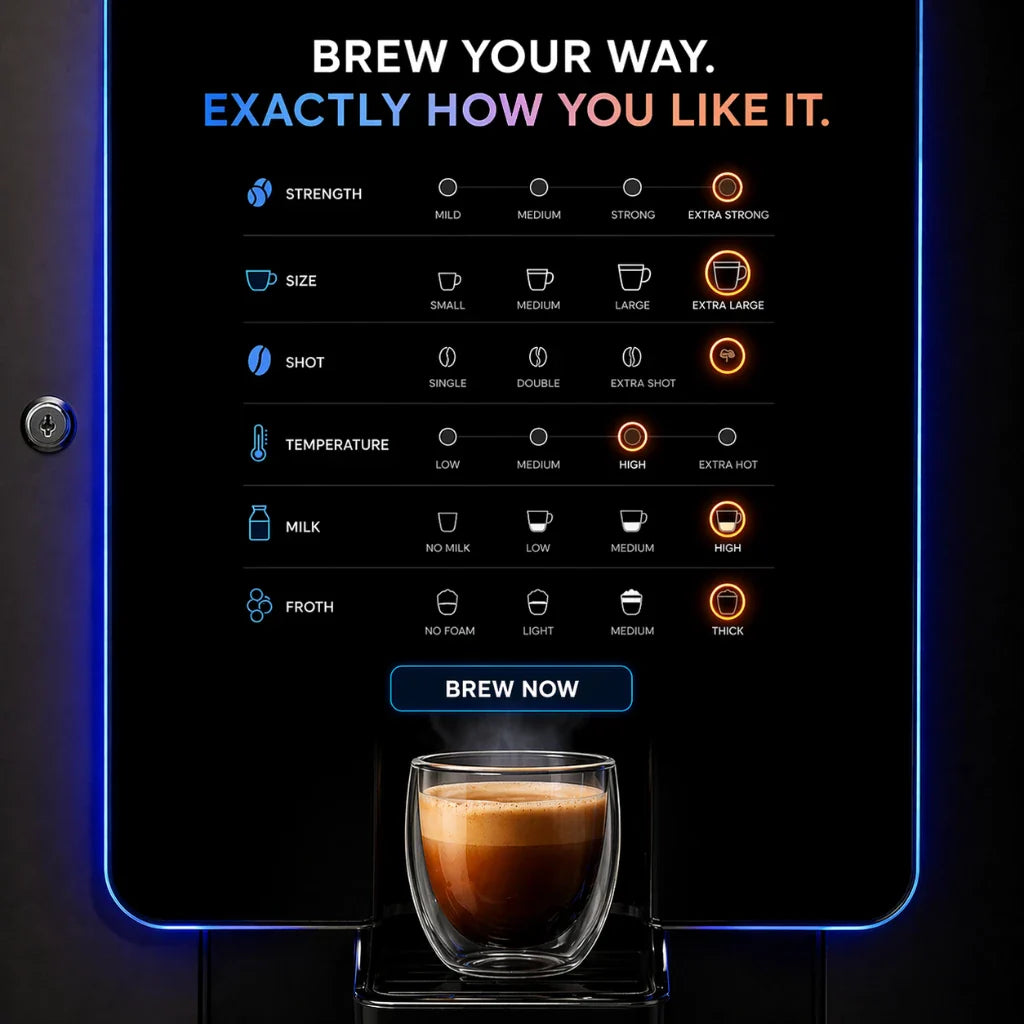
Modern commercial office coffee dispensers utilize high-resolution Android-powered capacitive touchscreens ranging from 7 inches to 15.6 inches. Intuitive interfaces reduce order friction, allowing employees to customize drink strength, milk foam density, cup sizing, and sugar levels in under 15 seconds.
Telemetry modules connect coffee machines to cloud-based management platforms via Wi-Fi, Ethernet, or 4G LTE cellular modems. Facility managers receive real-time alerts for low bean inventory, full waste grounds containers, water filter exhaustion, and active component diagnostics.
[Coffee Machine Sensors] ➔ [MDB 4.2 Telemetry] ➔ [Cloud Management Portal] ➔ [Real-Time Reorder/Maintenance Alert]
Commercial vending configurations integrate MDB (Multi-Drop Bus) 4.2 protocols to support contactless credit card readers, RFID employee badge access, and Apple Pay/Google Pay modules. Implementing cashless payment systems for coffee vending machines allows organizations to subsidize employee drink allowances while monetizing guest usage effortlessly.
Automated self-cleaning cycles prevent milk protein build-up and coffee oil rancidity inside internal fluid lines. High-end bean-to-cup machines execute automated Clean-In-Place (CIP) hot-water flushes after every milk-based drink selection and complete deep chemical cleaning routines at scheduled end-of-day intervals.
Removable brew groups allow staff to rinse the extraction chamber directly under tap water without specialized technician tools. Commercial units feature internal waste cake bins capacity rated for 30 to 50 used coffee pucks before requiring manual emptying.

Adhering to a standardized coffee vending machine cleaning and maintenance guide prevents emergency service calls and extends internal pump life past 100,000 brew cycles.
Spatial planning requires measuring cabinet depth, overhead clearance, water line access, and electrical circuit capacity prior to equipment delivery. Countertop machines typically require 400 mm to 600 mm of depth and up to 700 mm of height clearance to allow bean hopper refilling.
Allowing 50 mm to 100 mm of rear ventilation space prevents heat accumulation around internal power transformers and compressor cooling units. You can reference complete physical installation specs via this guide on office coffee machine dimensions.
Electrical requirements vary by heating output: compact countertop units run on standard 120V / 15A dedicated circuits (1400W–1800W), while high-capacity dual-boiler systems demand 208V–240V / 20A lines (2600W–3000W+) for rapid heat recovery.
Selecting the proper equipment ensures optimal performance, minimal maintenance, and maximum return on investment. Explore our complete commercial coffee vending machines collection to view full technical specifications.
For boutique firms and compact work environments, space efficiency and silent operation are critical.
Key Specs: Intuitive touchscreen interface, compact cabinet footprint, quiet grinder assembly, dual-beverage dispensing.
Best For: Executive suites, small agencies, and law firms needing low daily cup volumes with premium espresso quality.
Medium-sized workplaces demand higher hourly throughput, expanded beverage variety, and robust plumbing capabilities.
Top Model: Pro Coffee Vending Machine
Key Specs: Plumbed-in water supply line, multi-powder canister support, fast dispense speeds, automated self-rinsing.
Best For: Growing corporate offices, tech hubs, and regional operations centers balancing quality and volume.
High-traffic environments require heavy-duty floor-standing or high-capacity countertop systems designed for continuous operation.
Top Model: CorePro Coffee Vending Machine
Key Specs: High-capacity bean hoppers, MDB cashless telemetry compatibility, high-volume dual boilers, heavy-duty waste cake bin capacity.
Best For: Corporate breakrooms, hospital staff lounges, manufacturing plants, and high-footfall public facilities.
Organizations exploring remote or hybrid work environments can also evaluate best coffee machines for home office setups.
Evaluating technical specs side-by-side simplifies the procurement process across different organizational tiers.
| Technical Feature | Small Office Tier | Medium Office Tier | Large Enterprise Tier |
| Recommended Daily Output | 20–50 Cups | 50–150 Cups | 150–500+ Cups |
| Water Supply Architecture | 2L–4L Tank / Plumbed | Plumbed-In Direct Line | Plumbed-In Direct Line with Dual Filters |
| Grinder Engineering | Single Steel / Ceramic Burr | Dual Ceramic Flat Burrs | Heavy-Duty Commercial Ceramic Burrs |
| Thermal System | Single Thermoblock | Dual Thermoblock / Dual Boiler | Multi-Boiler Dedicated Steam & Brew |
| Payment & Telemetry | Basic Touchscreen | MDB 4.2 / Contactless Ready | Full Cloud Telemetry + RFID + Cashless |
| Waste Capacity | 15–20 Coffee Pucks | 30–40 Coffee Pucks | 50+ Pucks / Under-Counter Chute |
Acquiring a commercial office coffee system involves evaluating direct capital expenditure (CapEx) against long-term leasing or operating rental models. Outright purchase grants complete equipment ownership and avoids ongoing financing interest, but leaves routine maintenance costs on internal facilities budgets.
Equipment rental and leasing agreements bundle machine delivery, preventive service contracts, water filter replacements, and emergency repairs into a predictable monthly operational fee. Reviewing current coffee vending machine rental costs helps financial officers compare total multi-year equipment costs accurately.
Providing high-quality coffee perks increases in-office attendance and boosts morale. Investing in workplace amenities pays measurable retention dividends, as detailed in our analysis on retaining employees with premium coffee perks.
To maintain office harmony and operational standards, implement a standardized office coffee machine policy template covering breakroom cleanliness, user etiquette, and refill responsibilities. For broader equipment background, refer to our ultimate guide to office coffee machines.
Daily cup capacity and peak hourly throughput represent the most critical technical features. Matching boiler recovery speeds and pump durability to peak employee break times prevents mechanical strain, internal overheating, and morning breakroom queues.
Plumbed-in lines supply continuous water directly to internal boilers, eliminating manual reservoir refill labor. Connected inline water filters remove scale-forming minerals, preserving water quality and internal boiler lifespans.
Thermoblocks heat water instantly on demand through internal narrow channels, ideal for low to medium usage. Dual boilers maintain dedicated water volumes for espresso extraction and steam production simultaneously, delivering superior temperature stability during peak demand.
Milk lines require automated daily CIP flushing to eliminate bacteria and dairy residues. Brew groups require weekly rinsing, while internal descaling and filter replacements should occur every 3 to 6 months depending on local water hardness.
Yes, modern commercial machines equipped with cloud telemetry monitor real-time cup counts, component wear, and ingredient levels. Automated systems alert facility managers via cloud dashboards when beans, powders, or filter replacements are required.
Ceramic burrs are ideal for office environments because they generate less friction heat during grinding and operate at significantly lower decibel levels than steel burrs. Ceramic burrs also maintain sharp cutting edges up to three times longer.
Commercial coffee machines use MDB (Multi-Drop Bus) 4.2 controller interfaces to connect card readers, RFID badge scanners, and mobile wallet processors. This allows businesses to charge guest fees or implement employee card subsidies easily.
Compact machines run on standard 120V / 15A office outlets. High-capacity, multi-boiler systems require 208V–240V / 20A dedicated circuits to power high-wattage heating elements (2600W to 3000W+) efficiently.
Pre-infusion gently saturates compressed ground coffee under low pressure ($1$ to $3$ bar) before applying full extraction pressure ($9$ bar). This prevents water channeling through the puck, ensuring consistent flavor extraction across back-to-back drinks.
Purchasing outright minimizes long-term equipment costs if internal staff can manage routine restocking and basic maintenance. Renting includes preventive maintenance contracts, filter changes, and repair service within a fixed monthly operational expense.

Share:
Office Coffee Machine Latte Calories: Complete Nutritional and Calibration Guide
How to Report Illegal Food Vending - Step by Step Reporting Guide