



Design the perfect vending solution for your location and customers.

Sales, inventory and alerts for your whole route, from one machine to a fleet.
Answer a few questions about your location, products and budget and get a shortlist.
Estimate revenue, payback period and margin before you buy.
Sales, setup help, warranty and parts from the VMFS USA team.
Join the VMFS newsletter and step into a thriving network dedicated to collective success.
One signup. Endless possibilities.
There is a strange and stubborn tradition in this industry, and it is this: almost nobody has ever touched the machine they bought.
Think about how much money moves on a spec sheet and a rendered product photo. An operator commits four, six, sometimes fourteen thousand dollars to a cabinet they have only seen in pixels, shipped from a warehouse they have never visited, built by people they will never meet. It is a strange way to buy vending machines, and it has been the industry default for decades. They find out what they actually purchased on the day the crate lands in the parking lot. If the coil pitch is wrong for their product, if the screen is dimmer than the render, if the payment hardware was never configured, they discover it at the worst possible moment: after the money is gone and the location is waiting.
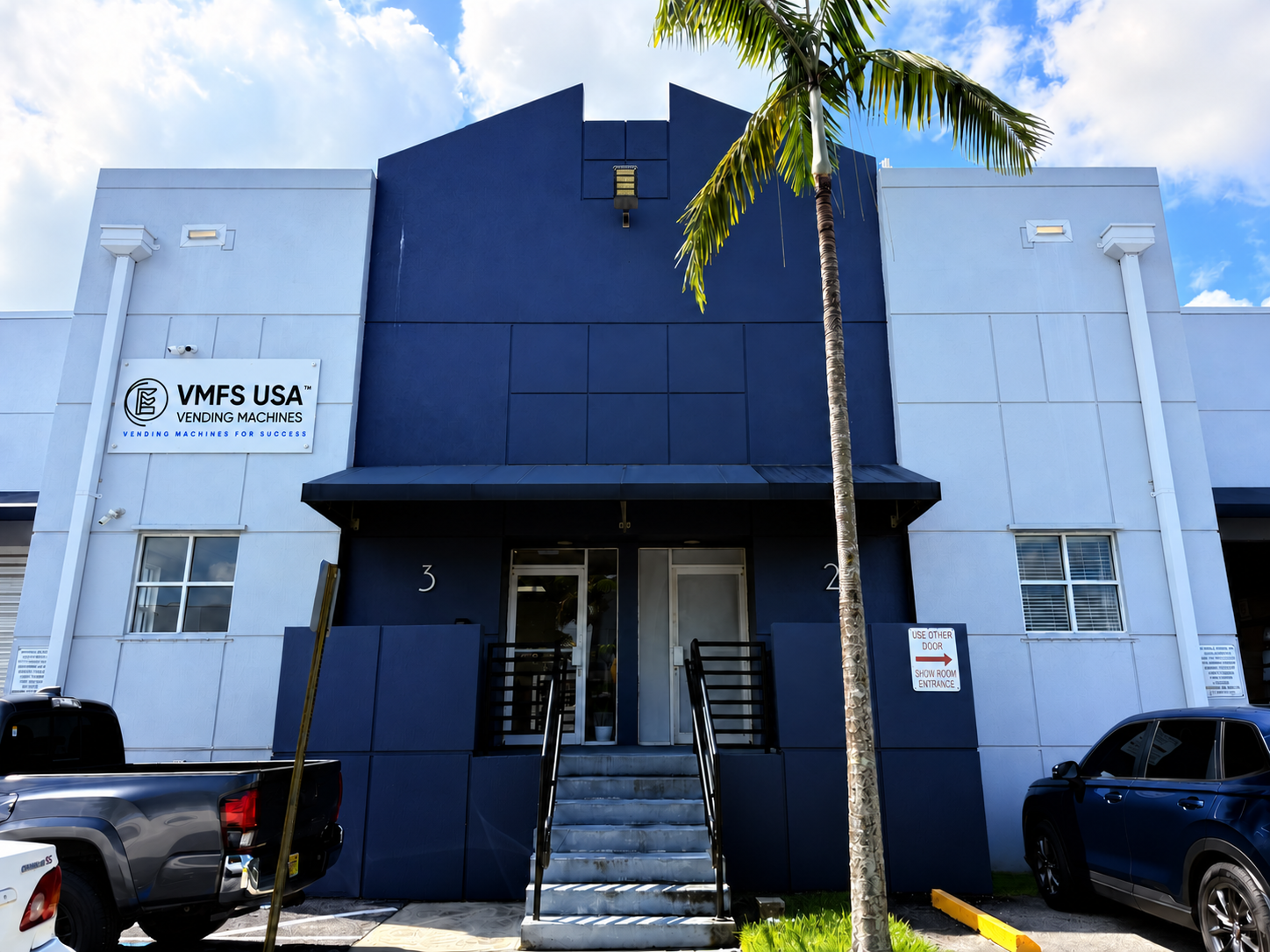
We have been quietly building the answer to that for a long time, and it is finally open. The VMFS USA Demo Showroom in Miami is a by appointment space where operators, brands, and property partners can see live automated retail hardware running before a single dollar changes hands. Behind it sits something bigger and frankly less glamorous, which is the part we are proudest of: an expanded Miami campus doing customization, quality assurance, assembly and order processing in house, a new research and development facility a short walk from the main building, and stocked shipping warehouses in Los Angeles and Atlanta feeding parts and machines out across the country.
Here is what all of it actually does for the person running the route, because that is the only measure that matters to us. If you would rather skip ahead and simply look at the hardware, the full catalog of vending machines for sale is filterable by location type, product, temperature and budget. Otherwise, stay with us, because the story behind the machines is the more useful one.
Most showrooms are museums. A fixed lineup gets installed once, the sales team learns the script, and three years later the same units are still standing in the same spots collecting the same dust while the catalog behind them has moved on entirely.
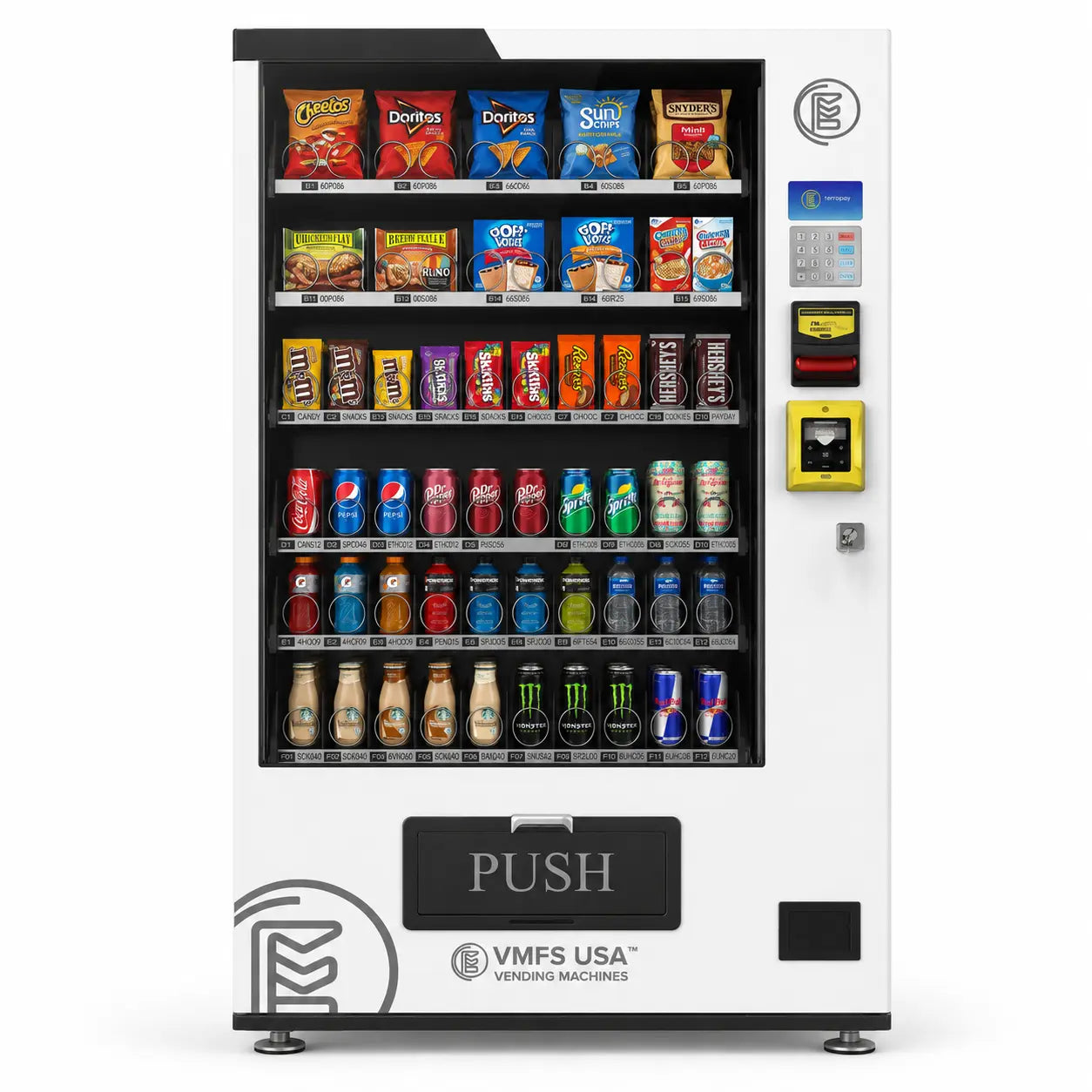
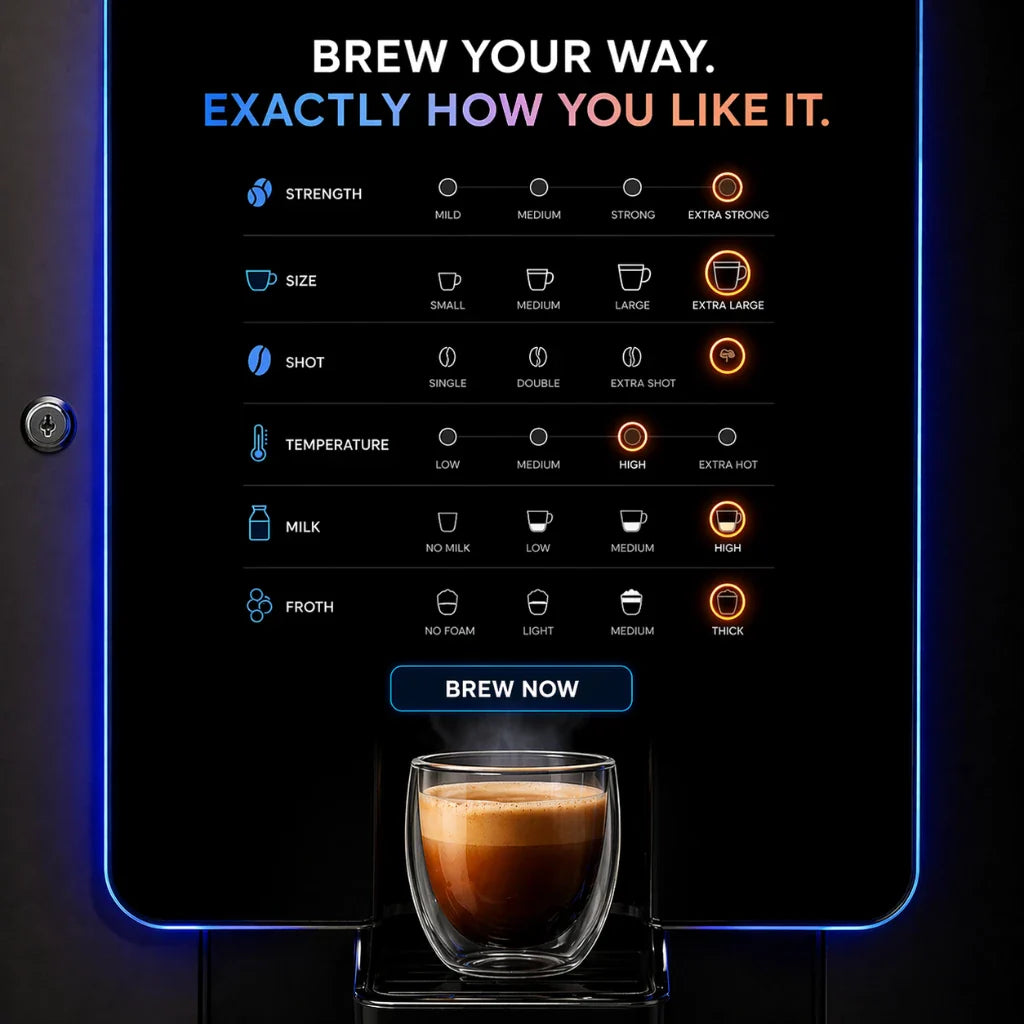
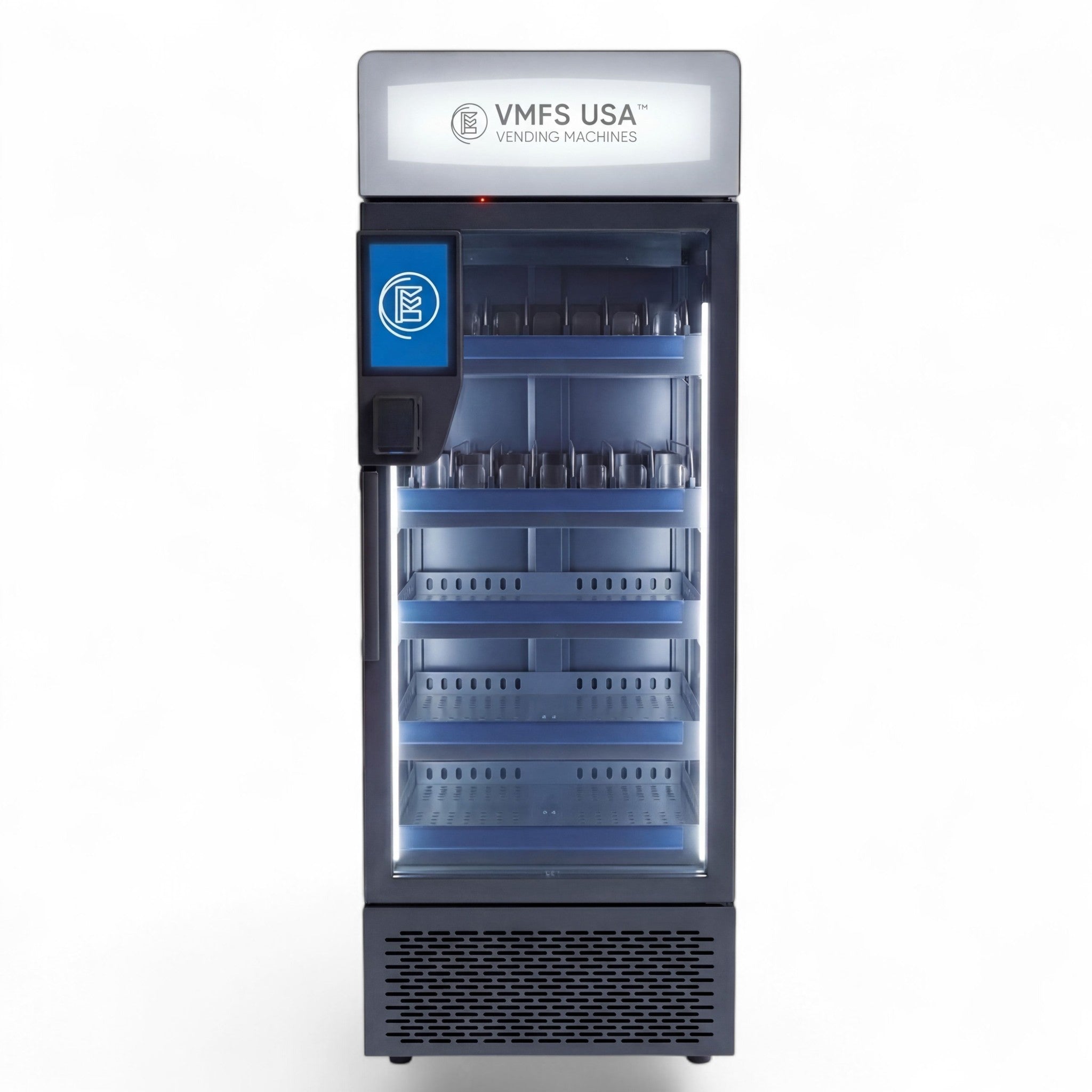
Ours rotates. The Demo Showroom runs on a revolving inventory model, which means the floor reflects whatever VMFS USA is actively building, testing, configuring and deploying at that moment. Visit in March and you might find the coffee lineup front and center with a print machine beside it. Visit in June and the floor could be weighted toward grab and go coolers and touchscreen combos because that is what is moving through the campus that month. It is a live cross section of the business rather than a curated highlight reel.

The floor rotates with what the campus is actively building, so no two visits look the same.
Every unit on the floor is a working machine, not a display shell. They run the same VMFS Cloud software, the same configurable payment hardware, and the same vision systems that our deployments run in the field. When you press a selection, the product drops. When the sale completes, it appears on the dashboard. When you pull a door open on a grab and go cooler, the recognition system does what it is going to do in your location, in front of you, with no salesperson standing between you and the result.
That distinction sounds small until you have been burned by it. A powered down cabinet with a printed sign taped to the glass tells you nothing about vend reliability, screen brightness under real lighting, dispense speed, the sound the conveyor makes in a quiet office, or how long a bean to cup cycle actually takes when someone is standing there waiting for it. Those are the details that decide whether a placement thrives or gets pulled in four months, and none of them live on a spec sheet.
A member of the team walks the floor with you. Not a scripted tour, a working conversation about your locations, your product mix, your foot traffic and your budget. If a machine on the floor is wrong for what you described, we will tell you it is wrong for what you described. Sending the wrong cabinet to the wrong site is a slow and expensive way to lose a customer, and we would rather lose the sale on Tuesday than the operator in six months.


Live units, powered and connected. Every machine on the floor runs the software your fleet would run.
We are not against spec sheets. We publish detailed ones, and every serious buyer should read them closely. The point is narrower than that: there is a specific category of information that simply does not survive translation into a table of dimensions, and it is exactly the category that determines whether a machine earns.
Cabinet noise is the one that surprises people most. A compressor cycle that is completely unremarkable in a busy gym becomes the defining feature of a quiet law office reception, and the property manager who signed your placement agreement will be the one who calls about it. You cannot learn that from a document. You learn it by standing in a room with the machine running and going quiet for thirty seconds.
The same goes for the software. VMFS Cloud is where the real operating leverage lives, with live sales, slot level stock, refill alerts, remote pricing and fleet visibility from one login, and it is a paid subscription at $7.99 per month per machine. We would much rather you sat down with it on the showroom floor, clicked through it, decided for yourself whether it fits how you work, and then made a call. Reading a feature list is not the same as using the thing.
The showroom is the front door. The neighboring VMFS USA facilities in Miami are where the actual work happens, and they now carry the full weight of customization, quality assurance, assembly and order processing.

Configuration and quality assurance benches sit on the same floor as the racked inventory.
Bringing this in house and onto one campus was not a cost decision. It was a control decision. When configuration happens somewhere else, you inherit somebody else's standard, somebody else's schedule and somebody else's definition of acceptable. When it happens on your own floor, you set all three. Every unit is configured, tested and branded to VMFS USA standards on site before it goes anywhere near a truck.
The phrase we use internally is that a machine should arrive ready to earn rather than ready to troubleshoot. Every step above exists because at some point an operator called us about a problem that should never have reached them, and the honest answer was that we had not owned enough of the process to catch it.


Intake, racking, staging and order processing all now run on the Miami campus.
Ask any operator who has been running machines for more than two years what genuinely hurts, and they will not say the purchase price. They will say the week a machine sat dead in a good location waiting on a part.
That is the quiet killer of vending economics. A machine that is not vending is not just earning nothing, it is actively burning the relationship with the property that gave you the space. Every day of downtime is a day the location manager walks past a dark cabinet and reconsiders the arrangement. The part itself might cost forty dollars. The delay costs the placement.
So the Miami campus now works in concert with VMFS USA shipping warehouses in Los Angeles and Atlanta, where the majority of products, replacement parts and components are stocked. Three coordinated points instead of one means the geometry of the country changes in your favor.
Additional strategic processing facilities are already in the pipeline, each one intended to strengthen the physical service side of this business: the hands on work of repair, replacement and field support that every machine eventually requires no matter how intelligent its software is.
And the effect compounds in a way that is easy to miss. Shorter freight distances lower cost. In house build capacity lowers defect rates. Stocked regional inventory shortens the gap between a part failing and a part arriving. Those three things pull in the same direction at once, which is why the result is more flexibility and more strength across the whole United States supply chain rather than a marginal improvement in one column of a spreadsheet.


Machines staged and wrapped for outbound freight across all fifty states.
A short distance from the main campus, a new research and development facility has opened, and it exists to answer one uncomfortable question honestly: does this actually work in an American location, or does it just work in a demo?

The Miami campus, where the showroom, the build floor and the R&D facility sit within walking distance of one another.
Plenty of hardware performs beautifully in a controlled room and then meets a Phoenix parking lot in August, or a Chicago loading dock in February, or a coastal Florida corridor where the humidity never really drops, and behaves differently. Compressors work harder. Screens read differently. Seals age faster. Payment hardware sees network conditions nobody modeled.
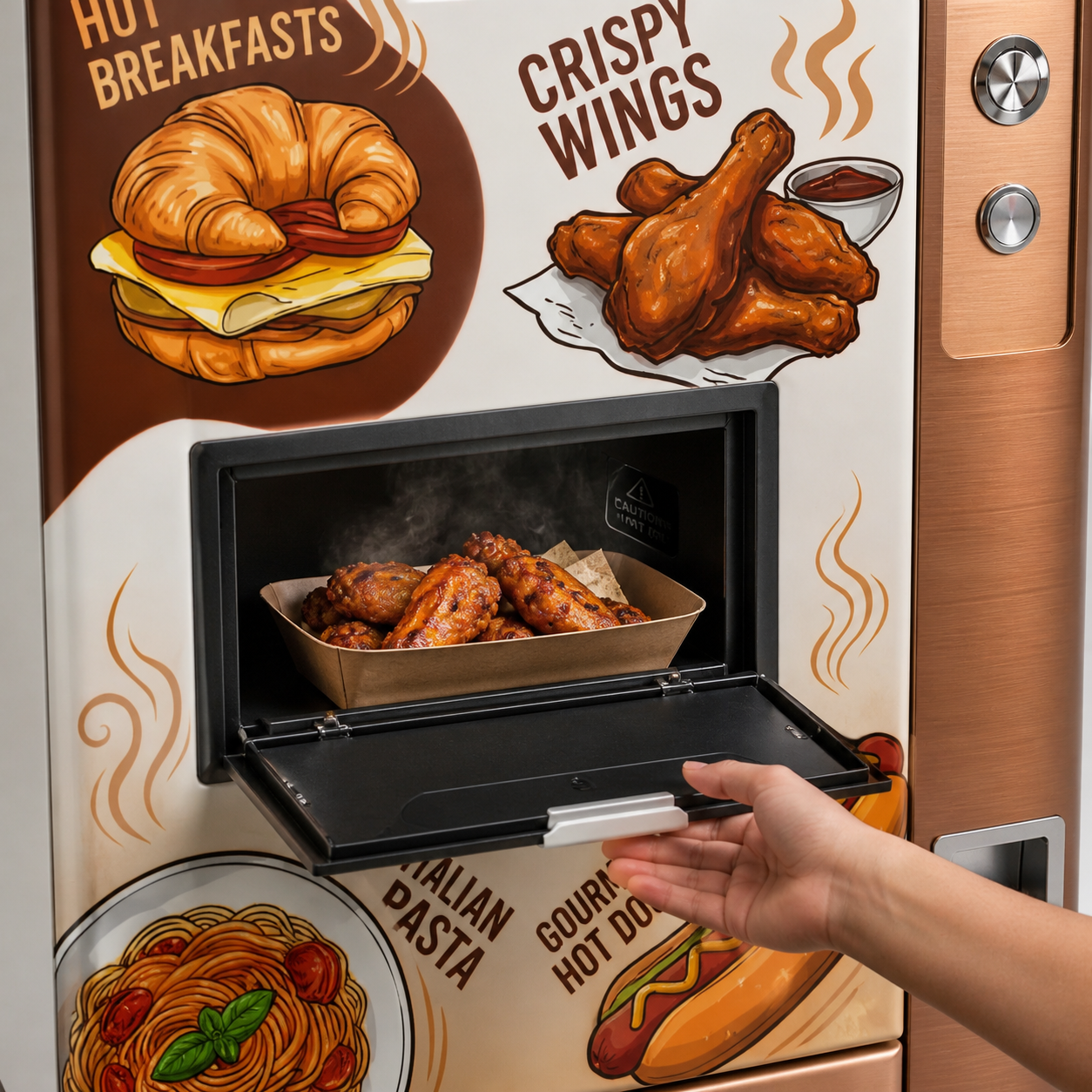
This is why we run pilot programs across hardware categories in real American sites rather than trusting a datasheet written for another market. Protein shake machines in gyms. Bean to cup coffee in workplaces. Hot food in night shift environments. Custom print units in high traffic retail. Outdoor rated cabinets in genuine outdoor heat. We specify equipment for the conditions it will actually live in, and when a pilot tells us something unflattering, that finding goes straight back into how the next unit gets built on the campus floor. If you operate a site that would make a good pilot location, that invitation is genuinely open.
Five years ago, most of what we are building on this campus was not practical to attempt. The technology caught up, and we made the decision to build here rather than wait for someone else to do it.
Infrastructure announcements are easy to write and easy to ignore, so here is the plain translation into things that affect your money.
You can evaluate before you commit. Whether you are weighing coffee vending machines for an office contract, comparing AI vending machines for a grab and go build, or looking at mini vending machines for a site with no floor space to spare, you can now do it standing in front of the hardware instead of squinting at a photograph.
Your machine arrives configured. Coils pitched to your product, payment hardware fitted and tested, cloud connection already proven on our floor. In stock units ship in seven to twenty one days, and lead times vary by machine and configuration because different builds genuinely take different amounts of work.
Downtime gets shorter. Three stocked distribution points mean a part is closer to you than it used to be, whichever coast you are on. Every machine carries a one year standard parts warranty, with extended two and three year options available, and that coverage is parts.
And the rest of the operating stack sits alongside it. Placement help runs through VPlaced, which matches operators with property partners and runs the free machine placement program where an operator installs and maintains a machine at a host site. Compliance questions, which get complicated fast once age verification or food handling enters the picture, are handled through VAdviced. These are services in a connected network rather than freebies bundled with a cabinet, and we would rather be straight about that than surprise you later.
Most people walk a showroom passively and leave with an impression rather than a decision. A visit is worth far more if you come loaded. Here is exactly what to bring and what to do.
Bring your actual product. Not a description of it, the physical item. Three or four of your trickiest SKUs, the awkwardly shaped ones, the ones that hang up in a coil. Load them and vend them. Ten minutes of this answers a question that months of emails cannot.
Bring a photo and measurements of the site. Doorway width, corridor turns, ceiling clearance, the location of the nearest outlet, and whether there is a step or a lip at the entrance. Delivery problems are almost always access problems, and almost all of them are discoverable in advance.
Know your foot traffic number, even roughly. A machine that suits four hundred daily passersby is a different machine from one suited to forty. If you do not know, count for two hours at your busiest window before you visit. It is the single most useful number you can carry into the room.
Run a transaction yourself. Do not watch someone demo it. Tap your own card, wait through the dispense, and then look at the dashboard entry it created. That full loop is the product you are buying.
Ask what breaks. Ask which component fails most often on the model you are considering, what the replacement costs, and how long it takes to arrive at your zip code. A supplier who cannot answer that has not thought about your second year.
Price the whole configuration, not the cabinet. No payment system is standard on any machine here, so card reader, contactless tap, bill acceptor, ID scanner where you need one, wrap, and the VMFS Cloud subscription all belong in your number. Build the real total before you compare anything.
Come with your financing question ready. We do not offer leasing, machines are purchase only, and financing runs through registered outside partners including PayPal, Klarna and ClickLease. Knowing which route you are taking before you walk in keeps the conversation on hardware.
Software and machine intelligence in this industry have moved at a genuinely startling pace. Vision systems, cloud fleet management, dynamic pricing, real time stock visibility: the things that were research projects a few years ago are now ordinary expectations. According to industry bodies including NAMA, the convenience services sector has been reshaped more by that software layer in the last decade than by anything on the mechanical side.
But warehousing, parts logistics, service capacity and assembly throughput did not automatically move with it, and that gap is where operators actually get hurt. The most intelligent cooler in America is worth nothing to you on the fourth day it has been waiting for a compressor. We are investing heavily in the physical infrastructure precisely because it is the half nobody puts in a launch video.


Loading bays on the Miami campus, where outbound freight leaves for all fifty states and Latin America.
Together the showroom, the campus, the R&D facility and the national distribution network are built to serve every part of this business at once, from enterprise accounts and custom commercial builds down to the first time operator placing a single machine in a laundromat. The first time operator matters just as much here, because that person becomes the twenty machine operator in three years if the first one does not go badly.
If you are on the growth side of that, the wider network is there when you need it: marketing and search visibility for your route through VMarketed, and consumer discovery for your placed machines through VendingFinder, which puts live machines on a public map so customers can find yours before they walk past it.
Thank you to every operator, partner and team member who told us plainly what was broken. This campus is largely a list of your complaints, taken seriously and then built into concrete and racking. Keep telling us. It works.
Showroom visits are by appointment. Operators evaluating a first deployment, existing operators scaling a fleet, and property partners exploring placement are all welcome on the floor.
Browse vending machines for saleVMFS USA builds, configures and ships new vending machines to operators across all fifty states and a growing Latin American market, backed by VMFS Cloud software, configurable payment hardware, AI vision and fleet management. Explore the full range of combo vending machines and every other category in the catalog, or plan a visit to the Miami showroom. Designed, built and configured in Miami.
Share:
Can You Use Food Stamps on Vending Machines? SNAP EBT Rules
Do Pokemon Vending Machines Stop Selling at Night?