




Design the perfect vending solution for your location and customers.

Join the VMFS newsletter and step into a thriving network dedicated to collective success.
One signup. Endless possibilities.
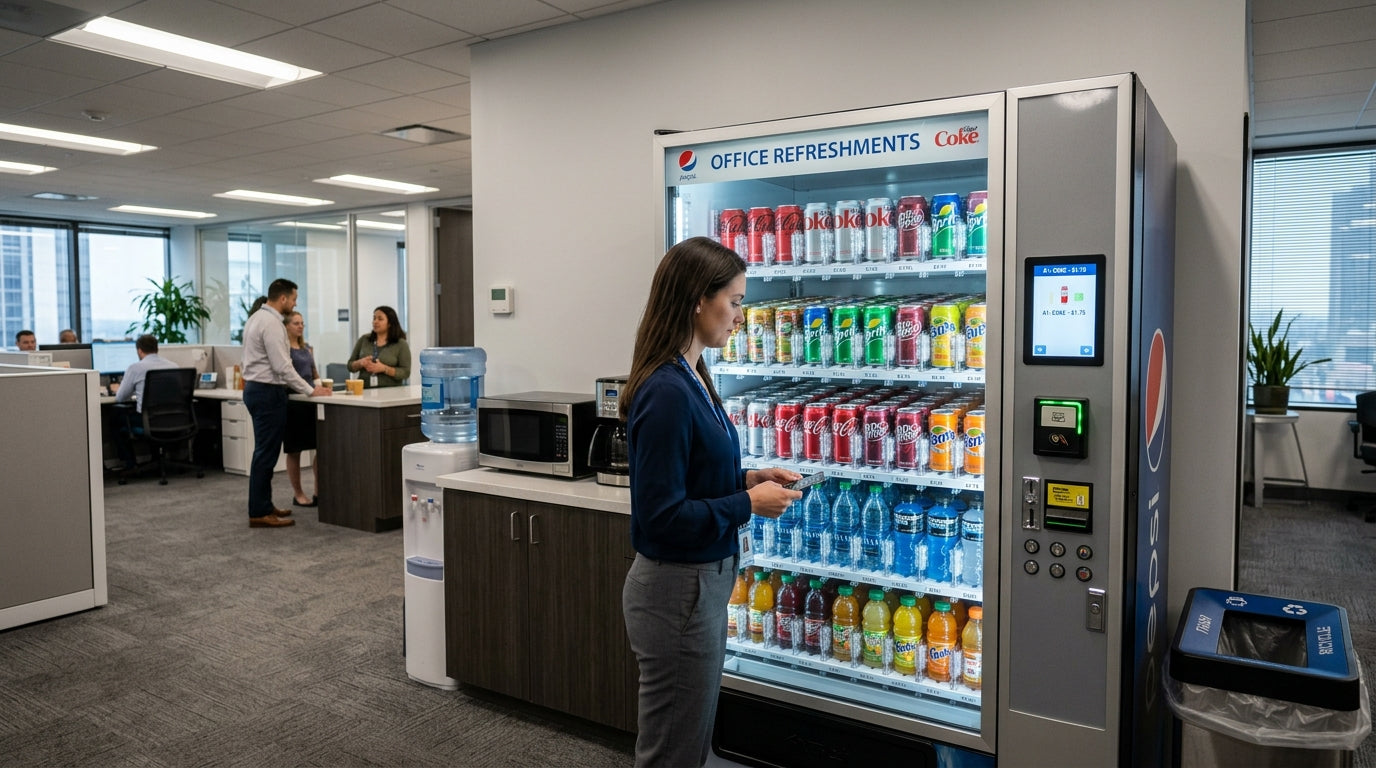
A drink vending machine for office use keeps employees hydrated without a walk to the corner store, and it does so at a predictable monthly cost once you know what you're buying. Offices account for roughly a quarter of all vending machine placements in the United States, second only to manufacturing sites, according to 2026 vending machine industry data from Market.us. This guide walks through pricing, capacity, placement rules, compliance requirements, and how to pick the right unit for a break room of any size.
Quick takeaways
A new office-grade drink vending machine costs $4,000 to $6,000, while combo snack-and-drink units run $3,000 to $5,500.
Break room machines typically hold 150 to 300 cans, well below the 500+ capacity built for high-traffic public locations.
Controls, coin slots, and dispensing trays must sit between 15 and 48 inches from the floor to meet ADA reach-range rules.
Free placement through an operator is often more cost-effective for a single office than buying outright. See the comparison below.
A drink vending machine for office use is a refrigerated, coin-and-card-operated cabinet installed in a break room, lobby, or corridor that dispenses canned or bottled beverages on demand. It differs from a public-venue machine mainly in scale: office units are built for a captive, repeat-visit population of a few dozen to a few hundred people rather than the transient foot traffic of a mall or transit hub, so they run smaller, quieter compressors and lower-capacity columns. Because the population is fixed and predictable, office machines are also the easiest category to size correctly, since you know your headcount before you buy, which removes most of the guesswork that trips up vending buyers in public locations.
Offices represented about 25.4% of all vending machine placements tracked in a 2026 industry survey, trailing only manufacturing sites at 30.2%, and commercial offices accounted for 22.18% of vending transaction value in 2025 according to Mordor Intelligence's global vending machine market report. That scale is why manufacturers build office-specific configurations rather than treating every buyer the same as a stadium or airport operator.
Three configurations cover nearly every office scenario, and the right one depends on headcount, floor space, and whether snacks need to share the footprint.
A dedicated drink machine devotes its entire refrigerated cabinet to beverages, which means deeper columns, more facings per selection, and a glass front that lets buyers see exactly what's cold. This is the right call when the office already has a separate snack station or micro-market and simply needs beverage capacity. Dedicated units also tend to run more efficient compressors per can stocked, since the whole cabinet is optimized for one refrigeration zone instead of splitting cooling between a drink section and an ambient snack section.
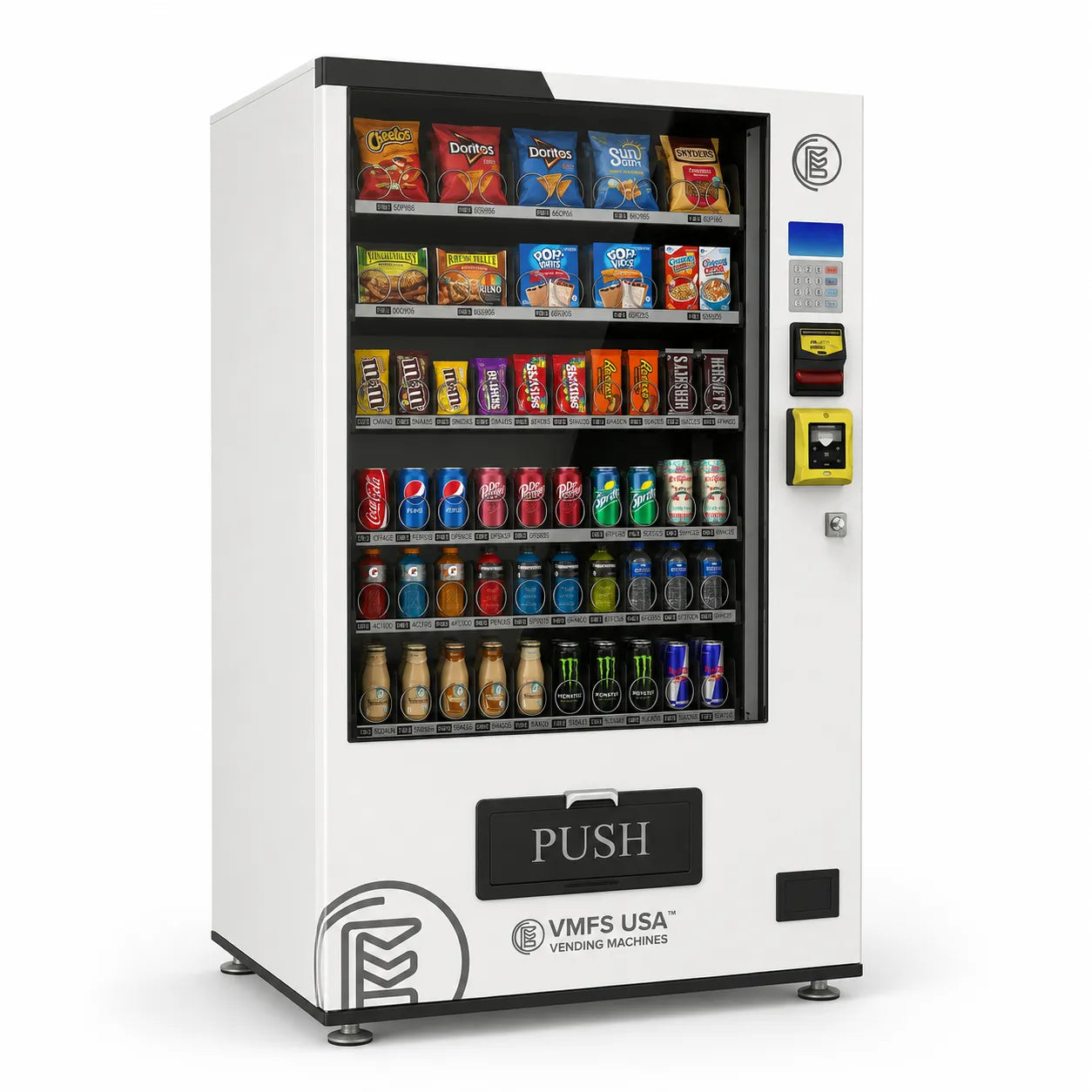
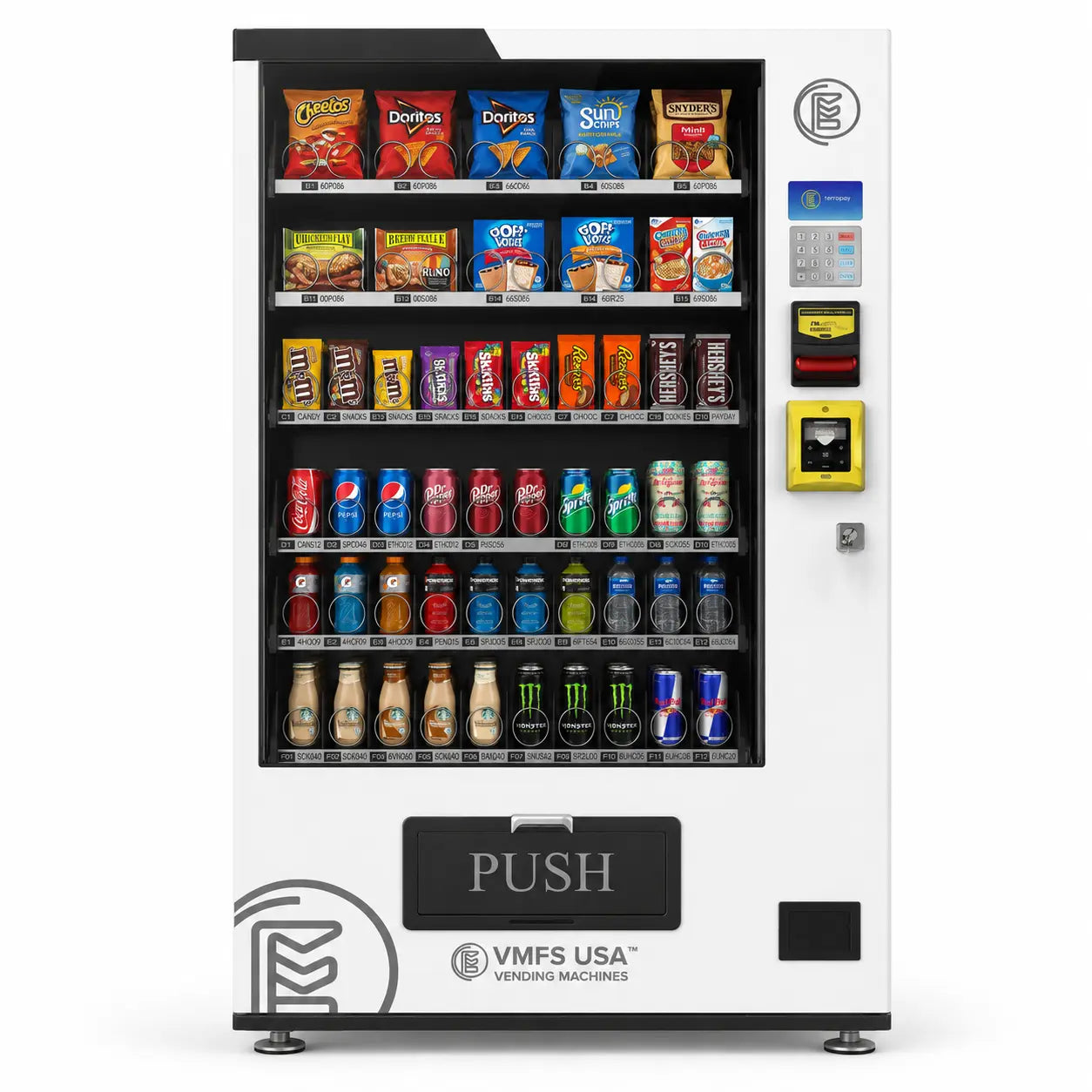
A combo machine splits one cabinet between refrigerated beverages and ambient snacks, which is the most common choice for small-to-midsize offices that don't have room for two machines. The tradeoff is capacity: a combo unit typically holds fewer drinks than a dedicated beverage machine of the same footprint because part of the cabinet is reserved for snack trays. For an office under roughly 75 people, that tradeoff is usually worth it, since one combo machine covers both needs in the space a single unit would take.

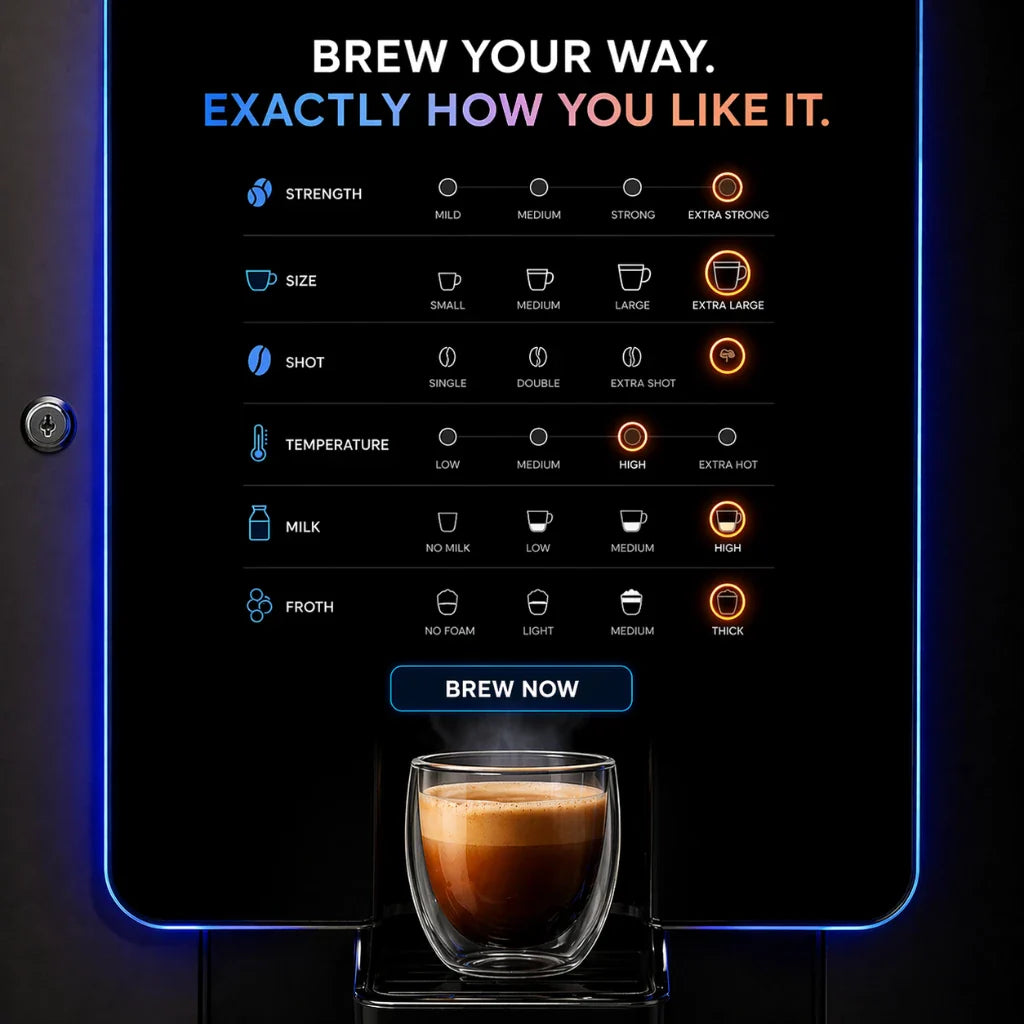
Cashless payment is no longer an upgrade. It's the default. Over 60% of new vending machines now ship with card readers and mobile payment support, and cashless already accounts for 75.8% of global vending transaction volume according to Grand View Research's 2026 market analysis. Smart machines add telemetry that reports stock levels remotely, which matters more for offices than it sounds: it lets an operator or facilities team restock on a schedule instead of discovering an empty machine when an employee complains.
Ready to Equip Your Break Room?
Browse ready-to-ship drink vending machines or configure a custom unit built for your office's headcount and floor plan.
A new refrigerated drink vending machine costs between $4,000 and $6,000 in 2026, roughly $1,000 to $1,500 more than a comparable snack machine because of the added compressor, insulation, and evaporator hardware. Combo snack-and-drink units run $3,000 to $5,500 new. Used and refurbished drink machines are available for $1,500 to $3,000 and can be a reasonable option for a first office installation, provided the compressor and door seals are inspected before purchase.
Beyond the purchase price, budget $50 to $150 per machine per month for restocking, electricity, and payment-processing fees. A standard-efficiency refrigerated machine draws 3,000 to 5,000 kWh per year, which is one reason electricity shows up as a meaningful line item even in a small break room. For a full breakdown of financing options, lease-to-own structures, and what drives price up or down, see our drink vending machine pricing guide.
Office break room machines typically hold 150 to 300 cans, compared with 400 to 500+ cans in machines built for shopping centers or transit hubs. For a typical office of 50 to 100 employees, a 200-to-300-can capacity or a 150-to-200-drink combo unit is the most common fit, large enough to cover a week or two of demand without letting product sit long enough to go stale in low-turnover slots. A full-size dedicated beverage machine commonly measures around 72 inches tall, 47 inches wide, and 32 inches deep, though dimensions vary by manufacturer and column configuration, per Dimensions.com's beverage vending machine specifications.
A single vertical column typically holds around 60 cans, and most drink machines stack 6 to 9 columns behind separate selection buttons. Combo units sacrifice one or more of those columns for snack trays, which is why a combo machine's drink capacity runs lower than a dedicated unit of similar overall size. For a granular breakdown of can counts by model and column count, our drink vending machine capacity guide walks through the math for each configuration.
Beyond the machine's own footprint, plan for at least 30 inches of clearance in front for restocking access and door swing, plus a few inches of side and rear clearance for compressor airflow, since tight clearances cause compressors to run longer and hotter, which shortens their service life. Full dimensional drawings for common office-format machines, including door-swing radius and delivery-access requirements, are covered in our drink vending machine dimensions reference.
Placement determines usage more than machine quality does. A machine tucked into a rarely-visited corridor will underperform an identical unit placed on the path between desks and the restroom, elevator bank, or main break room, simply because visibility drives impulse purchases. Facilities teams generally get the best return by placing the machine where employees already pass multiple times a day rather than creating a new destination trip.
A dedicated 20-amp, 115-volt circuit is the standard electrical requirement for a refrigerated vending machine. Running one off a shared or daisy-chained outlet is the single most common cause of nuisance compressor trips. Ventilation matters too: the compressor exhausts heat from the rear and sides, so placing a machine flush against a wall or inside an unventilated closet will shorten compressor life and raise the electric bill through inefficient cycling.
Break rooms, near elevator lobbies, and adjacent to high-traffic hallways consistently outperform low-visibility placements. For a broader look at how placement location affects sales volume across different facility types, not just offices, see our guide to best placement locations for a drink vending machine.
Any vending machine that is bolted, secured, or wired into an office building is subject to ADA operable-parts rules because it counts as a fixed element of the accessible route. Under the 2010 ADA Standards, every operable part, including selection buttons, coin slots, card readers, and the product-delivery bin, must sit no higher than 48 inches and no lower than 15 inches from the finished floor for an unobstructed side reach, per the U.S. Access Board's official guide to operable parts. This replaced the older 1991 standard, which allowed reach as high as 54 inches, so a machine installed under the earlier rule may need to be re-mounted or replaced to stay compliant.
A clear floor space of at least 30 by 48 inches must be maintained directly in front of the machine so a wheelchair user can approach for either a forward or side reach. Because the ADA scoping rule requires at least one of each type of vending machine on a floor to meet these standards, a facility installing a single drink machine per break room should treat every unit as the compliant unit by default rather than assuming an exemption applies.
Calorie labeling on vending machine beverages is a federal requirement, but only for operators who own or operate 20 or more machines. The FDA's vending machine labeling final rule, issued under Section 4205 of the Affordable Care Act, requires those operators to disclose calorie counts at the point of purchase, either through a sign next to the selection button or front-of-package labeling visible through a glass-front cabinet. The compliance date for most provisions was December 1, 2016.
A single office buying one or two machines for internal use, rather than operating a vending route, falls below the 20-machine threshold and is not required to comply, though operators who prefer to disclose calories voluntarily can register with the FDA using Form 3757. If your office contracts with a third-party vending operator that services multiple client sites, confirm whether that operator crosses the 20-machine threshold, since the labeling obligation follows the operator, not the individual location.
Refrigeration is the largest energy draw on any drink vending machine, which is why the ENERGY STAR label matters more here than on most office equipment. Current-generation ENERGY STAR certified refrigerated beverage machines run about 9% more efficient than standard models on average, saving roughly 1,000 kWh per year, according to the EPA's ENERGY STAR vending machine program page. Certified units also ship with a low-power mode that drops lighting and refrigeration into a reduced-energy state during off-hours, which is especially useful for an office machine that sits idle overnight and on weekends.
On the purchasing math, the U.S. Department of Energy's Federal Energy Management Program calculates that an ENERGY STAR-qualified refrigerated beverage machine pays for itself over its lifetime as long as it costs no more than about $97 more than a less efficient comparable model, with the best available models saving up to $264 over their service life, per DOE FEMP's guidance on purchasing efficient vending machines. Choosing a lower global-warming-potential refrigerant, such as R-290 or R-600a, further reduces environmental impact if the unit is ever serviced or decommissioned.
Most offices don't need to own a machine to offer vending. A vending operator will often install, stock, and service a machine at no upfront cost in exchange for a location commission on sales, a model sometimes called free placement. Buying outright makes sense when the office wants full control over pricing, product mix, and branding, or when it plans to run the machine as a small internal revenue source rather than purely an employee amenity.
Free Placement: Pros
No upfront equipment cost or maintenance burden on facilities staff.
Operator handles restocking, repairs, and cash collection.
Lower administrative overhead, with no business entity or tax registration needed.
Free Placement: Cons
Limited say over product selection and pricing.
Commission revenue is modest compared to full ownership margins.
Service response time depends entirely on the operator's schedule.
The economics of self-operating have gotten tighter industry-wide. U.S. vending machine operator revenue has actually declined at a 3.8% compound annual rate between 2021 and 2026 as consumer habits shifted toward retail loyalty programs and delivery apps, per IBISWorld's Vending Machine Operators industry report. For a single office with modest, predictable foot traffic, that trend makes free placement through an established operator the lower-risk starting point, with the option to buy a machine later once demand is proven.
Have Space, Not a Machine?
List your office as a vending location and get matched with a qualified operator who supplies, stocks, and services the machine for you.
List Your Office as a Vending LocationIf your office decides to buy and self-operate a machine as a small revenue line, say a company store fund or an employee-owned break room concession, it's worth separating that activity from personal liability the same way any small vending operation would. Structuring it as a formal entity, most commonly a single-member or multi-member LLC, keeps a mechanical failure, a slip-and-fall near the machine, or a product liability claim from reaching personal assets, and it gives you a clean structure for tax reporting on vending income separate from payroll.
The formation steps are the same as any small business: choose and register the entity, obtain an EIN, register for sales tax collection in your state if applicable, and put a location or revenue-sharing agreement in writing with the building owner if the office space isn't wholly your own. None of this is required for a company simply installing a machine as an employee amenity funded from the general budget. It only applies once the machine is treated as its own small revenue-generating operation.
Need to formalize a self-operated vending line?
Our partner site walks through entity selection, registration, and liability protection specific to vending operations.
Form an LLC for a Vending Machine BusinessDay-to-day operation of an office drink machine is straightforward, but two issues account for most employee complaints: selection errors from worn spiral coils, and items that stick in the delivery chute rather than dropping. Neither requires a service call in most cases. Our step-by-step walkthrough on how to use a drink vending machine covers selection, payment, and troubleshooting basics for employees, while our guide on how to get a stuck drink out of a vending machine covers the safe, warranty-preserving methods for freeing a jammed can or bottle without shaking or rocking the cabinet, which can damage the compressor mounts.
On the maintenance side, wipe down the exterior and door gasket weekly, keep the rear ventilation clearance free of stored boxes or furniture, and schedule a coil cleaning roughly twice a year to keep the compressor from overworking in a warm break room.
Match the machine to headcount and space before comparing brands. A small office under 30 people rarely needs more than a compact or slim-profile unit; a mid-size office of 50 to 150 benefits from a full combo or dedicated drink machine; and any office running a shared cafeteria or multi-department floor should consider a smart, telemetry-enabled unit so restocking can be scheduled proactively instead of reactively.
Compare Office-Ready Models
Five configurations built for the office headcounts and floor plans described above.
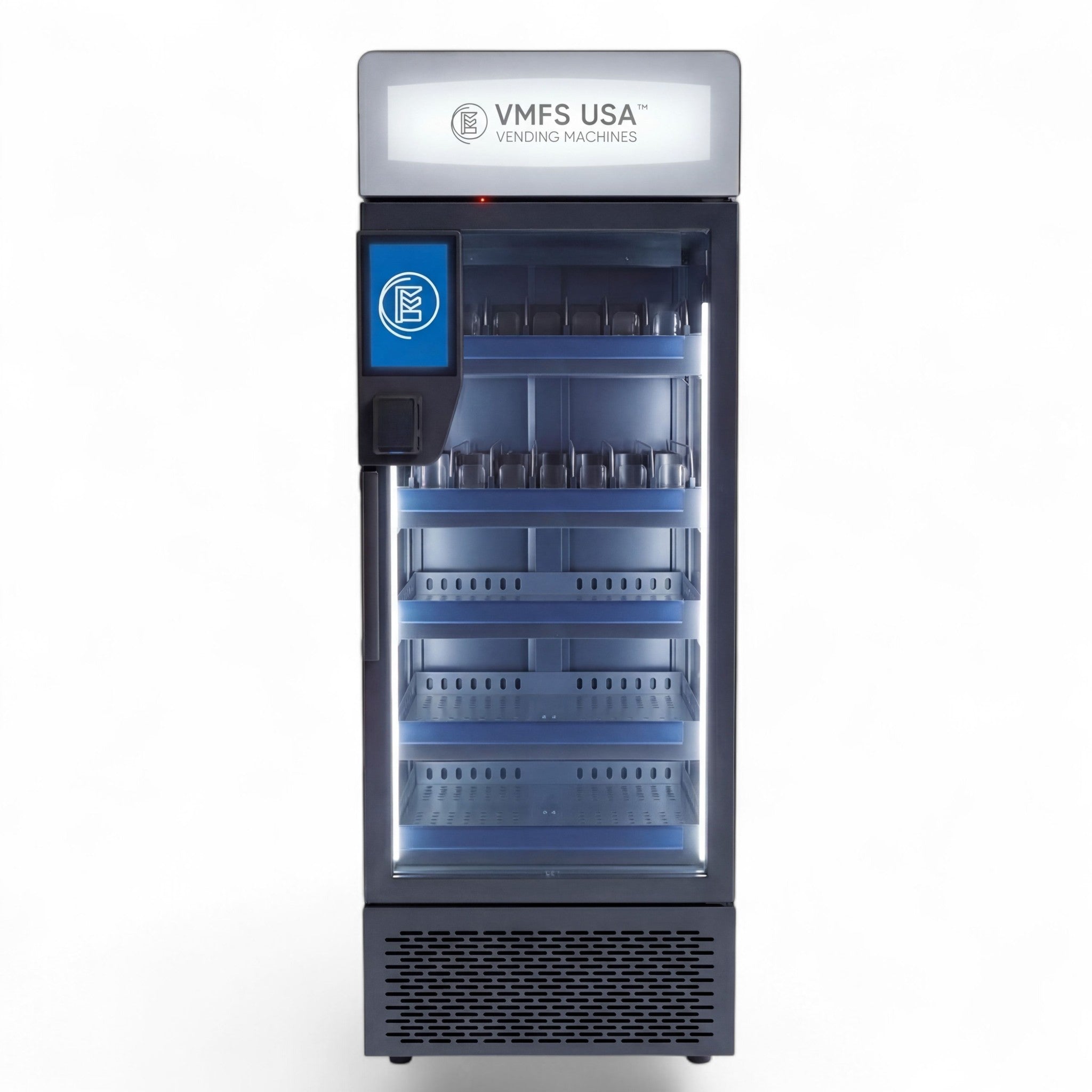
Once headcount and footprint narrow the shortlist, the deciding factors are usually refrigeration capacity, payment technology, and whether the cabinet needs a snack section at all. A dedicated beverage machine wins on can capacity and visibility; a combo unit wins on footprint efficiency; a smart machine wins on operational visibility for facilities teams managing multiple floors or buildings.
Frequently Asked Questions
Share:
Pokemon Vending Machine Drop Times: When Machines Actually Restock
Pokemon Vending Machine Maintenance Guide: How Long Does It Actually Take