




Design the perfect vending solution for your location and customers.

Join the VMFS newsletter and step into a thriving network dedicated to collective success.
One signup. Endless possibilities.
The hardest part of small format vending is not the machine. It is finding a room where the machine earns.
Full size cabinets solve that by brute force: put a 40 inch unit somewhere with 500 people a day and it works. Compact units do not get that luxury. A countertop machine in the wrong salon does $40 a month and a countertop machine in the right one does $350, and the hardware is identical.
So this guide is about the rooms rather than the equipment. Seven location types that consistently pay, what each one buys, and how to tell a good one from a flattering one before you deliver anything. If you already know the site and just need to match a format to it, mini vending machines cover every compact configuration mentioned below.
Three reasons, and none of them are about trends.
The placement conversation is easier. A salon owner who refuses a 72 inch cabinet will often say yes to something sitting on a shelf, because you are not asking them to give up floor space they pay rent on.
The cost of being wrong is small. If a compact unit underperforms in 60 days, you move it. Getting a full size placement wrong ties up several thousand dollars in a room that will not produce.
And large operators genuinely do not want these sites. A 35 person office, an 80 member studio, a car wash with a 20 minute wait. None of that is worth the route time of an operator running 200 machines, which leaves the whole segment open to anyone building locally.
Compact machines have a narrower margin for error, so the qualifying question is not "does this place have people in it." It is a specific combination.
The dwell time rule: at a small venue, roughly 20 minutes of captive waiting converts better than three times the foot traffic with no waiting. A 12 chair salon with 45 minute appointments beats a corridor with 300 people walking through it.
Dwell time runs 45 to 90 minutes and the customer is seated with nothing to do. That is close to ideal.
Keep the product set neutral and light. Water, flavoured drinks, mints, small snacks. Nothing that smells, nothing messy, nothing a stylist has to clean up.
Expect $150 to $350 a month. The placement barrier is almost zero if you use a counter unit rather than asking for floor space.
Smaller membership than a commercial gym, but members visit more often and the average ticket is far higher. Protein products and electrolytes outsell everything ambient.
Expect $250 to $600 a month, which is the strongest of the seven. The trade-off is stock rotation, since chilled product punishes an operator who visits irregularly.
The pricing and planogram logic differs enough from other small venues that it is worth reading the full breakdown on gym vending machines before you stock one.
Steady weekday traffic from people who arrived without food. Under 50 desks is exactly the size large operators skip.
Property managers here are usually professional and quick to decide, which makes them some of the easiest placements to close. Expect $200 to $500 a month.
A compact vending machine system suits this well, since coworking members want both a snack and a drink and will not walk to two machines.
A guest at 11pm is not leaving the property. They will use whatever is near the elevator, at whatever price is on it.
Properties with 50 to 150 rooms are accessible to independent operators in a way large chains with corporate vending contracts are not. Expect $200 to $500 depending on occupancy.
This is where narrow footprints earn their keep. A slim combo vending machine fits corridors where a standard 35 to 40 inch cabinet simply will not go, which is the difference between winning the placement and never being considered.
Wait times of 20 to 45 minutes, a stationary audience, and no food competition inside the building. On paper this is the best of the seven.
In practice it is the fussiest. Keep it neutral: water, mints, light snacks. Nothing strong smelling, nothing that looks indulgent in a clinical setting.
Product rules also tighten here, since some facilities and some states restrict what can be sold on medical premises. VAdviced covers vending compliance and licensing as a paid service in the network if you are unsure what applies. Expect $150 to $400.
Pure wait-based revenue. Customers are stuck for 20 to 45 minutes and there is nothing else to do.
Car washes are the better of the two because the customer has already spent $15 to $30 and is in a spending frame of mind. Laundromats skew heavily to weekends, so plan your service around that rather than a fixed weekday.
Keep prices accessible here. This is the one segment on the list where the audience is genuinely price sensitive. Expect $150 to $400.
The most overlooked segment on the list, and the one that scales best.
A single 30 person office is a modest site. Five of them within ten minutes of each other is a real route, and almost nobody is competing for them because the economics do not work for a large operator.
Offices also pair well with a separate coffee solution, and the two conversations often happen together. Our guide to the best coffee machine for an office covers that side. Expect $150 to $400 per location.
| Location | Dwell time | Monthly gross | Difficulty to close |
|---|---|---|---|
| Boutique gym | 45 to 90 min | $250 to $600 | Medium |
| Coworking space | Full day | $200 to $500 | Low |
| Boutique hotel | Overnight | $200 to $500 | Medium |
| Salon or studio | 45 to 90 min | $150 to $350 | Low |
| Medical waiting room | 20 to 45 min | $150 to $400 | High |
| Car wash or laundromat | 20 to 45 min | $150 to $400 | Low |
| Small office | Full day | $150 to $400 | Low |
Four compact formats, and the choice is almost always dictated by the space rather than by preference.
Sits on a counter or shelf, no floor footprint to negotiate. These produce the easiest placement conversations you will ever have because the machine asks almost nothing of the owner.
A countertop vending machine carries 60 to 120 items and suits reception areas, salons, and offices under 30 people. Modest revenue, near zero barrier.
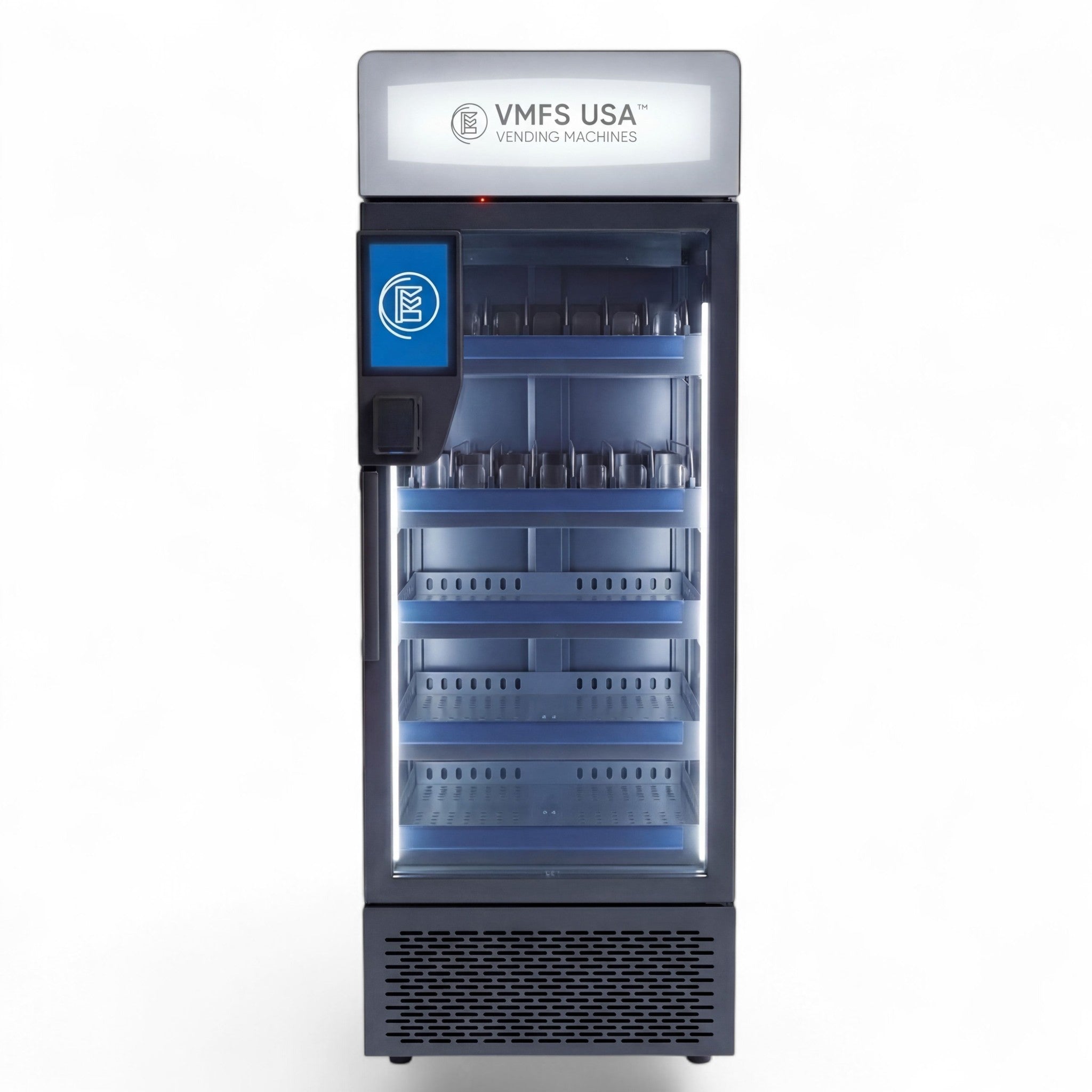
Twelve to sixteen inches wide against 35 to 40 for a standard cabinet. That gap is the entire reason the format exists.
They carry 100 to 200 items, take card and contactless, and run on a standard outlet. Hotel corridors, clinic hallways, and breakrooms already half-consumed by a coffee station.
Snacks and drinks from one compact footprint. One outlet, one agreement, one service trip.
Best where you get one spot and one chance. When a venue outgrows the compact unit, the natural upgrade is a full size cabinet from the combo vending machines range without renegotiating the placement.
Refrigerated compacts lift average ticket sharply but demand tighter rotation. If you cannot visit often enough to rotate properly, start ambient and add chilled once the site proves out.
At sites where members carry no cash at all, AI grab and go vending machines in a compact footprint let someone tap once and take several items, which lifts basket size well above a single-vend unit.
Every revenue figure above is gross. Here is what a $400 a month countertop unit leaves you after everything.
| Line | Amount | Note |
|---|---|---|
| Gross sales | $400 | Salon or waiting room |
| Cost of goods at 50 percent | minus $200 | Buy at club stores |
| Venue commission | $0 | Most small venues take nothing |
| Payment processing at 2.75 percent | minus $11 | |
| Card reader and telemetry | minus $18 | Fixed regardless of machine size |
| Electricity | minus $10 | Ambient. Chilled runs higher |
| Insurance, allocated | minus $15 | Spread across the route |
| Net monthly | $146 | Roughly 37 percent of gross |
Small machines net a higher percentage than large ones. Not because they earn more, but because most small venues take no commission at all. That 15 to 20 percent a commercial site would take stays with you, which is why five small sites frequently beat one large one on the same gross.
At $146 a month, a $1,500 countertop unit pays for itself in about ten months. A $3,000 slim unit at a $600 site clears in roughly twelve. Track it per machine rather than as a route average, using the method in tracking vending machine ROI per machine.
Keep it to 8 to 12 SKUs on a snack unit and 6 to 10 facings on a chilled one. Too much choice slows decisions and builds waste a small machine has no capacity to absorb.
| Location | Stock | Avoid | Price band |
|---|---|---|---|
| Salon or studio | Water, flavoured drinks, light snacks, mints | Heavy meals, energy drinks | $2 to $4 |
| Boutique gym | Protein bars, electrolytes, water | Sugary soda, candy | $3 to $6 |
| Coworking | Mixed snacks, sparkling water, coffee | Heavy junk sets | $2 to $5 |
| Hotel corridor | Snacks, water, soda, mints | Anything perishable | $3 to $6 |
| Medical waiting room | Water, light snacks, mints | Strong smelling food | $2 to $4 |
| Car wash or laundromat | Soda, water, chips, gum | Premium health items | $1.50 to $3 |
Facing and rotation matter more on a compact unit than a large one, because there is no depth to hide a mistake in. The mechanics are in the guide to loading and stocking a vending machine.
Use two or three price bands only. Value, standard, premium. A unique price per slot creates hesitation in a machine with very little real estate to work with.
Put your two best sellers at eye level and group by need rather than by category. Protein together, light snacks together, drinks in one clean band.
And price for access, not against a grocery store. A slim unit in a hotel corridor at midnight has no competition, and pricing it as though it does gives away margin nobody asked you for. Working the numbers per item is covered in vending machine margin per item.
Any compact machine worth buying takes card and contactless. Cash only is close to fatal at these venues, since almost nobody in a salon, gym, or coworking space carries notes.
Check MDB compatibility before you buy, especially on cheaper countertop units. A machine that cannot accept a standard MDB payment device locks you out of both cashless and telemetry permanently, and there is no software fix for it.
Telemetry matters more on a small route than a large one. With fewer machines, each one has to perform, and a stockout on an 80 item unit costs a far higher share of potential revenue than one empty row in a 300 item cabinet.
VMFS Cloud provides live sales data, low stock alerts, and machine status at $7.99 a month, which lets you service the machines that need it instead of running a fixed schedule that wastes trips on full units. The full feature set is in introducing VMFS USA Cloud.
| Format | New unit price | Typical payback |
|---|---|---|
| Countertop unit | $800 to $2,500 | 6 to 14 months |
| Slim floor unit | $1,500 to $4,000 | 8 to 16 months |
| Small combo unit | $2,000 to $5,000 | 9 to 18 months |
| Mini chilled unit | $2,000 to $4,500 | 8 to 15 months |
Most operators spread the cost rather than paying outright. Vending machine financing runs through registered outside partners, which keeps working capital free for inventory rather than sunk into hardware on day one.
A salon owner is not thinking about revenue share percentages. They are thinking about three things and none of them is money.
Answer all three in the first minute. Show a photo of the unit in a comparable venue, give the exact footprint in inches, and confirm every service call comes to you. Most small venue owners say yes once those are off the table.
If you would rather not build a cold list at all, vending machine placement runs as a service in the VMFS network, matching operators to venues that have already been qualified.
Most small venues take no commission. The machine is a perk for their customers rather than a revenue line, which is why the free placement model dominates this segment.
That does not mean skip the agreement. A handshake with a salon owner is worth nothing when they redecorate and want the counter back. One page covering footprint, access hours, electricity, and notice period is enough.
The trade-offs between commission, flat rent, and free placement are laid out in commission vs rent vs free placement.
Compact machines have almost no buffer stock. A stockout on an 80 item countertop unit is a much bigger problem than one empty row in a 300 item cabinet.
Once you have four or five sites, route order starts to matter more than visit frequency, and the sequencing is worked through in vending machine restock scheduling and routes.
One warm drink or one expired label kills the buying habit at a small venue faster than anything else, because the customer base is small enough that word travels.
Overstocking a countertop unit. Filling every slot feels prudent and is not. It builds waste, buries your best sellers behind slow movers, and makes the machine hard to read at a glance.
Trusting enthusiasm over traffic. A delighted property manager with 20 people a day walking past is still a bad site. Count before you deliver.
Buying the cheapest unit without checking MDB compatibility. You lock yourself out of cashless and telemetry from day one, at exactly the venues where nobody carries cash.
Skipping the agreement because it felt informal. The most avoidable mistake on this list.
Moving the machine before moving the product. Two slow visits usually means the wrong SKU, not the wrong room. Swap the product first. If it is still flat after that, relocate vs pull the machine covers how to decide.
You are on track when two or three items sell out before everything else at every service, chilled write-offs stay under 5 percent of stock, and your service trips get less frequent as your picklists sharpen.
The fixes are small and fast. Stockouts mean adding a facing or raising the par. Slow movers get one cycle at eye level before you pull them. One change per service cycle, measured across two visits, tells you what you need.
Once two sites are running clean, replicate the pattern rather than diversifying into unfamiliar venue types. The framework is in deciding which machine types and locations to replicate.
Anywhere with dwell time above 15 minutes and no convenient food alternative. Boutique gyms produce the highest revenue at $250 to $600 a month because the ticket is larger. Coworking spaces and small offices are the easiest to close and scale best as a cluster. Salons, medical waiting rooms, car washes, and laundromats all work on the same principle: a seated or waiting audience with nothing else to do.
Less than people expect, because dwell time matters more than volume. A 12 chair salon with 45 minute appointments outperforms a corridor with 300 people walking straight through. As a rough floor, look for 20 or more people a day who are stationary for at least 15 minutes within sight of the machine.
Gross revenue typically runs $150 to $400 in salons, waiting rooms, car washes, and small offices, and $200 to $700 in gyms, coworking spaces, and hotels. Net is around 35 to 40 percent of gross, which is higher than large format because most small venues take no commission. A $400 a month unit nets roughly $146 after cost of goods, processing, telemetry, electricity, and insurance.
Usually not. Free placement is the normal model at this size, because the machine functions as a customer perk rather than a revenue line for the owner. That is a large part of why small format nets a higher percentage than commercial placements, where 15 to 20 percent of gross goes to the venue. Get the arrangement in writing regardless.
More often than a full size unit, not less. Compact machines carry 60 to 200 items against 300 or more, so there is very little buffer. Start at two to three visits a week for busy gyms and offices, weekly for salons, hotels, clinics, and laundromats, then adjust from sell-through data once you have a few weeks of it.
Yes, and more than a large one does. Salons, gyms, coworking spaces, and boutique hotels serve audiences who routinely carry no cash at all, so a cash only unit is invisible to most of the room. Confirm MDB compatibility before buying any compact machine, because a unit that cannot accept a standard payment device is locked out of both cashless and telemetry with no upgrade path.
Small format vending is a location business wearing a hardware costume. The machine is nearly interchangeable. The room is not.
Qualify on dwell time, confirm there is no easy alternative nearby, match the footprint honestly, and get one page signed before you deliver anything.
When you know the room and need the format, the full range of mini vending machines for sale covers countertop, slim, small combo, and compact chilled configurations, with in stock units shipping in 7 to 21 days and a one year parts warranty.
If the site turns out bigger than you expected, you can buy vending machines across every full size format too, or see the complete lineup of vending machines alongside placement and compliance support.
Share:
How Age Verification Vending Machines Work: Every Option Compared
How to Make Money With a Gym Vending Machine in 2026