




Design the perfect vending solution for your location and customers.

Join the VMFS newsletter and step into a thriving network dedicated to collective success.
One signup. Endless possibilities.
-->
Everyone in vending has heard the same pitch. Micro markets generate more revenue. Customers spend more per visit. The numbers are better. And on the surface, the pitch is not wrong. Cantaloupe's 2025 Micropayment Trends Report confirmed that consumers spent 53% more at micro markets than at vending machines in 2024. Micro market locations grew 28% in a single year. The format crossed $1 billion in annual sales.
But here is what the pitch leaves out. William Blair, the investment banking firm that tracks unattended retail, published a clear finding alongside all that growth data: theft has limited micro market rollout to secure workplace settings where employee trust and surveillance are easier to manage. The format that outperforms on revenue also carries risks that can quietly destroy the margin advantage it creates.
This guide gives operators the full picture. Real costs, real revenue data, real theft numbers, and a clear decision framework for which format wins at which location. No software vendor pitch. No cheerleading for one format over the other. Just the math.
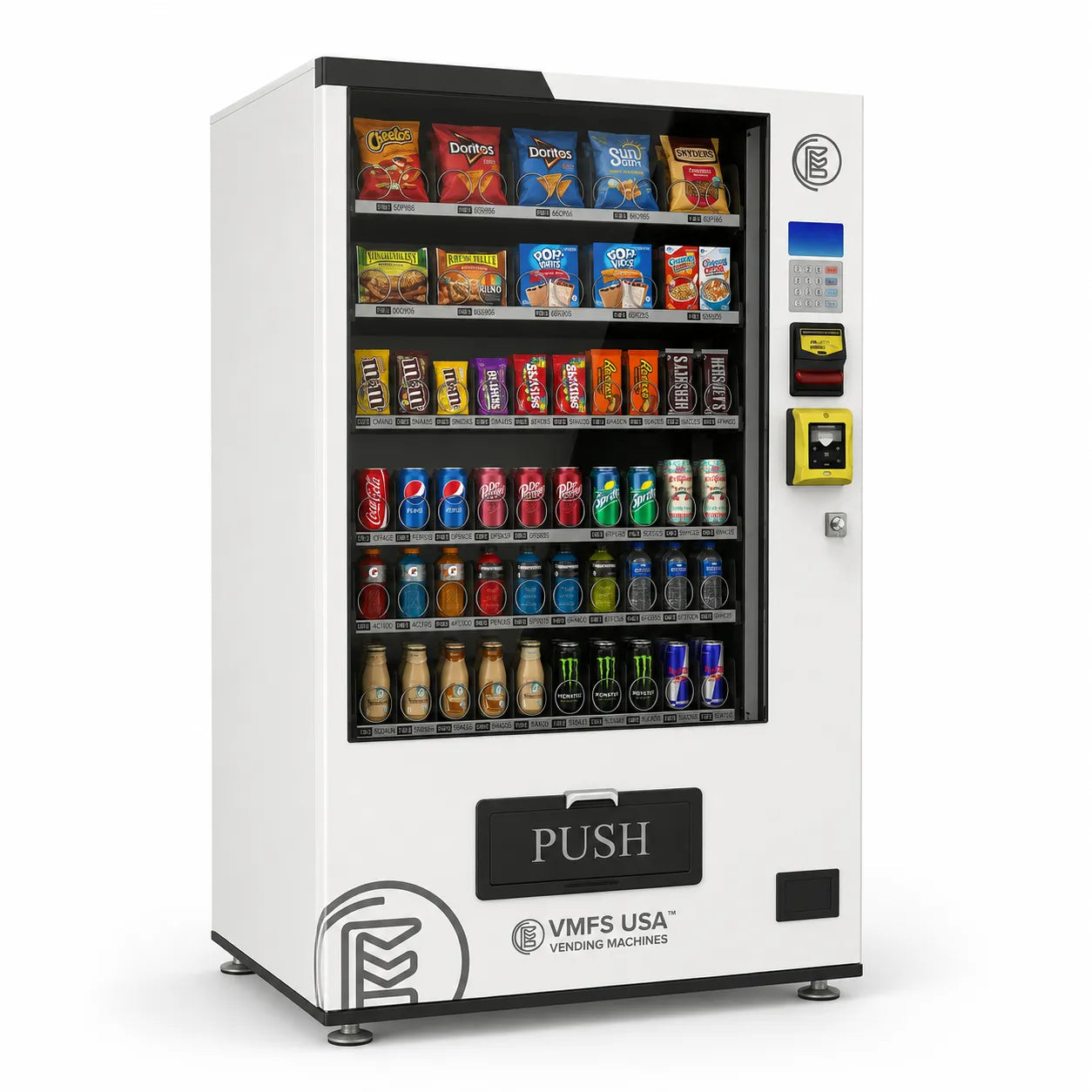
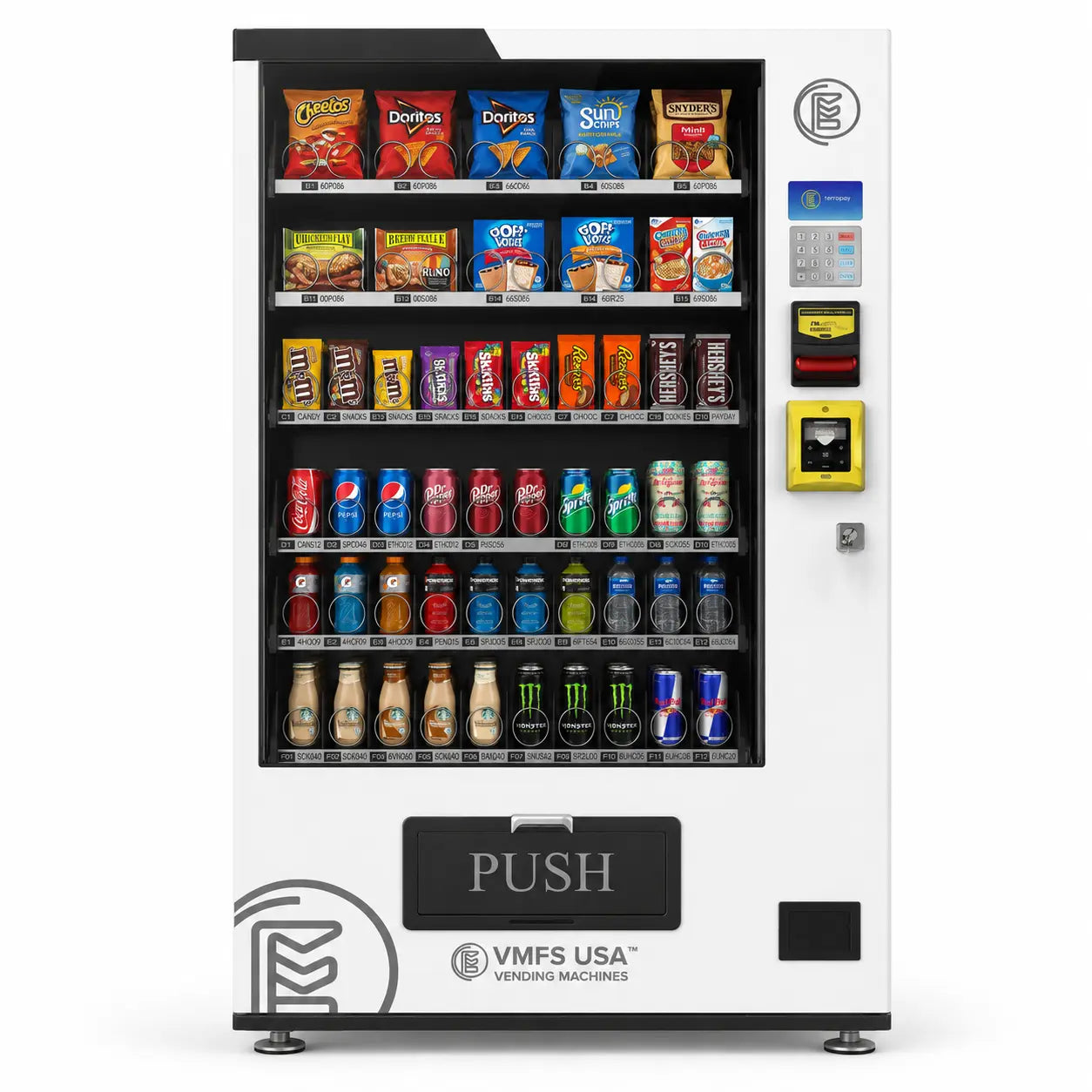
A vending machine is a locked, enclosed unit. Customers select a product, pay, and the machine dispenses it. The product cannot be touched before purchase. Operators looking to buy vending machines today will find formats ranging from slim vending machines at 12 inches wide all the way to large combo snack-and-drink units built for break rooms serving 200 people. Theft from a locked machine requires physically breaking into it, which is obvious, rare, and typically caught on camera.
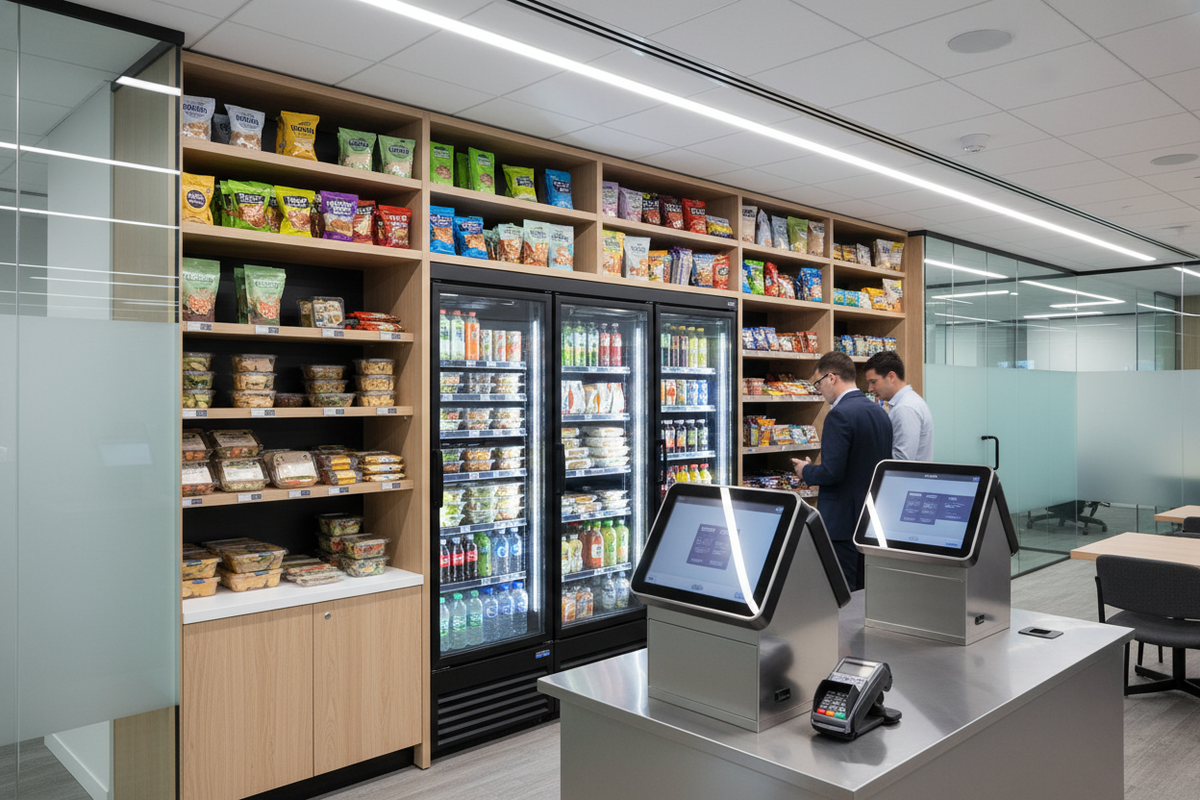
A micro market is an open-shelf, unstaffed convenience store format. Products sit on racks, in coolers, and on shelves in an accessible area. Customers grab what they want, walk to a self-checkout kiosk, and pay. Nothing physically prevents a customer from taking a product without paying. The entire model runs on trust, camera surveillance, and the social accountability of a workplace or closed environment.
That distinction is not a minor operational detail. It is the single most important factor in deciding which format belongs at a given location.
| Factor | Vending Machine | Micro Market |
|---|---|---|
| Product access | Locked. Dispensed after payment. | Open shelves. Customer grabs before paying. |
| Product range | Typically 40 to 60 SKUs | 150 to 400 plus SKUs including fresh food |
| Average monthly spend per customer | $7 per month (365 Retail Markets data) | $20 per month (365 Retail Markets data) |
| Theft risk | Low. Locked product, break-in required. | Higher. Open shelves require surveillance and trust. |
| Space required | Single machine footprint. Fits almost anywhere. | Minimum 150 square feet for a functional setup. |
| Suitable location types | Any location with foot traffic and power access | Closed-loop secure environments only |
| Upfront investment | $4,000 to $10,000 per machine | $10,000 to $20,000 per setup |
The revenue advantage of micro markets over vending machines is real, well-documented, and consistent across multiple independent sources. The disagreement between operators is not about whether micro markets generate more revenue. They do. The disagreement is about whether that revenue advantage survives when you factor in higher operating costs, theft, service frequency, and the narrower range of locations where micro markets can actually be deployed.
This is the same scenario used by Parlevel Systems and confirmed by 365 Retail Markets with their own location data. A 200-person white-collar office, no in-and-out public traffic, two snack and two beverage combo vending machines against a comparable micro market setup. Operators who already run new vending machines at office accounts will recognize these numbers immediately.
| Metric | 4 Vending Machines | Micro Market Setup |
|---|---|---|
| Upfront setup cost | $10,000 | $12,000 |
| Monthly revenue (200 employees) | $1,200 | $4,000 |
| Gross margin (40%) | $480 | $1,600 |
| Break-even period | 17 to 21 months | 7 to 8 months |
| Year 1 net profit (after break-even) | $2,400 to $3,360 | $12,000 to $14,400 |
The numbers are not close. At a qualifying location, micro markets are significantly more profitable, break even faster, and generate far more revenue per employee per month. Nayax data shows operators making 65 to 70% more sales with a micro market than with traditional vending at the same location. That is the honest case for micro markets.
Every micro market analysis that leads with revenue but skips operating costs is doing operators a disservice. The margin advantage of a micro market is real. So are the additional costs that compress it. For operators evaluating the full capital picture before committing to either format, flexible vending machine financing is worth understanding early rather than after you have already signed a placement agreement.
A vending machine can be visited once or twice a week based on sell-through data from your cloud vending management platform. A micro market requires daily visits at minimum. Open shelves that look half-empty signal abandonment to employees and reduce purchases. The micro market format sells more partly because it looks like a well-stocked store. The moment it starts looking depleted, that advantage erodes.
Daily service visits versus twice-weekly visits translate directly into route driver time, fuel, and labor cost. For an operator running ten locations, the difference between vending and micro market service frequency can mean the difference between needing one part-time driver and two full-time ones. That labor cost never shows up in the revenue comparison tables that micro market vendors publish.
Micro markets stock fresh food. Salads, sandwiches, yogurt, and fruit are a primary reason employees spend more per visit. They are also a primary source of write-offs. Fresh product that does not sell by its expiration date is a direct cost to the operator. Vending machines stocked with packaged shelf-stable products, whether standard combo vending machines or mini vending machines in tighter spaces, carry near-zero waste from expiration.
Industry leaders document shrinkage rates under 2% as a benchmark for operational maturity in micro markets. Operators starting out regularly hit 5 to 8% before they dial in their ordering. Every percentage point of shrinkage at a $4,000 monthly revenue location is $40 to $80 per month in pure loss.
This is the cost that separates functional micro market operators from operators who got burned. William Blair's research documented it clearly: theft has limited micro market rollout to secure workplace settings precisely because the open-shelf format cannot survive in high-turnover or public environments.
An office of 200 long-term employees who see each other daily has strong social accountability. A distribution center with 300 workers across three shifts and high turnover does not. The same micro market that generates $4,000 a month in one location generates $4,000 minus $400 to $800 in theft losses in another location that looks superficially similar on paper.
| Additional Operating Cost | Vending Machines | Micro Markets |
|---|---|---|
| Service visit frequency | 2 to 3 times per week, data-driven | Daily minimum to maintain shelf appearance |
| Fresh food waste | Near zero (shelf-stable products) | 2 to 8% of stock depending on operator discipline |
| Theft and shrinkage | Near zero (locked product) | 2 to 10% at mature vs new installations |
| Inventory management complexity | Low. Planogram-based, predictable SKUs. | High. 150 plus SKUs, fresh rotation, expiry tracking. |
| Camera and security infrastructure | Optional | Required. Non-negotiable for theft control. |
The honest answer to micro markets vs vending machines is not a format question. It is a location question. The format that wins is the one matched correctly to the environment it is placed in.
Vending machines win at every location where the micro market format would either lose money, fail to get placement, or underperform because the environment does not support open-shelf trust. Operators who buy vending machines for these location types are making the right call for the right reasons.
Micro markets win at a specific and well-defined location type: large, secure, closed-loop environments with consistent employee populations and strong social accountability.
This is the angle most comparison articles miss entirely. Both vending machines and micro markets have been transformed by AI-powered management systems, and that transformation affects the cost comparison in ways that were not true five years ago.
Modern AI vending machines use computer vision to track which products customers interact with, generate predictive restocking recommendations, flag maintenance issues before they cause downtime, and feed real-time sales data to a cloud vending management platform. The practical result is that the service cost disadvantage of vending compared to micro markets is narrower than it used to be. A well-monitored machine on a data-driven route requires fewer unnecessary service trips and fewer stockouts than an operator guessing from weekly drive-bys.
Cantaloupe's Seed Copilot, launched at NAMA 2025, lets operators ask plain-language questions about their route performance and get AI-generated answers. Which locations are underperforming? Where is the most spoilage happening? What prices should adjust? Operators running new vending machines with telemetry built in get this data automatically without any manual logging. These tools compress the operational gap between vending and micro markets for operators who use them.
Micro markets running computer vision technology, where cameras track product selection and payment confirmation, represent the highest-performing version of the format. They generate the revenue advantage of open-shelf browsing while closing a significant portion of the theft gap through real-time detection.
The limitation is cost. Computer vision micro market infrastructure runs $15,000 to $25,000 per installation before inventory. That investment is justified at a high-revenue corporate campus. It is not justified at a 150-person distribution center where monthly revenue does not support the payback period. In those environments, a pair of AI vending machines with smart inventory alerts delivers data-driven operations at a fraction of the cost.
| Technology | Format | What It Changes | Cost Impact |
|---|---|---|---|
| AI pricing dashboard (Cantaloupe Seed Analytics) | Vending | Suggests optimal prices by location, reduces underpricing | Included in software subscription |
| Telemetry and cloud monitoring | Both | Eliminates unnecessary service trips, prevents stockouts | $20 to $50/month per machine |
| Computer vision product recognition | Micro market | Tracks open-shelf purchases, reduces theft significantly | Adds $5,000 to $10,000 to setup cost |
| AI demand prediction | Both | Forecasts SKU velocity by location, reduces waste | Part of advanced VMS subscriptions |
The most interesting finding from the 2025 Vending Times industry review is not that micro markets are growing. It is that the operators generating the strongest returns are deploying hybrid fleets: traditional vending machines at smaller or public locations, micro markets at large secure workplace accounts, and a mix of both at mid-size locations where the economics support it.
This is not a compromise. It is the correct application of each format to the environment where it performs best. Most operators who run hybrid routes start by using flexible vending machine financing to build the vending side of their fleet first, then reinvest that cash flow into their first micro market installation.
A practical hybrid route might look like this:
The micro market carries the revenue load. The vending machines provide low-maintenance base income and diversify the route against the operational risk concentrated in the micro market. A single cloud vending management platform runs across all of them from one dashboard, so the operator is not juggling separate systems for each format.
Run every prospective location through these four questions before committing to a format.
If yes, micro market is viable. If the location has public access, rotating visitors, high staff turnover, or limited camera coverage, use vending machines. This is the single most important filter. Operators unsure about a specific account can use vending placement services to get a pre-qualified read on whether it supports open-shelf retail or needs a locked format.
Under 150 people: vending machines. The service economics of a micro market do not justify daily visits for this revenue volume. 150 to 300 people: borderline, evaluate the environment carefully. Over 300 people in a secure setting: micro market has a clear financial case. Operators building out at scale should also look at Seaga vending machines as complementary units at secondary locations within the same facility.
Under 100 square feet: vending machines only. Slim vending machines solve the space constraint without sacrificing product range. Over 150 square feet in an accessible break room: micro market becomes viable. If you are comparing options side by side before committing, browsing new vending machines alongside micro market kiosk pricing gives a realistic cost anchor for both paths.
If employees or visitors are looking for salads, sandwiches, and fresh meals and no other food option exists nearby, micro markets capture that demand at a significant premium. If the location is primarily a snack and drink environment, a well-stocked vending machine meets the need at far lower operating complexity. For operators still weighing the capital commitment of either format, flexible vending machine financing makes it easier to start with the right equipment rather than the cheapest option available.
| Location Type | Recommended Format | Why |
|---|---|---|
| Large corporate office (300 plus employees, secure) | Micro market | Revenue advantage decisive. Environment supports trust model. |
| Mid-size office (100 to 300 employees) | Combo vending machines or small micro market | Evaluate space and turnover. Both can work. |
| Small office (under 100 employees) | Combo vending machine or mini unit | Micro market service economics do not justify the location size. |
| Manufacturing or distribution facility | Vending machines | High turnover, shift workers, limited social accountability for open shelves. |
| Hotel, gym, waiting room, public venue | Vending machines | Public access makes micro market theft losses unmanageable. |
| University campus (staff areas) | Micro market | Consistent population, high spend per visit, strong fresh food demand. |
| Hospital staff break rooms | Micro market or large vending bank | Secure staff-only environment supports micro market. Size determines which. |
The format decision is only half the equation. The other half is securing the right locations in the first place. A micro market at the wrong location loses money regardless of how well it is operated. A vending machine at the right location generates reliable income with minimal intervention.
For operators who want pre-qualified locations matched to the right format from the start, vending placement services connect operators with venues that have already been evaluated for foot traffic, environment security, and audience profile. The location matching step is where most operators waste the most time and make the most expensive mistakes. Getting it right from the beginning protects both the format investment and the placement relationship.
Whether you are starting with a single smart vending machine at a well-qualified account or building a hybrid fleet across ten locations, the format you choose and the location you put it in will determine the outcome more than any other operational variable. Does your next account look more like a locked-format location or an open-shelf location?
At qualifying locations, yes. Consumers spend 53% more at micro markets than at vending machines according to Cantaloupe's 2025 data. Average monthly spend per customer is $20 at a micro market versus $7 at a vending machine. However, micro markets carry higher operating costs through daily service requirements, fresh food waste, and theft at unsecured locations. The net advantage depends on location quality and operational discipline.
Theft and shrinkage. The open-shelf format requires social accountability from the customer base. William Blair research confirmed that theft has limited micro market rollout to secure closed-loop environments like corporate offices and university campuses. A micro market placed in a high-turnover facility, a public venue, or any location without consistent employee accountability will generate significant shrinkage that compresses the revenue advantage quickly.
Vending machines. The operational complexity of a micro market, including daily service visits, fresh food rotation, inventory management across 150 plus SKUs, and theft monitoring, is not a good learning environment for a first-time operator. Starting with Seaga vending machines or a simple combo vending machine format builds the route management skills that make micro markets profitable when you are ready to scale into them.
A basic micro market setup for a 200-person location runs $10,000 to $12,000 in equipment. A full-size installation for a 500-person location with kiosk, shelving, coolers, and security cameras runs $25,000 to $40,000. Computer vision AI systems for theft detection add $5,000 to $10,000 on top of that. By comparison, four vending machines covering the same location run $10,000 to $16,000 in equipment costs. Flexible vending machine financing makes the vending side of that comparison accessible without tying up working capital.
Yes, and high-performing operators often do. A micro market in the main break room handles fresh food and premium products. Mini vending machines in corridors, near entrances, or on different floors capture impulse purchases from employees who do not walk to the break room. The hybrid model uses each format for what it does best rather than forcing one format to cover every use case in the building.
Share:
How to Make Money With a Gym Vending Machine in 2026
ID Scanner for Vending Machines: The 2026 Operator Guide